
Your global talent search is broken. Let's fix it.
A founder posts an overseas role on Monday, gets 86 applications by Friday, and still has zero real candidates. Half the resumes are inflated. A few agencies promise “global reach” and ask for money before they've proved they can source anyone decent. Then the hidden work starts. Payroll. Compliance. Time zone friction. Onboarding someone who looked great on paper and stalls in week two.
This is the core problem with recruitment companies for overseas jobs. Too many sell access and deliver admin. Too many chase volume, then call it coverage. If you care about speed, cost, and quality at the same time, you need a tighter filter.
The market is big enough to justify that standard. The global recruitment industry was valued at $650 billion in 2023 and is projected to reach $690.3 billion in 2026 and $989.32 billion by 2031, according to Workwell Global's recruitment market analysis. Big market. Plenty of mediocre operators.
So this isn't another polite roundup. It's a founder's playbook.
I'm going to call out which services are fast, which ones are overpriced, which ones control for candidate quality, and where each one creates extra work for you after the hire. You'll also get a comparison matrix, a cost breakdown, and a blunt shortcut if your real goal is simple: hire vetted outbound talent fast without building an international recruiting function from scratch. If that's you, start with a practical outsourced recruiting option for vetted SDR hiring and compare everything else against that bar.
Stop buying recruiter theater. Buy speed, fit, and proof.
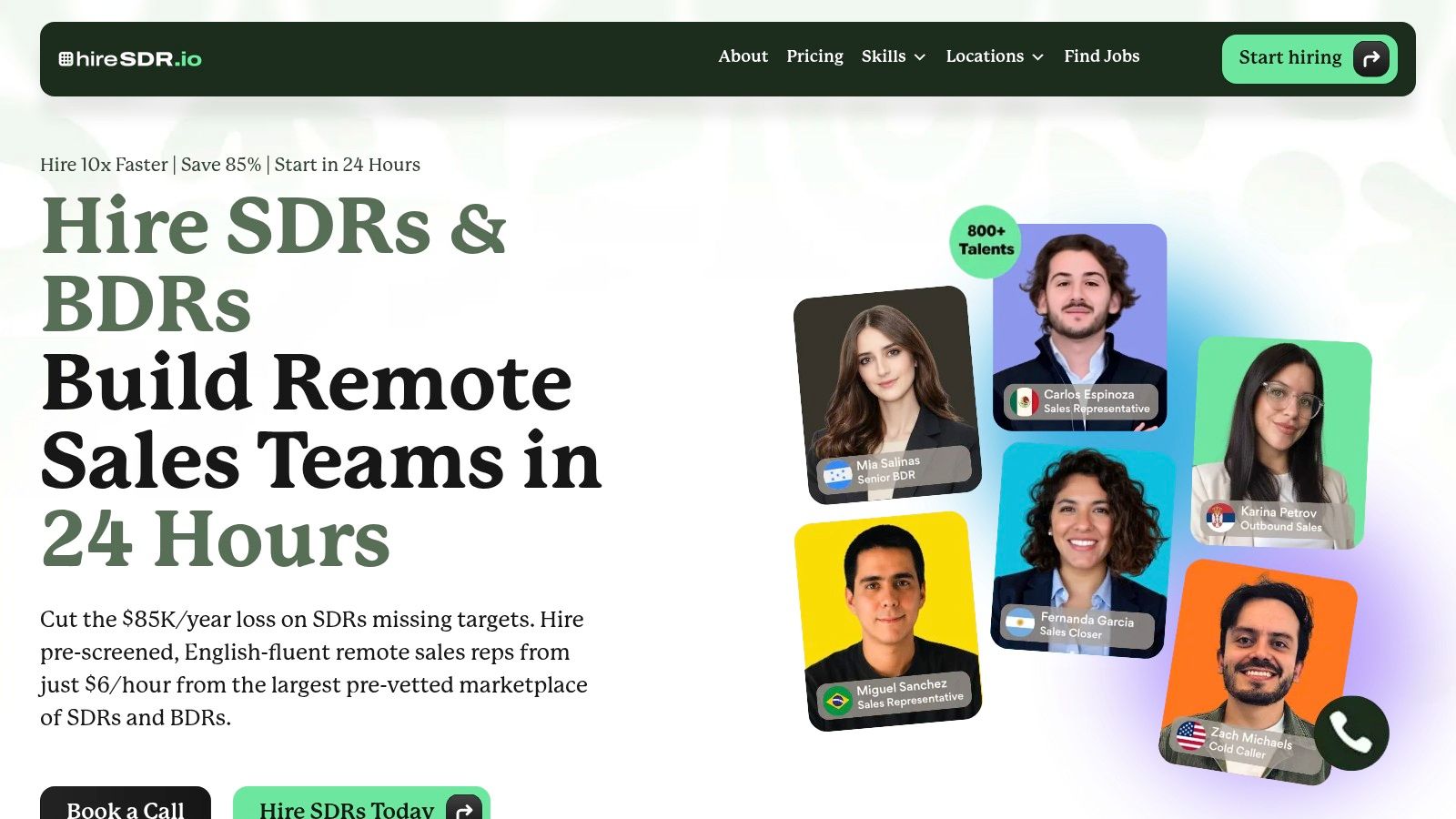
You need pipeline this quarter. Your AE is asking for meetings, your founder-led outbound is running on fumes, and you do not have time to build an overseas recruiting stack from scratch. In that situation, hireSDR.io is one of the few options here that feels built for operators instead of procurement teams.
Its edge is simple. It focuses on sales hiring, keeps the process tight, and removes the usual cross-border mess that slows founders down. If your target hire is an SDR, BDR, or another outbound-focused rep, that focus matters. Generalist overseas recruiters love to brag about role coverage. Then they send you a mixed bag of candidates and call it a shortlist.
The model is practical. AI helps with matching, but humans still do the screening. Good. Pure automation is how you end up interviewing polished resumes with weak spoken English and no real prospecting discipline.
hireSDR.io says it vets candidates across five areas: English fluency, skills, references, culture fit, and live assessment. That is the right stack for outbound hiring. A sales rep can survive a slightly imperfect resume. They cannot survive weak communication, no coachability, or a habit of crumbling on live calls.
My rule: If a recruiter cannot tell you exactly how they test spoken English, outbound judgment, and references, they are not screening. They are passing leads.
There is also a cost and speed argument here. hireSDR.io supports hiring across 30-plus countries, wraps in payroll and compliance support, and offers month-to-month engagement with no upfront fee. That setup is a lot more founder-friendly than a long agency contract followed by weeks of back-and-forth and extra admin your team still has to handle.
If you want the clearest view of how the model works, review their outsourced recruiting for SDR and BDR hiring page.
For this article's speed, cost, and quality lens, hireSDR.io scores well because it stays narrow. Narrow is good. Specialists usually beat broad marketplaces when the role has a clear performance profile.
The tradeoff is obvious. This is not the service I would pick first for senior executive search or weird edge-case roles. It is built for sales hiring, especially SDR and BDR talent. If that is your bottleneck, that specialization is a feature, not a flaw.
My take. If you want a cheat-sheet option for hiring vetted outbound reps fast, this belongs on the shortlist immediately. It is one of the few recruitment companies for overseas jobs here that understands the difference between sending candidates and sending candidates who can book meetings.
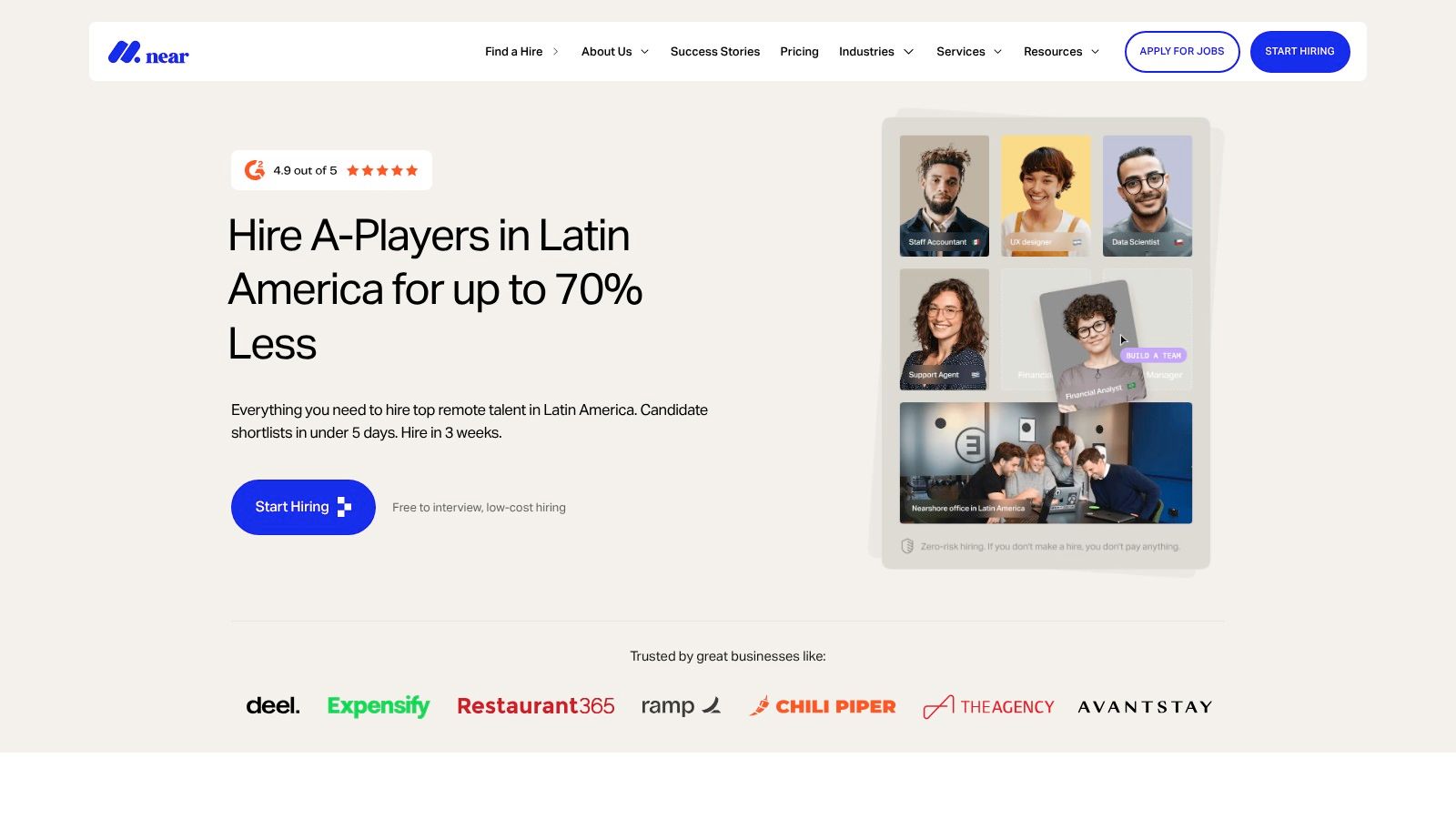
Hire With Near is what I'd call a focused operator. It doesn't try to be globally everything for everyone. It leans hard into Latin America, and that's a smart choice if your team works U.S. hours and needs people who can collaborate in real time without someone joining pipeline review at midnight.
That LATAM focus is the selling point and the limitation. If your hiring plan is mostly nearshore and you want sales talent that's already comfortable working with U.S. companies, Near is a strong option. If you want broader region coverage, keep moving.
Near handles sourcing, screening, and interview coordination end to end. That's useful if your internal team is thin and your sales leader doesn't want to spend afternoons playing recruiter. It also has enough sales-oriented proof on its site to feel more credible than agencies that claim to hire “all roles in all regions” and somehow say nothing concrete.
What I like is the clarity of the niche. Plenty of recruitment companies for overseas jobs talk about borderless hiring in broad, shiny language. Near says, more or less, “we do LATAM well.” Good. Specialists usually beat generalists.
Near is a good pick when your top priority is U.S. timezone overlap and a smoother handoff into your existing sales process.
The knock is pricing transparency. You'll need to talk to them for a quote, which isn't unusual, but it does slow down comparison shopping. And because the service is region-specific, it won't help much if you want to compare LATAM talent with candidates from Africa or Southeast Asia in the same process.
Choose Near if you already know LATAM is your lane. Don't choose it if you're still figuring out region strategy and want optionality.
That sounds obvious, but founders ignore this all the time. They pick the prettiest website, then act surprised when the “global” solution is really one geography wearing a trench coat.
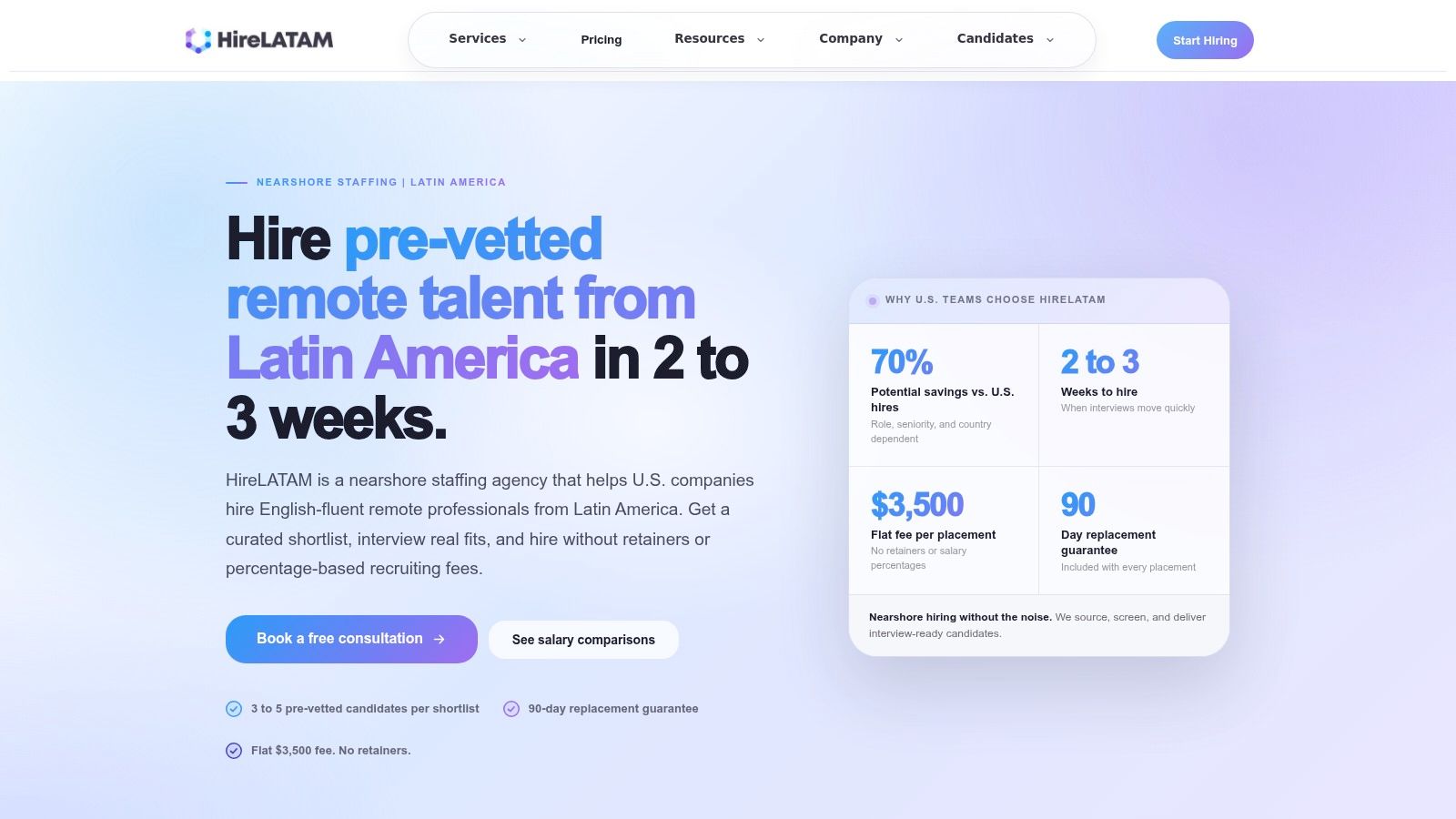
HireLATAM is the practical buyer's choice for people who hate mystery pricing. That alone earns points. A lot of agencies still behave like revealing a pricing model would collapse Western civilization.
HireLATAM keeps it simpler. It focuses on Latin American talent, offers a flat-fee placement model, and pitches curated shortlists of interview-ready candidates for remote roles, including sales support and SDR-type work. If you want a straightforward placement partner and don't need a giant managed service wrapped around it, this one is easy to shortlist.
The flat-fee approach is appealing because it lets you model cost without a scavenger hunt. It also advertises a replacement guarantee, which doesn't make a bad hire fun, but at least it lowers the sting.
This is a placement shop, not a magic growth machine. That means your team still owns onboarding, management, enablement, and performance. Some buyers forget that and then blame the agency because the rep never got proper training.
If you're weighing agency support against doing more internally, it helps to understand the broader mechanics of global hiring. This explainer on how to hire international employees is useful because it lays out the extra layers most founders underestimate.
HireLATAM is a clean option for teams that want nearshore talent without getting pulled into a complicated service bundle. It's especially attractive if you value predictability and just want a shortlist of solid candidates.
The catch is simple. It's LATAM-only. If your best-fit talent might be in Southeast Asia or Africa, this won't be the right tool for the job.
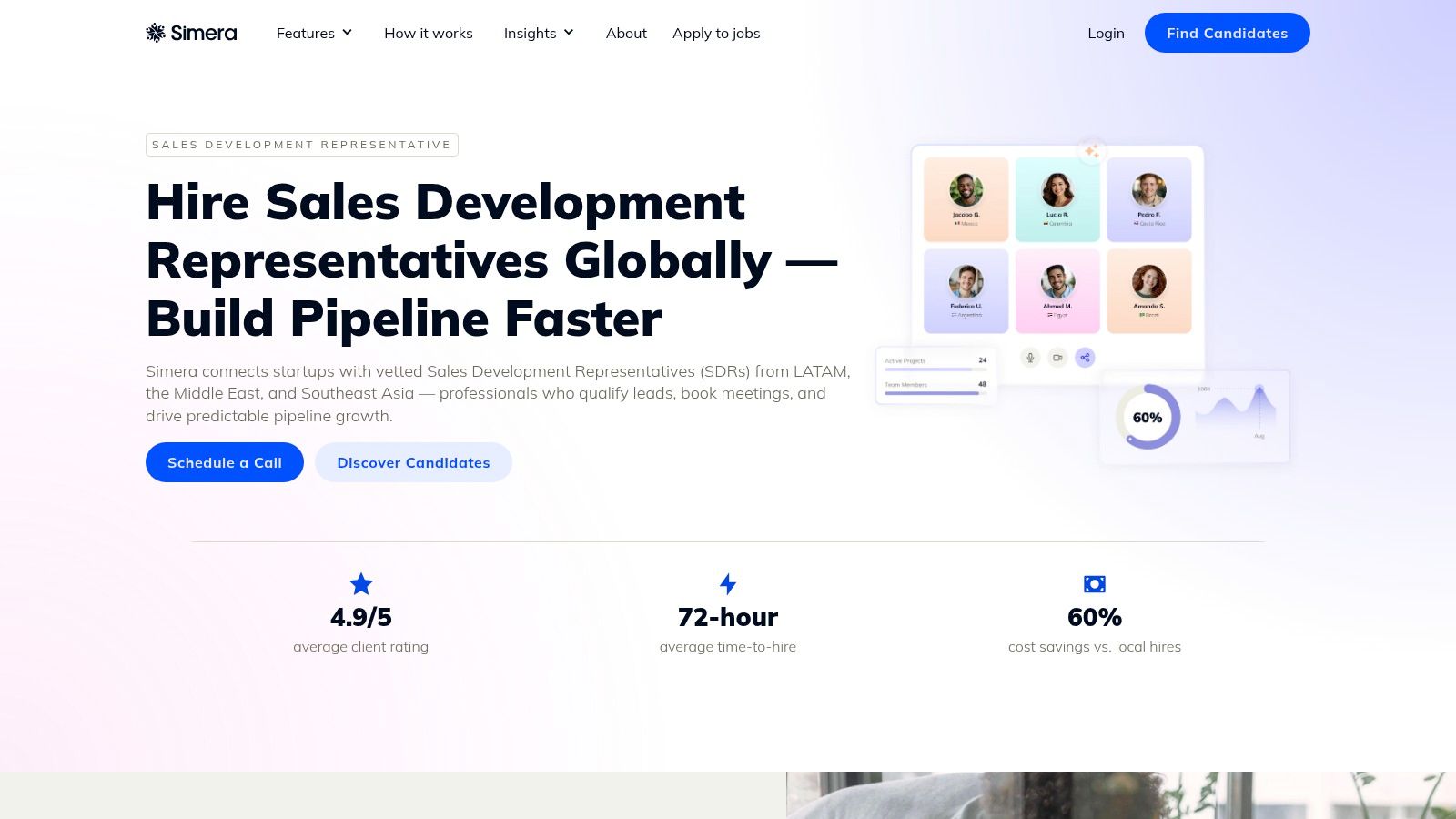
A founder posts an SDR role, says they want “global talent,” and then realizes they have no idea whether the best fit sits in Colombia, the Philippines, or the UAE. That is the Simera pitch.
Simera covers multiple overseas talent markets instead of forcing you into one lane. That matters if your hiring brief is still in motion and you care about language coverage, budget, or timezone overlap more than regional loyalty. As noted earlier, cross-border hiring infrastructure is growing fast, and Simera is built for that trend.
Simera sells flexibility first. That is useful if you are still testing the shape of the role and do not want to run separate searches by region. A broader talent pool gives you an advantage. It also gives you more variables to sort through, which means more work on your side unless the recruiter is sharp.
I would look at Simera for founder-led teams that need options, not certainty. If you are comparing compensation bands across regions or trying to balance English fluency against cost, this model makes sense. If you want context on the operating model behind firms like this, this breakdown of RPO recruitment and how it works is a useful primer.
The weak spot is predictability.
Platform-style hiring can be great in one market and average in another. Candidate quality often depends on the role, geography, and who is running your search. Pricing is not public either, which slows down comparison if you are trying to stack speed, cost, and quality side by side like a serious buyer should.
Simera is a good fit if regional flexibility is part of the plan. You are buying optionality.
If you already know the exact profile you want, such as LATAM SDRs in U.S. hours, a specialist will usually get you to shortlist faster with less noise. But if your real goal is to compare markets before committing, Simera deserves a hard look.

You need an SDR in U.S. hours, your pipeline is thin, and your team does not have time to babysit payroll, contracts, and replacement clauses. That is the buyer LatHire is chasing, and the pitch is pretty clear. LatHire sells speed, pre-vetted LATAM talent, and enough operational support to keep founders out of admin hell.
That is smart positioning. In this category, speed matters almost as much as candidate quality. If a provider can get you to a credible shortlist fast, with reps who can work U.S. schedules and communicate well, it saves weeks of drag and a lot of bad interviews.
LatHire's strength is convenience. You are not just buying sourcing. You are buying a tighter process with payroll and compliance support wrapped around it. For a founder who wants one vendor instead of three, that has real value.
If you want context on the model behind services like this, read this explanation of how RPO recruitment works in practice. It helps explain why some firms focus as much on process and back-office coverage as raw candidate volume.
I would look at LatHire if your hiring brief is narrow and urgent. LATAM SDRs. U.S. overlap. Quick turnaround. Minimal internal setup.
That focus is also the limit.
If you want broad regional comparison, highly specialized enterprise sellers, or a provider with a long public track record, LatHire is less convincing. This is not the option I would pick for a sprawling multi-role hiring plan. It is the option I would test when speed and operational simplicity beat flexibility.
Here is the blunt version:
LatHire is a practical choice for founders who want a fast path to vetted LATAM SDRs without stitching together recruitment and admin on their own.
Just do not confuse a clean offer with proven execution. Ask how many candidates you will review, how replacements work, who handles compliance issues, and what happens if the first hire flames out in 30 days. Serious buyers check delivery, not just positioning.
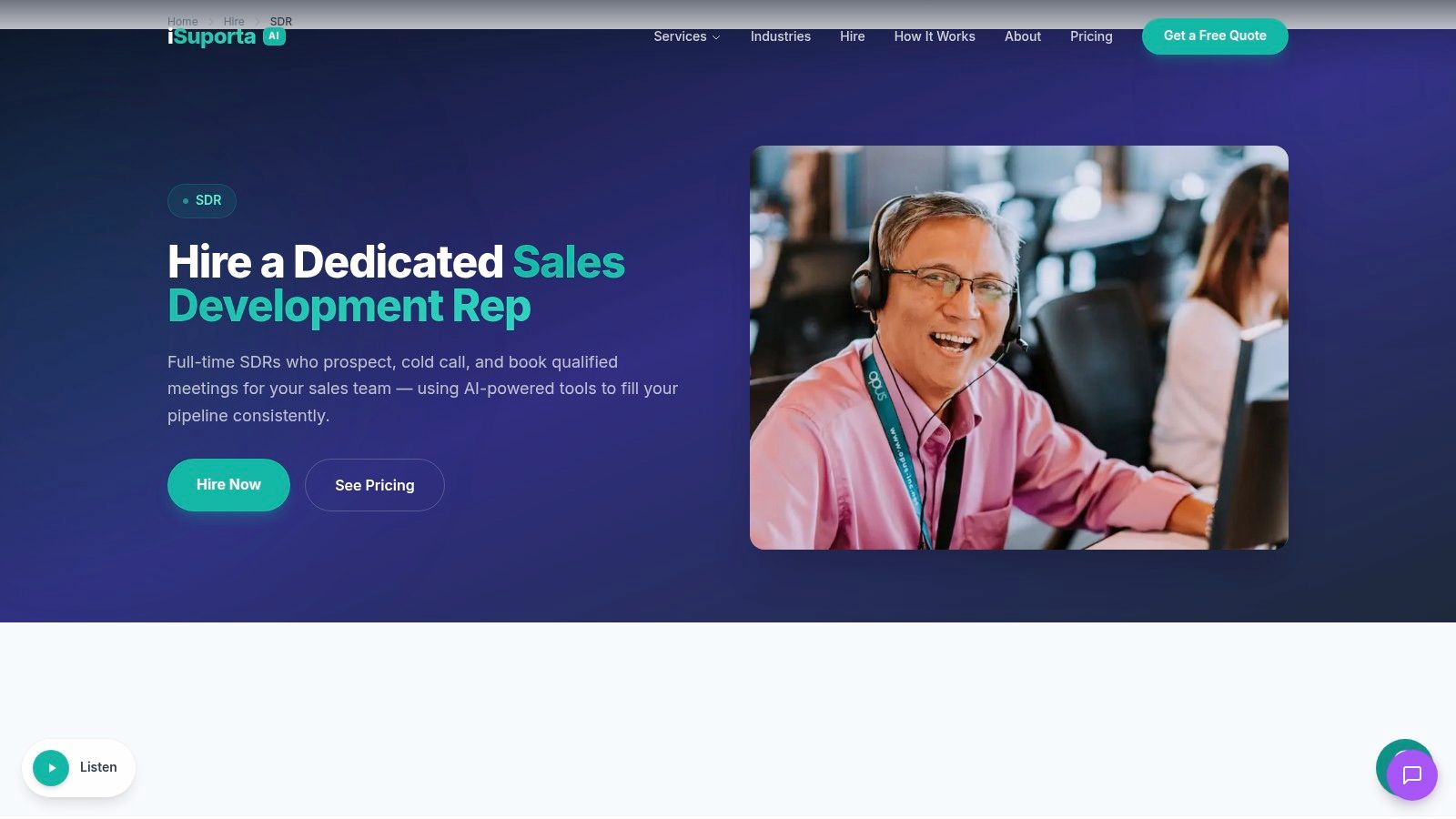
iSuporta is the Philippines-focused option for teams that want a more managed staffing setup, especially around dedicated SDR support. It's U.S.-managed, office-based in Cebu, and much more explicit than most providers about what the rep does day to day.
That clarity is refreshing. Too many recruitment companies for overseas jobs hide behind vague promises. iSuporta spells out the SDR function more directly, which makes it easier to judge fit before you get dragged into a sales call.
If you want full-time dedicated reps and prefer a setup with visible oversight, iSuporta has appeal. Some teams like office-based management because it gives them more confidence around continuity, training rhythm, and accountability.
The published pricing guidance also helps. I'm always more comfortable with vendors that give buyers at least some directional transparency instead of forcing every conversation through a custom quote funnel.
If your playbook depends on phone-heavy outreach into the U.S., ask hard questions about schedule sustainability and rep retention before you sign anything.
That last point matters here more than with LATAM providers. Philippines-based hiring can absolutely work for U.S. sales support, but timezone overlap can require night-shift patterns. For some teams that's fine. For others, it creates avoidable churn risk.
iSuporta is best for companies that want a structured, managed Philippines setup and are comfortable with that geography's trade-offs. It's not the best fit if your sales culture depends on same-day collaboration during North American hours in a more natural timezone band.
Good option. Just don't pretend geography doesn't matter. It always matters.
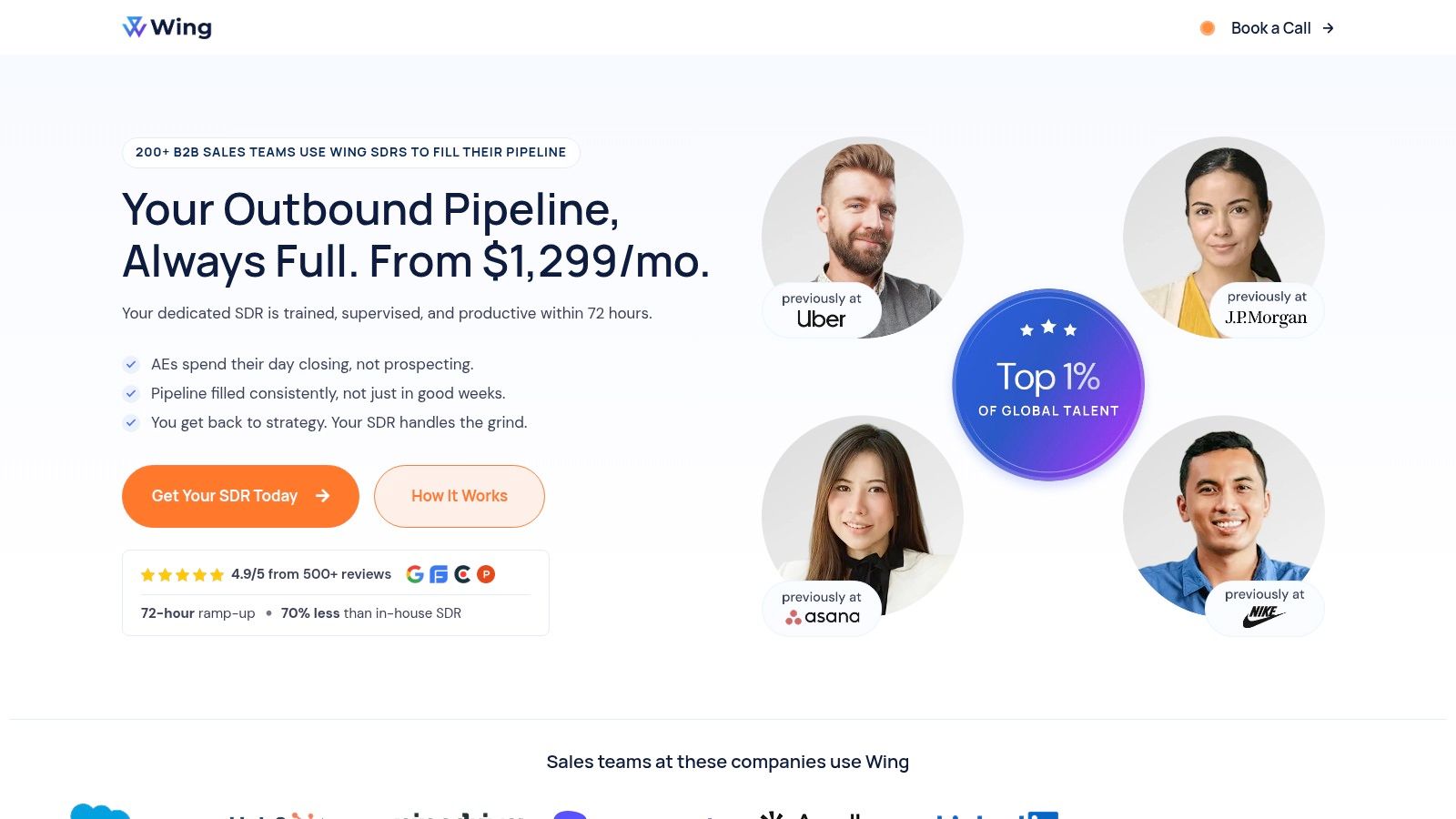
Wing Assistant is less of a classic recruiter and more of a managed SDR-as-a-service play. That distinction matters. You're not just buying access to candidates. You're buying a system, a service layer, and ongoing management.
For some teams, that's exactly the right answer. If your internal sales leadership is stretched thin, a managed model can get activity live faster than hiring a direct overseas rep and building your own support structure around them.
Wing leans into published package pricing, fast ramp messaging, tool familiarity, and backup coverage. That's useful if your bigger problem is execution bandwidth, not candidate discovery. You want outbound happening. You don't want to become a part-time SDR manager by accident.
This model also changes the control equation. You usually get more operational support, but less direct control over how the function is staffed compared with hiring named employees yourself. Some founders love that. Others hate it after two weeks.
Wing is a good fit when you want sales development as a service, not just a recruiting partner. That's a real difference, and buyers should treat it like one.
If you want tighter control over the individual hire, region, and long-term team build, choose a recruiting-first platform instead. If you want someone to plug in and run motion with less oversight from your side, Wing becomes a much stronger option.
| Provider | Implementation complexity | Resource requirements | Expected outcomes | Ideal use cases | Key advantages |
|---|---|---|---|---|---|
| hireSDR.io | Low, 24–48h shortlists, month-to-month onboarding | Low-cost (≈ $6/hr, many <$3k/mo); built-in payroll & compliance | Rapid hires, reduced ramp, consistent activity; claims 80–90% cost savings vs on‑shore | Startups and revenue teams needing fast, timezone‑aligned SDRs across LATAM/AFR/SEA | Very fast sourcing, rigorous 5‑stage vetting, payroll/EOR support |
| Hire With Near | Moderate, requires engagement for scoped search (~2–3 weeks to hire) | Mid cost; estimated 30–60% payroll savings vs US; pricing by quote | Reliable LATAM hires with strong US time‑zone overlap and sales track records | Companies focused exclusively on LATAM sales hires wanting documented outcomes | LATAM specialization and sales‑specific case studies |
| HireLATAM | Low, flat‑fee placement model with clear timelines (2–3 weeks) | Transparent flat placement fee (published); no retainers | Curated 3–5 candidate shortlists; hire in ~2–3 weeks; 90‑day replacement | Teams seeking simple, transparent placement for LATAM SDRs | Public pricing, fast cycle and replacement guarantee |
| Simera | Low–Moderate, AI‑assisted matching, typically 7–10 day time‑to‑hire | Pricing via sales; claims up to ~60% cost reduction vs US | Multilingual, multiregional candidates; relatively fast matches; public ratings | Companies needing broad regional coverage (LATAM, MENA, SEA) and language options | AI matching, broader geography and public client rating |
| LatHire | Low, 24‑hour shortlists from pre‑vetted pool | Published hourly/monthly rates; EOR/payroll and contracts handled | Very fast candidate delivery (24h), U.S. hour overlap, replacement guarantees | Firms needing immediate LATAM SDRs with operational EOR support | Transparent entry pricing, quick turnaround, operational extras (EOR) |
| iSuporta | Moderate, Philippines office‑based management and structured onboarding | Published all‑inclusive monthly pricing; office oversight in Cebu | Dedicated full‑time SDRs on U.S. hours with clear ramp expectations | Companies prioritizing Philippines-based reps for US outreach and oversight | U.S.-managed operations, office supervision and clear ramp metrics |
| Wing Assistant | Low, fully managed SDR-as-a-service with quick ramp (72h) | Published package pricing (part‑time/full‑time); ongoing service fees | Fast ramp to first activity, continuous coverage, reporting and backups | Teams that want a managed SDR program without hiring employees | Fully managed model, backup coverage, published plans and SLAs |
You've got enough here to make a decision. That's the point. Not to admire the array of recruitment companies for overseas jobs like it's a museum exhibit, but to pick a model and test it.
The market is big, and it's not slowing down. In the U.S. alone, the staffing and recruiting ecosystem included about 27,000 staffing and recruiting companies in 2021, and the industry supported about 11 million workers in 2024, according to the American Staffing Association's industry statistics page. That scale is useful context, but it doesn't help you if you pick a partner that's all sales deck and no delivery.
Here's my blunt advice. If you need vetted SDR talent fast, want timezone-aligned reps, and don't want to get buried in cross-border admin, hireSDR.io is the best first test. It's fast, structured, and built around the actual pain points founders complain about after trying to do this the hard way. Toot, toot.
If you already know your region, use a specialist. Near, HireLATAM, and LatHire all make more sense when LATAM is a clear decision rather than a vague preference. If you want broader regional optionality, Simera is more useful. If you want a managed Philippines setup, iSuporta is the more obvious lane. If you want SDR activity as a service, Wing is playing a different game and should be judged that way.
One thing people still miss in this category is legitimacy. If a provider recruits across borders and touches foreign labor workflows, do your homework. The U.S. Department of Labor maintains a Foreign Labor Recruiter List and recruiter disclosure resource, and more buyers should be using official registries, contracts, and disclosure checks before signing anything. This is not paperwork theater. It's how you avoid fraud, fee abuse, and ugly surprises.
There's also a strategic point most listicles skip. Agencies aren't always the answer for every role. Some employers use specialist networks and split-fee models, while others compare agencies against broad global staffing platforms. NPAworldwide's explanation of how split-fee recruitment networks work is a useful reminder that one standalone agency isn't automatically the best choice in every hiring situation.
Still, don't let nuance turn into stalling.
Run a small test. Fill one role. Measure ramp, quality, and manager effort. Then scale the model that works instead of the one with the flashiest pitch deck. Your pipeline will notice before your board deck does.
If you need overseas SDRs or BDRs quickly, hireSDR.io is the cleanest shortcut on this list. You get pre-vetted sales talent, fast shortlists, payroll and compliance support, and the flexibility to scale without locking yourself into a bloated contract. If your team needs pipeline now, not next quarter, start there.

You know the scene. Your VP Sales is reviewing resumes between forecast calls. Your best AE is “helping” with interviews instead of closing deals. Your...

Your reps are busy all day, your CRM is full of “activity,” and somehow pipeline still feels anemic. Founders see that and reach for the...

You're probably here because local hiring feels like a bad joke. You post for an SDR, get a pile of mediocre applicants, spend weeks interviewing,...

Tell us who you need. We'll have pre-vetted candidates in your inbox within 72 hours. No commitment until you hire.