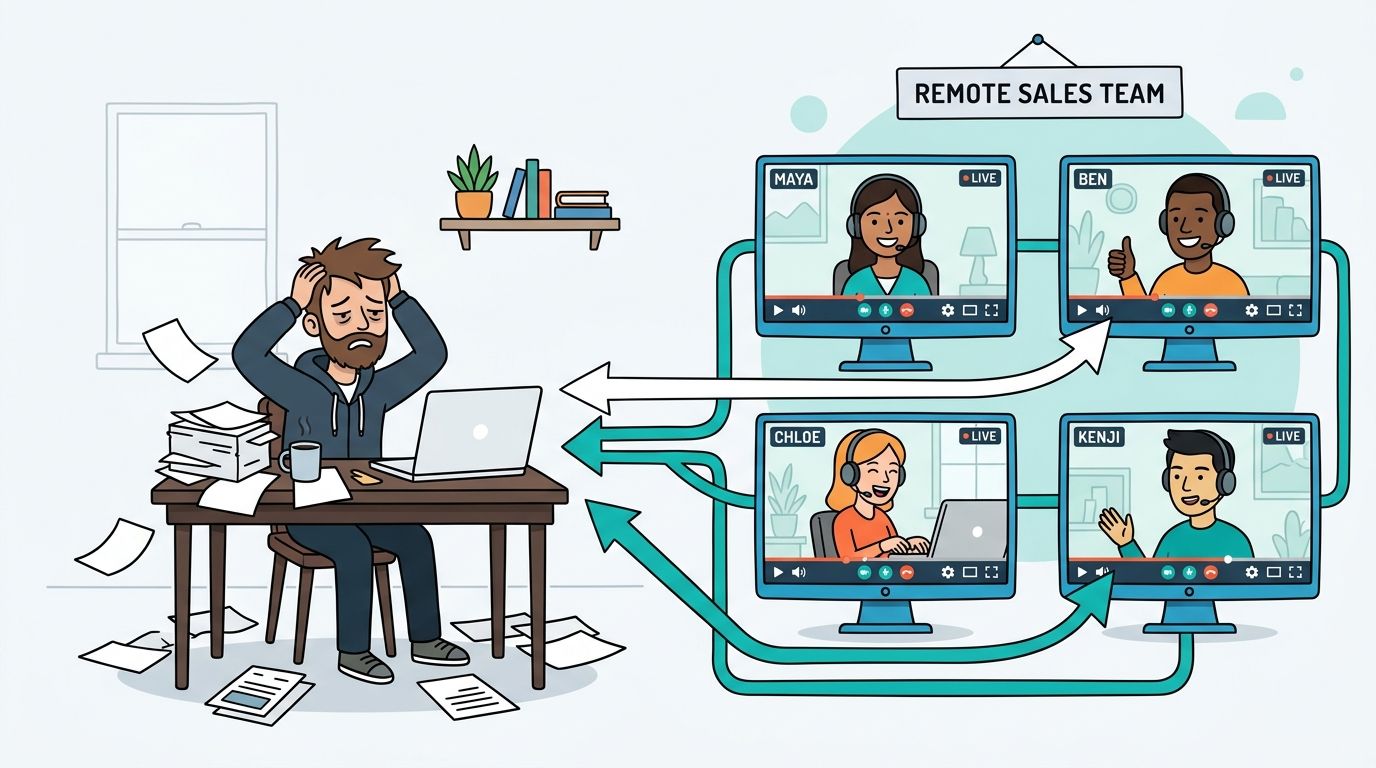
You're probably in one of two modes right now.
Mode one: you're still taking first calls yourself, hopping from a product standup to a demo, then wondering why your pipeline looks like a ghost town by Friday. Mode two: you made your first sales hire, they're drowning, and now you're staring at the cost of another full-time seat thinking, “Cool, so growth now requires selling a kidney.”
That's where sales outsourcing for startups gets interesting. Not because it's cheap. Cheap usually gets expensive later. It gets interesting because it can give you coverage, speed, and breathing room without locking you into the kind of payroll commitment that turns a rough quarter into a board-level therapy session.
I've seen founders make the classic panic move. They hire too early, hire the wrong person, then spend months pretending the problem is onboarding instead of admitting the system never existed. I've also seen founders use outsourced SDR support the right way: tightly scoped, heavily managed, and treated like a testable growth lever instead of a magic trick.
The difference isn't luck. It's discipline.
A lot of founders treat sales hiring like ordering takeout. Pipeline looks thin, calendar feels ugly, so they throw money at “someone who can own outbound.” Then they act shocked when six weeks later they've paid a base salary, bought tools, burned founder time on onboarding, and still can't explain why nobody qualified is showing up.
That mistake isn't rare. It's startup canon.
One bad sales hire can cause $50k to be lost by the time you count salary, recruiter fees, tool access, management drag, and the opportunities they never created. Worse, the greater damage isn't the cash. It's the false sense of progress. A bad rep with a full calendar of “activity” can keep a founder optimistic right up until runway gets uncomfortable.
And runway gets uncomfortable fast. Research on startup risk factors indicates that roughly 40–46% of early-stage companies fail due to running out of cash, often because they hire too many full-time sales staff before product-market fit is clear.
They frame the choice badly.
It's not “hire in-house because that's what serious companies do” versus “outsource because we're broke.” That's lazy thinking. Ultimately, the choice is whether you want a fixed-cost bet or a controlled experiment.
A full-time SDR seat is a bet. You're betting on hiring quality, management quality, market timing, and your own playbook quality all at once.
A smart outsourced setup is an experiment. You can narrow the scope, define the outcome, and kill it fast if it stinks.
Practical rule: If you can't explain exactly what success looks like before kickoff, don't hire anyone. Internal or external.
Founders love to delegate sales problems too early. Bad move.
This isn't an ops task. It touches cash burn, GTM clarity, hiring pace, and investor confidence. The global B2B sales outsourcing services market was estimated at about USD 127.02 billion in 2026 and is projected to reach around USD 260.65 billion by 2035, with a 9.78% CAGR over that period. Translation: this isn't some weird corner-cutting hack anymore. It's a mainstream growth model.
That matters for startups because mature markets create better vendors, clearer pricing, and more standardized expectations. You're not duct-taping together some experimental offshore arrangement from a Facebook group. You're choosing from an increasingly established category.
Here's the blunt version:
Only one of those gives you room to be wrong without wrecking the quarter.
Most outsourcing advice is written by people trying to sell outsourcing. Funny how that works.
So let's start with the part they usually bury. You might not be ready, and if you're not ready, outsourcing sales won't save you. It'll just help you fail with more process and nicer dashboards.
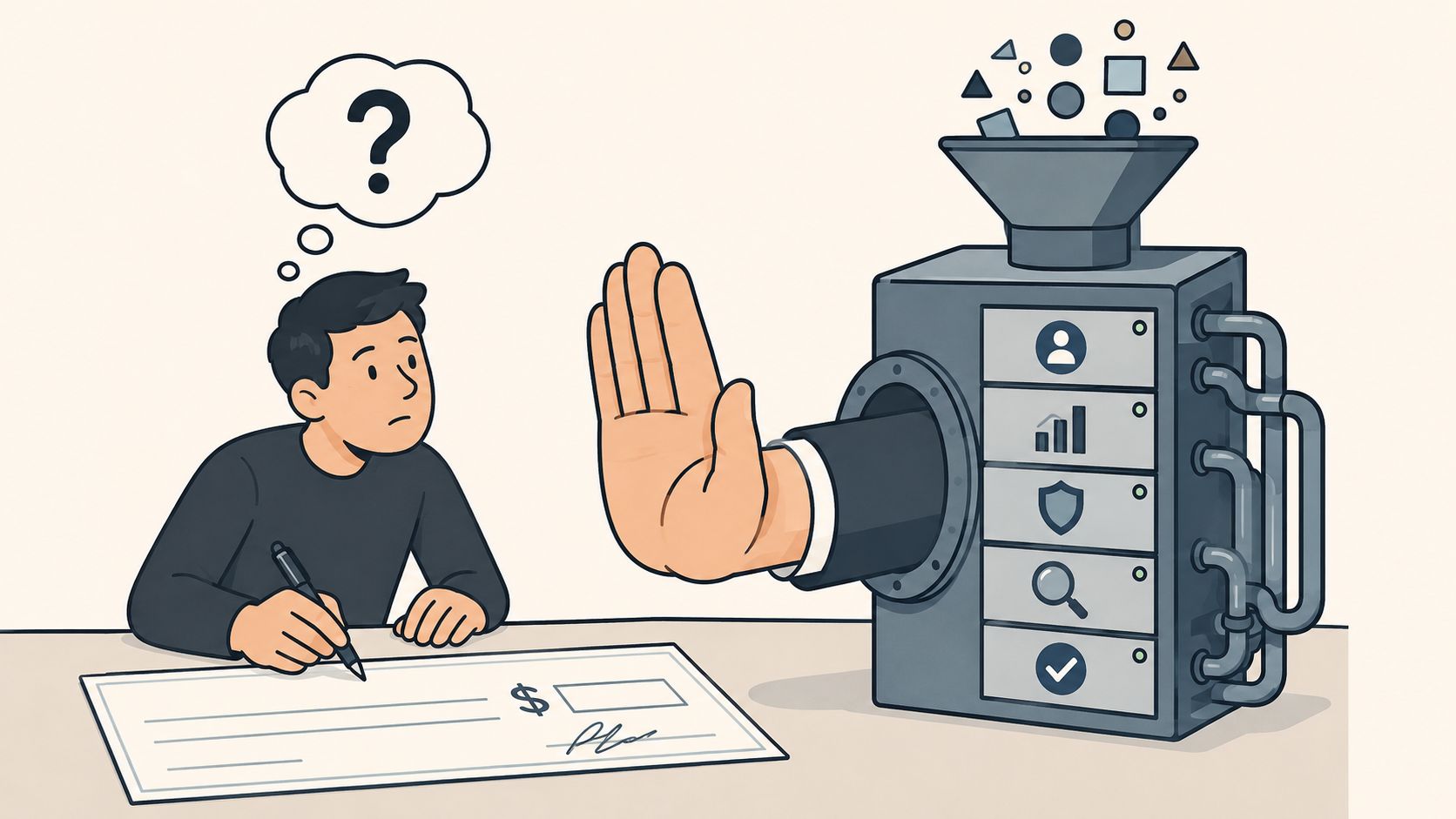
If you haven't personally closed enough deals to understand why customers buy, why they hesitate, and which messages land, do not outsource yet.
Guidance for startup sales outsourcing is pretty direct on this point. Founders who have personally closed fewer than 10–20 deals of their own are advised not to outsource sales yet, because the playbook, messaging, and ideal customer profile usually aren't dialed in.
That's not gatekeeping. That's self-defense.
An outsourced SDR team cannot invent your go-to-market motion for you. They can execute, test, and refine. But if you hand them fog, you'll get expensive fog back.
If your best answer to “Why do customers buy from us?” is “well, it depends,” you're not ready.
A lot of founders say they have a playbook. They don't. They have a few Slack messages, a half-decent pitch deck, and one AE who “just gets it.”
That's not a playbook. That's tribal knowledge wearing a fake mustache.
Before you pay anyone, you should be able to hand over:
If your current process lives mostly in your head, fix that first. If you need help pressure-testing hiring options while you get that foundation in place, outsourced recruiting support is a more sensible first step than pretending an external team can reverse-engineer your market.
This part deserves to be painfully clear.
Use this table as a gut check.
| Situation | My advice |
|---|---|
| Founder still guessing on ICP | Don't outsource yet |
| Message changes every week | Don't outsource yet |
| No one can define a qualified meeting | Don't outsource yet |
| Founder has closed enough deals and can train from real examples | You're getting close |
| Team can review calls, messaging, and pipeline weekly | Now we're talking |
Sales outsourcing for startups works best when the founder has already done the ugly reps. The first version of the playbook usually comes from scraped knees, not consultants.
Once you are ready, you'll run into three broad models. They all promise pipeline. They do not all deserve your money.
Here's the cleanest way to think about them.
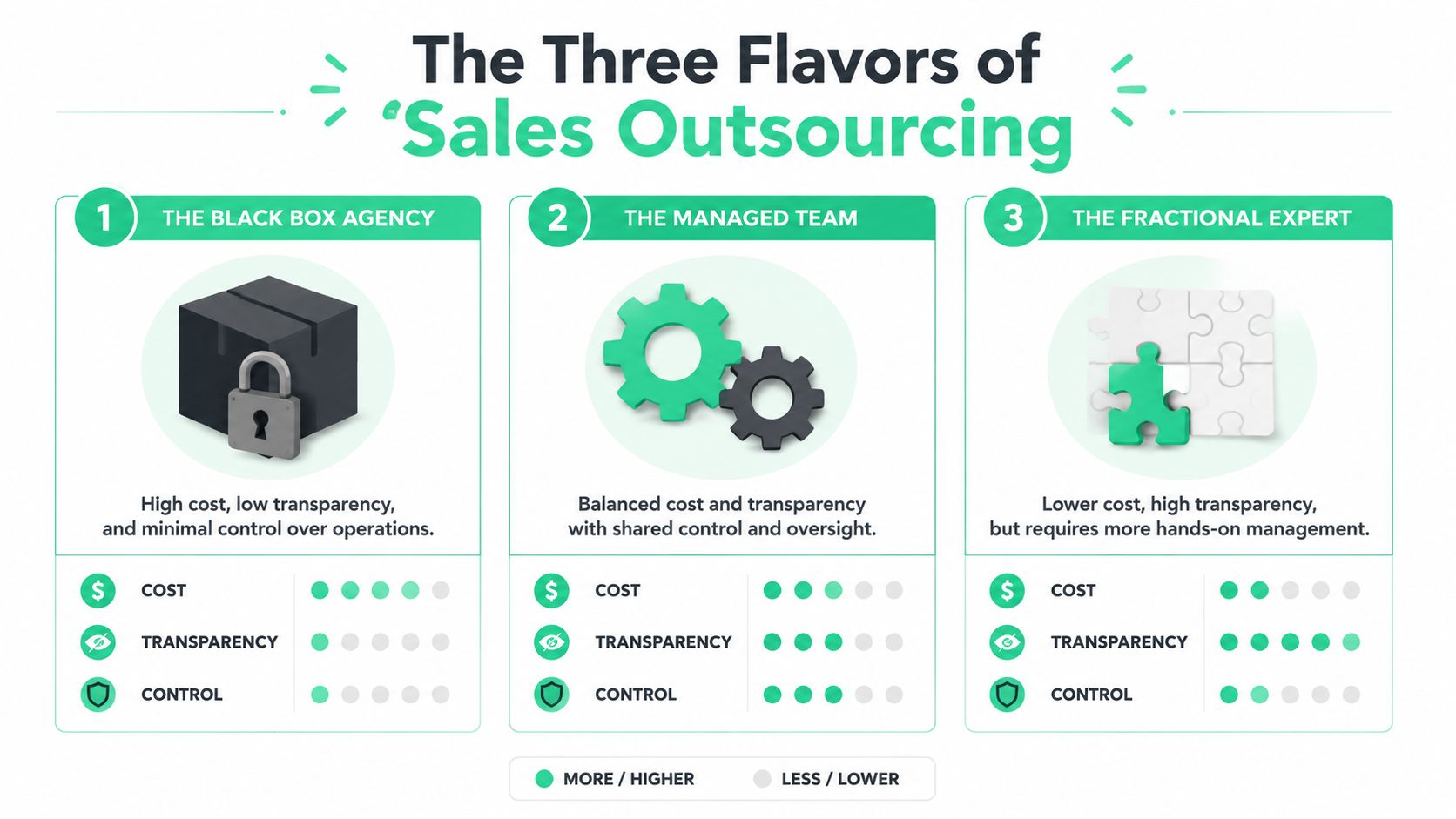
This is the polished pitch deck model.
You pay a premium. They tell you they've got “proprietary systems.” You get a weekly report full of activity metrics, a handful of meetings, and very little idea what reps are saying to prospects. Control is low. Visibility is low. Confidence is somehow still expected to be high.
Sometimes these agencies work. Often they don't. When they fail, they fail slowly because their process is opaque enough to buy themselves more time.
This model is dangerous for startups because your learning loop matters as much as the meetings. If you don't know which list segments, messages, and objections are showing up, you can't improve your motion.
This is the cheap option that seduces tired founders.
You find a solo rep or fractional operator. They're hungry, flexible, and affordable. For a minute, it feels brilliant. Then you realize you've hired yourself a second management job. They need copy, targeting, systems access, QA, and follow-up. If they disappear, the whole thing disappears with them.
This can work if you already know exactly what you want and have the patience to coach tightly. If you don't, it turns into a weird side quest where you become part-time SDR manager and part-time detective.
This is usually the best middle ground for startups that want an advantage without surrendering the wheel.
A managed team model gives you structure, some built-in operational support, and enough transparency to inspect messaging, meetings, and performance. It costs more than a random freelancer and less than swallowing a full in-house hiring stack too early. That balance matters.
If you're comparing this against building internally, the Salesforce analysis on outsourced sales economics is useful. It notes that outsourcing can save startups roughly 30–50%, and up to about 65% per rep, versus in-house. It also cites annual in-house SDR costs around $110,000–$150,000+ per rep, while outsourced SDR costs typically fall in the $42,000–$96,000+ per rep range.
That doesn't mean “pick the cheapest vendor and celebrate.” It means the economics can work in your favor if the structure is sane.
If you want a view of what a more controlled external setup can look like, outsourced inside sales teams are a useful reference point.
| Model | Best thing about it | Worst thing about it | My take |
|---|---|---|---|
| Black Box Agency | Less hands-on day to day | Weak visibility and vague accountability | Avoid unless they open the hood |
| Freelancer Wild West | Flexible and lower upfront cost | You become the manager of everything | Fine for operators, rough for founders |
| Managed Team | Better balance of cost, control, and oversight | Still requires active governance | Best fit for most startups |
Buy transparency first. Then talent. Then scale.
That order saves money.
Most vendors sound sharp on the first call. Of course they do. If smooth talk alone booked pipeline, half of SaaS would already be profitable.
The problem is simple. A lot of outsourced sales partnerships underperform because the basics were mushy from day one. Independent research into outsourced sales partnerships indicates that only about 7–33% of engagements are judged as “highly effective” by clients, largely because of misalignment in ICP, messaging, and governance.
That stat should make you a little rude. Politely rude, but still.
Don't ask, “Can you help with outbound?”
That question invites a sales pitch. Ask things that force specifics.
A bad partner usually tips their hand early.
Here are the classics:
A real partner wants to inspect your sales motion before they price it.
The best calls feel less like a vendor demo and more like an operator trying to poke holes in your GTM.
They ask awkward questions. They challenge your ICP. They want to hear recorded calls. They press on what counts as a good meeting. They care about handoffs to AEs and what happens after the first conversation.
That's what you want.
If they spend the first call talking mostly about themselves, their process, and their “top-tier talent network,” congratulations, you found a brochure.
Signing a long contract before a real pilot is how founders end up explaining “strategic learnings” to investors with the emotional energy of a hostage video.
Run a pilot instead. A real one. Tight scope, clear outcomes, fast review cycle.
The SalesHive guidance on outsourced sales pilots gets this right. Experts recommend a phased 90-day pilot with a clear SLA such as 12–15 qualified meetings held per month per SDR, plus a hard stop at 30% below target to trigger renegotiation or replacement. That structure is cited as cutting wasted spend by 30–40%.
That's how adults do this.
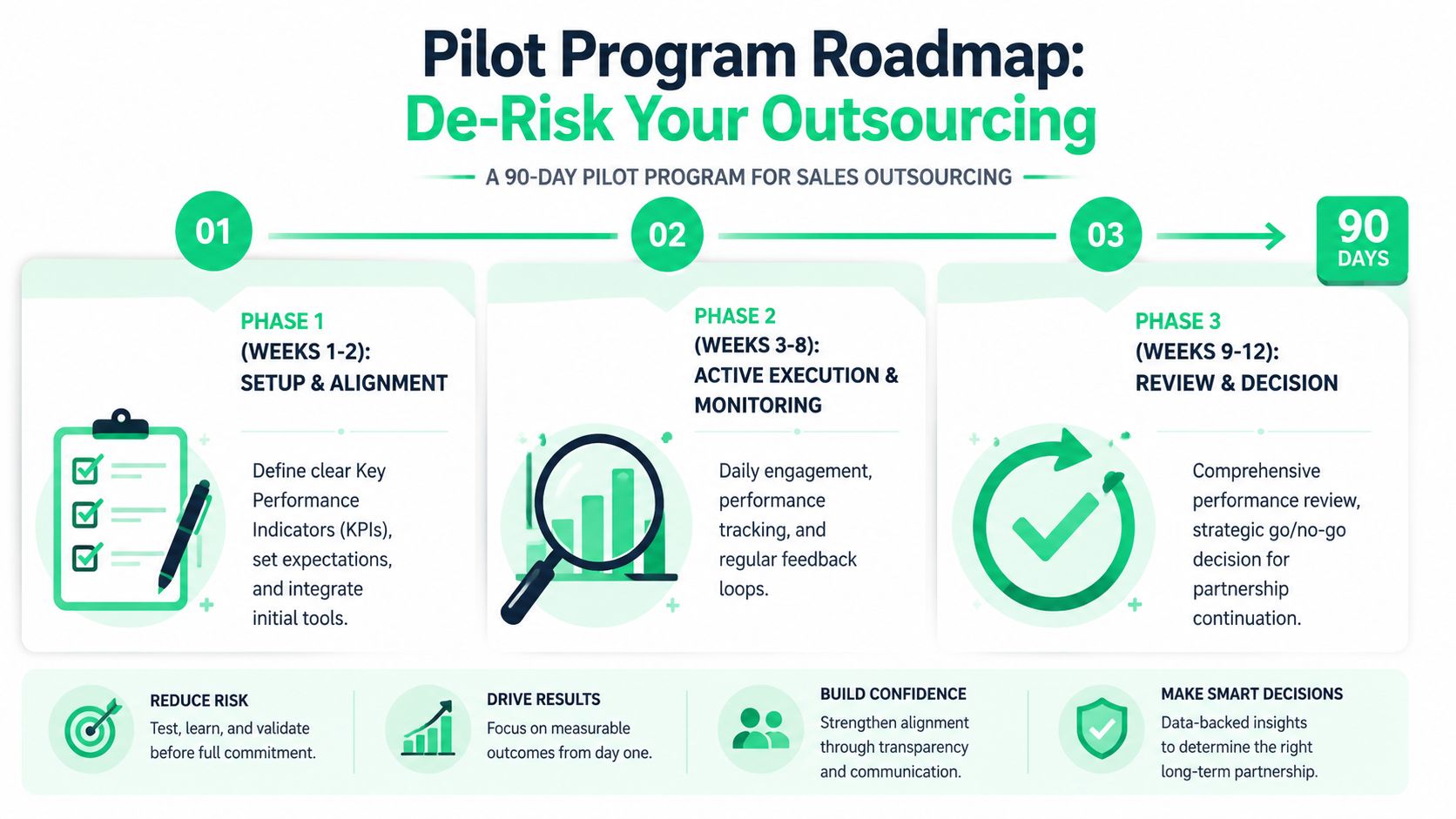
Do not launch with five personas, three channels, and a vague hope that “something will hit.”
Start narrow.
Pick one segment. Pick one primary channel, or a tightly paired combo if your team already knows it works. Define what counts as a qualified meeting. Agree on follow-up speed, routing rules, and feedback cadence before the first message goes out.
Your pilot brief should include:
Founders often become lazy here. Don't.
You need active governance. That means reviewing held meetings, no-shows, disqualification reasons, and actual call notes. If you only look at top-line counts, you'll miss the rot. A calendar full of junk meetings can keep a bad vendor alive for months.
Use a short scorecard.
| Metric | What you want |
|---|---|
| Held meetings | Consistent and qualified |
| Lead quality | Matches ICP and pain point |
| Handoff quality | Clean notes and clear context |
| Feedback speed | Fast updates after each meeting |
| Messaging iteration | Changes based on evidence |
Track outcomes. Activity is only interesting when it leads somewhere.
By the end of the pilot, you should be able to answer a few blunt questions.
Did this team create meetings worth taking? Did the prospects fit your ICP? Did your AE trust the handoffs? Did the vendor adapt when things missed? Did the motion improve as the pilot ran?
If the answer is mostly yes, keep going. If performance sits under the agreed threshold, use the kill switch and move on. No speeches. No sunk-cost romance.
Sales outsourcing for startups works when the pilot teaches you something usable. It fails when the pilot becomes a vague waiting room for better results.
Most outsourcing disasters are preventable. Not all. Most.
The survivors usually got three things right. They controlled the contract, they measured the right KPIs, and they kept a clean exit path.
You want terms that fit startup reality, not enterprise fantasy.
Push for month-to-month or short renewal windows. Keep ownership of CRM data, messaging assets, target lists, and call recordings. Tie renewals to performance, not promises. If a partner fights you on portability, they're telling you exactly how they plan to keep you.
A decent contract should make departure inconvenient, not catastrophic.
Ignore the theater. Calls, emails, and “brand touches” are supporting signals. The metrics that matter are the ones tied to pipeline quality and sales handoff integrity.
Look at qualified meetings held. Look at whether those meetings match your ICP. Look at whether AEs accept and progress them. Look at how quickly feedback from real conversations gets folded back into messaging.
If your vendor reports lots of effort and your team reports little trust, trust your team.
Blindly choosing all in-house or all outsourced is founder ego disguised as strategy.
The smarter path is often hybrid. Start with a tightly managed outsourced function. Once the motion stabilizes, add one internal owner who can coach messaging, inspect quality, and keep the loop tight. That setup tends to outperform either extreme because someone inside the company owns the nuance while the external team provides coverage and capacity.
The Activated Scale view on hybrid SDR setups notes that early startups that mix outsourced SDR efforts with one internal SDR manager achieve 20–30% higher outbound reply rates and lower cost per qualified meeting, because the internal manager creates tighter feedback loops and better message iteration.
That tracks with real life. Someone has to own the learning.
If you're trying to make that internal side more efficient, improving sales productivity becomes the next obvious lever once your outsourced motion starts producing usable signal.
The best outsourced setup doesn't replace sales leadership. It gives sales leadership more leverage.
Smart founders don't outsource responsibility. They outsource execution where execution can be measured.
That's the whole game.
If you need SDRs fast and don't want to spend the next month sorting resumes, hireSDR.io is worth a look. It helps founders and revenue teams hire vetted SDR and BDR talent quickly, with flexible month-to-month options and global hiring support that doesn't turn into an admin side quest.
Your reps are busy all day, your CRM is full of “activity,” and somehow pipeline still feels anemic. Founders see that and reach for the...

You're probably doing sales right now. Between product reviews, investor updates, and the Slack fire drill of the day, you're also writing cold emails, chasing...

Another “Fully Vetted” candidate who can't find the cafeteria? You've been there. The resume looked perfect. The recruiter swore they were a unicorn. Three weeks...

Tell us who you need. We'll have pre-vetted candidates in your inbox within 72 hours. No commitment until you hire.