
Your CRM is open. The dashboard looks busy enough to fool you for a minute, but the pipeline tells the truth. A few stale opportunities. Some demo requests that went nowhere. A handful of “good conversations” that somehow never turned into revenue.
Then someone on the team says, “We should hire an SDR.” Someone else says, “No, we need a BDR.” And now you're stuck in startup acronym soup, wondering whether the difference between SDR and BDR matters or whether this is just LinkedIn job-title cosplay.
It matters.
I've seen founders hire the wrong role, then spend months blaming messaging, blaming the CRM, blaming the market, blaming the moon cycle, anything but the obvious problem. They hired someone to solve the wrong bottleneck. That's like putting a great goalie at striker and acting surprised when the scoreline still stinks.
This decision hits three places fast: salary, management time, and morale. Get it right, and your sales motion gets cleaner. Get it wrong, and your account executives babysit weak leads while your pipeline wheezes politely in the corner.
You know the feeling. Marketing says leads are coming in. Sales says the leads are junk. The founders sit in forecast meetings using the phrase “top of funnel” like it's a prayer circle. Revenue doesn't care.
I've lived this one from both sides. One company had inbound forms rolling in, but nobody was following up with any real speed or consistency. Another had a polished website, a decent deck, and absolutely no one proactively creating conversations with target accounts. Same symptom on the surface. Flat pipeline. Totally different fix.
That's why the SDR versus BDR debate gets butchered so often. People treat it like a title question. It's an operations question.
If leads already exist and nobody is qualifying them properly, you don't need a prospector. You need someone who can sort signal from noise fast, keep response times tight, and hand your closers clean meetings.
If nobody is raising their hand in the first place, an inbound qualifier won't save you. You need someone willing to build lists, write cold emails that don't sound AI-generated by a sleep-deprived toaster, and make cold calls without emotionally collapsing by lunch.
Hire the role that fixes the current constraint, not the role that sounds more strategic in a board update.
A lot of founders also underestimate the system around the hire. Outbound only works if targeting, messaging, and follow-up discipline are real. Inbound only works if routing, qualification, and handoff are tight. If you need a useful primer on the moving parts behind outbound, OutboundXYZ's outbound engine guide is worth a look because it frames the mechanics founders usually ignore until they hurt.
The hidden cost of hiring the wrong role isn't just comp. It's the cleanup.
That last one stings. A solid BDR can fail as an SDR if they're impatient with qualification. A strong SDR can struggle badly in outbound if they hate ambiguity. Same person. Wrong lane.
Here's the short version. The difference between SDR and BDR is mostly about where the opportunity starts and what kind of work creates progress.
Early comparison helps, so let's keep it simple.
| Role | Main focus | Where leads come from | Core job | Best fit when |
|---|---|---|---|---|
| SDR | Inbound qualification | Marketing, forms, referrals, hand-raisers | Respond, qualify, route | You already have interest but weak follow-up |
| BDR | Outbound prospecting | Target accounts found through research | Create conversations from cold | You need net-new pipeline |
The easiest way to explain it is fishing.
An SDR works the net. Marketing has already put something in the water. People download a guide, book a demo, reply to a campaign, ask for more information. The SDR's job is to figure out who's a real fit, who's just curious, and who should talk to an account executive next.
A BDR is spear-fishing. Nobody's jumping into your boat. They pick a target, research the account, find the right people, and start conversations from scratch. It's more deliberate, more creative, and frankly more annoying to do well. That's why weak outbound is everywhere.
That's the cleanest mental model.
People often muddy the waters. Some companies swap the titles. Some call every entry-level sales rep an SDR. Some call outbound reps “SDRs” because that's what candidates search for. Fine. Titles drift. Reality doesn't.
What matters is the actual motion.
If your team is still fuzzy on the split between inbound and outbound, this breakdown of inbound and outbound sales helps clarify the operating difference without dressing it up in corporate glitter.
Most early-stage teams don't have an SDR problem or a BDR problem. They have a channel problem they haven't diagnosed truthfully.
If prospects are already showing up, tighten qualification. If they aren't, create conversations. Don't hire based on a job title. Hire based on traffic flow.
That's the whole game in one sentence.
Job descriptions lie by omission. They make both roles sound tidy. In real life, these jobs feel completely different by noon on a Tuesday.
Here's the visual version first.
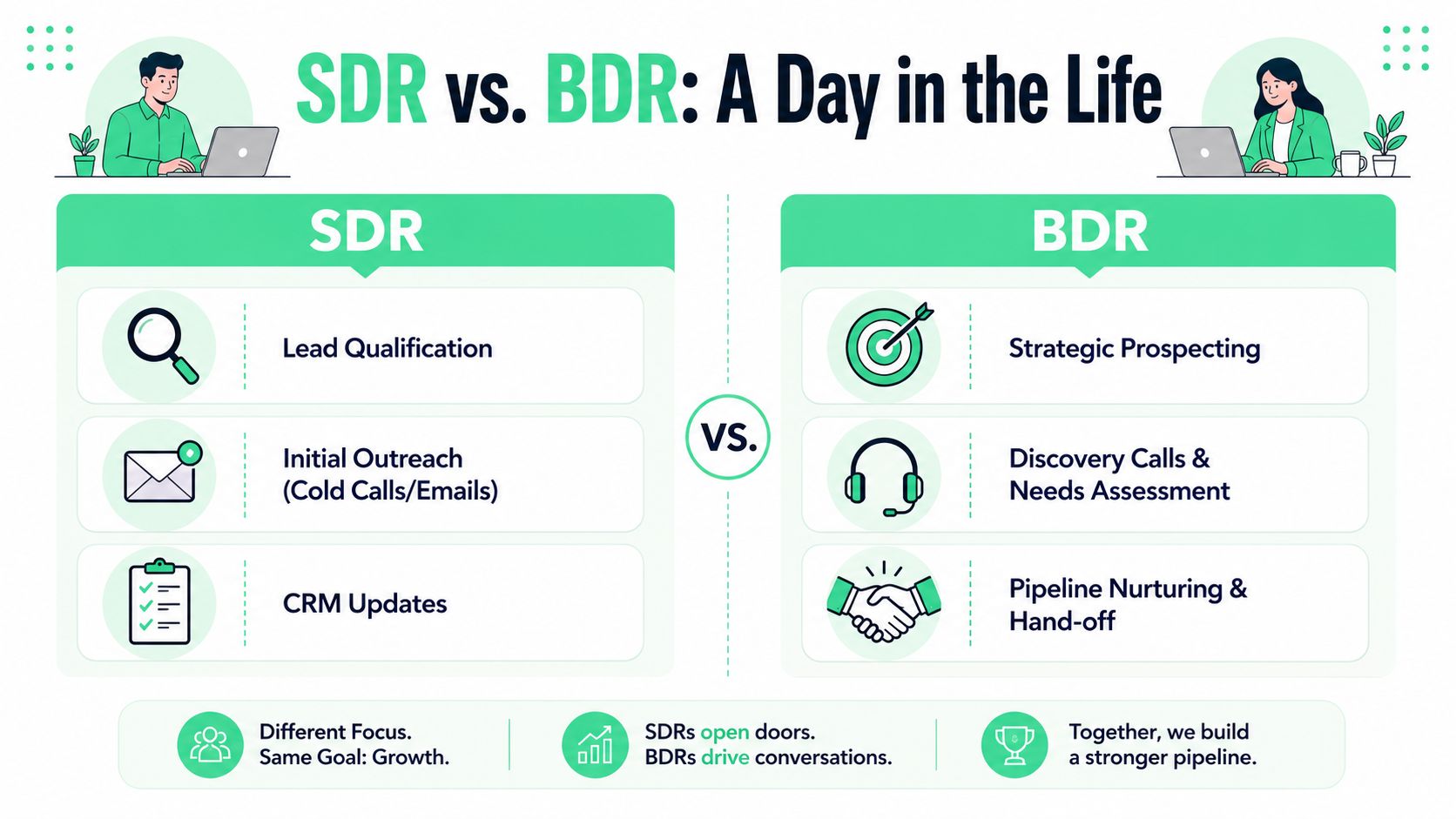
An SDR's mission is speed and judgment. A hand-raiser comes in. The SDR needs to respond while intent is still warm, ask the right questions, spot fit fast, and move the lead to the right next step. Their value comes from reducing waste. They protect closers from junk meetings and rescue good leads from dying in the queue.
A BDR's mission is attention and access. They're trying to break into accounts that didn't ask to hear from you. That means account research, persona mapping, personalized messaging, follow-up discipline, and enough persistence to survive silence without turning into a spam machine.
Same broad category. Totally different muscle groups.
The SDR day has a tempo to it. New leads come in. The SDR replies, books, qualifies, updates the CRM, nudges no-shows, and keeps the queue from rotting. If your routing is messy, the SDR spends half the day cleaning up someone else's operational sins.
The BDR day is more handcrafted. They're building account lists in tools like LinkedIn Sales Navigator, working through sequences in Outreach or Salesloft, making cold calls, testing subject lines, tweaking messaging by persona, and trying to turn indifference into curiosity.
That's why founders who collapse the two roles into one often get mediocre output from both. The work rhythms clash.
An SDR wins by being fast and consistent. A BDR wins by being targeted and stubborn.
The tools overlap, but the emphasis doesn't.
| Criteria | SDR | BDR |
|---|---|---|
| Primary systems | CRM, calendar, lead routing, chat, email | CRM, prospecting tools, sequencing tools, data sources |
| Common workflow | Respond, qualify, hand off | Research, sequence, test, follow up |
| Typical friction | Bad lead routing, weak qualification rules | Weak data, bad messaging, poor targeting |
| Success driver | Process discipline | Creative persistence |
An SDR lives inside HubSpot or Salesforce, calendar booking tools, inboxes, and whatever your marketing stack spits out. A BDR also lives in the CRM, but leans harder on prospecting systems and contact data.
If you're trying to clean up the machinery around outbound, there's a useful angle on streamlining B2B client acquisition that gets into the tooling side without pretending software alone solves bad process.
Founders often really blow it.
They assume both roles need “good communication skills” and call it a day. That's lazy hiring.
An SDR should be good at:
A BDR should be good at:
Some people love the structure of inbound. Some people love the chase of outbound. Put the wrong one in the wrong chair and you'll spend months trying to coach around a personality mismatch.
A sharp, methodical rep may crush SDR work and hate BDR work. A scrappy hunter may create brilliant outbound campaigns and get bored handling repetitive inbound qualification. Neither is broken. You just hired for the wrong battlefield.
Founders love “versatile” candidates. Revenue teams love role fit. Those are not the same thing.
Bad KPI design can ruin a good hire. I've watched companies measure SDRs and BDRs with the same scorecard, then act shocked when behavior goes sideways.
If you want clean output, the metrics have to match the job.
Here's the visual snapshot.
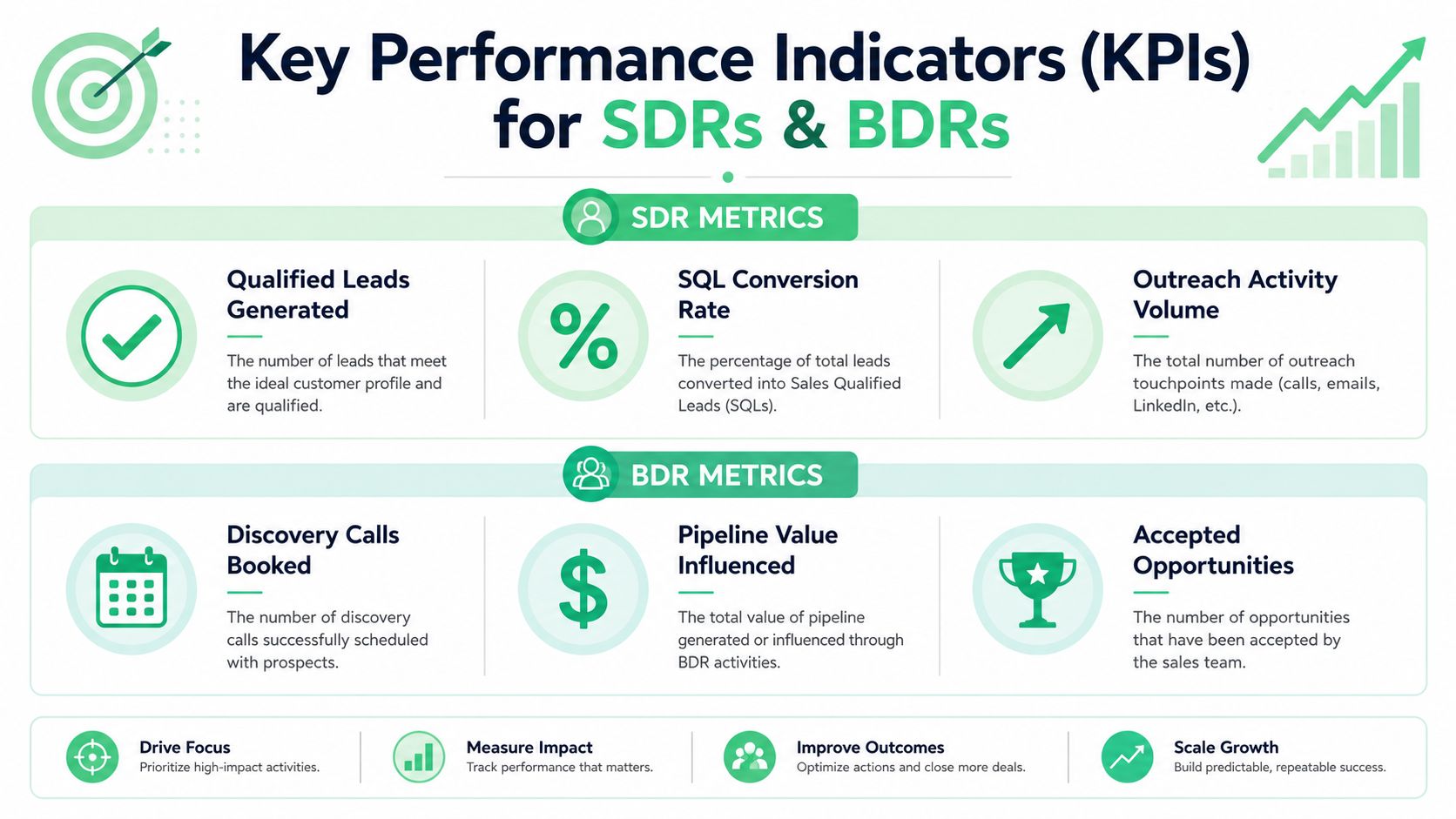
An SDR works on existing interest. That means their scorecard should emphasize how well they convert that interest into real sales conversations.
Good SDR indicators usually include:
If you only measure activity volume, SDRs will stuff calendars with weak meetings. Then your AEs revolt, and they'll be right.
A BDR starts colder. So the measurement has to account for the work required to get traction at all.
Useful BDR indicators usually include:
This is why measuring a BDR only on raw call counts is nonsense. Activity matters, sure. But if the messaging is bad or the targeting is sloppy, all you've done is industrialize irrelevance.
The fastest way to create dysfunction is to pay for the wrong output.
If SDRs get paid mostly on booked meetings, they'll jam unqualified meetings onto AE calendars. If BDRs get paid mostly on vanity activity, they'll optimize for noise. Compensation should reward useful progress, not just visible effort.
Practical rule: If your AE says, “These meetings are a waste of time,” your measurement model is broken before your people are.
A healthy sales org also uses different coaching questions for each role. With SDRs, ask whether qualification standards are sharp enough. With BDRs, ask whether targeting and messaging are earning attention. Same revenue engine, different pressure points.
Let's talk about the part everyone dances around. The money isn't the same. The ramp isn't the same. The career signal isn't always the same either.
That's not unfair. It reflects the work.
SDR work is usually more predictable because the lead has already raised a hand. There's still skill involved, obviously. Plenty of inbound teams butcher good demand. But the rep isn't manufacturing interest from scratch.
BDR work is harsher. They need to find fit, create relevance, survive silence, and keep refining the message until someone bites. That usually calls for a comp structure with stronger upside per successful meeting or accepted opportunity, because the path to that result is less straightforward.
No need to overcomplicate it. Harder motion, harder reward.
Founders often assume ramp means product training and CRM access. Cute. That's not ramp. That's logging in.
An SDR can often contribute faster because the workflow is more bounded. They learn qualification criteria, routing rules, handoff expectations, and objection handling for prospects who already know your name.
A BDR usually needs longer to get dangerous. They have to understand the market, shape a point of view, learn the ICP, test messaging, and work through enough rejection to separate personal bruising from useful signal. Early outbound almost always looks messier before it looks good.
The SDR path often builds toward:
The BDR path often builds toward:
That said, don't romanticize either ladder. Some people should not become AEs just because they survived a year in development. Promotion isn't a participation trophy.
The best next move isn't always “closer.” Sometimes your strongest builder of pipeline should keep building pipeline.
Match pay and progression to the actual challenge of the role. If you blur the difference between SDR and BDR here, the team will feel it before the org chart does. Good reps know when a company has thought this through, and they definitely know when it hasn't.
Most founders don't need a glossary. They need a trigger.
Here it is.
If you have a leaky bucket, hire an SDR.
If you have an empty bucket, hire a BDR.
That's the true answer.
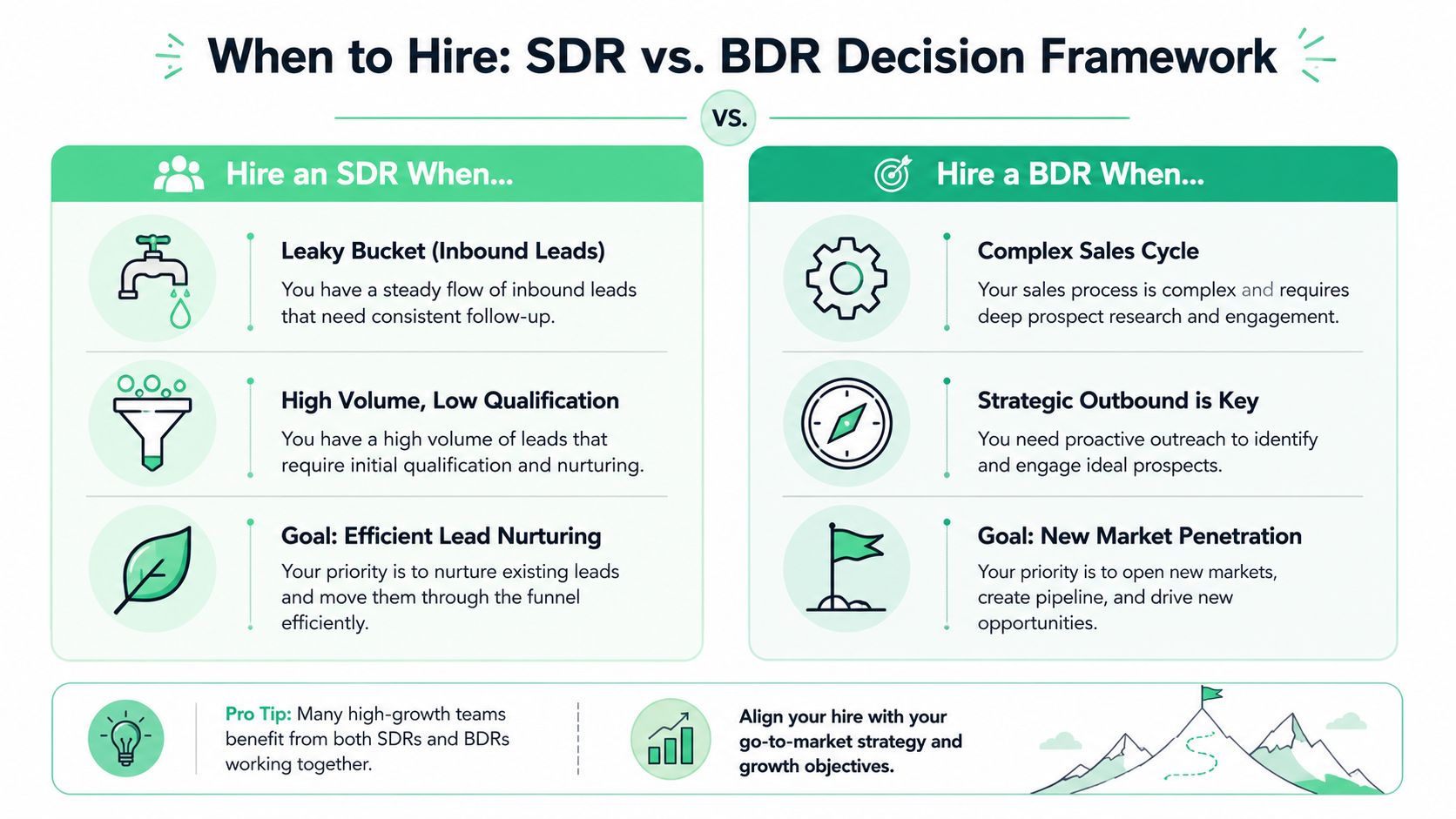
You should lean SDR if:
This is the classic leaky-bucket setup. Demand exists. Your system just can't catch and sort it properly.
You should lean BDR if:
That's where outbound earns its keep. If you want a broader view of how companies frame specialized titles around this motion, this guide to sales job titles is handy because it shows how often teams confuse labels with responsibilities.
Yes, one person can do both. Startups do it all the time. Sometimes they have to.
But let's call it what it is. A compromise, not an ideal design.
When one rep handles inbound qualification and outbound prospecting, one side usually wins attention and the other gets neglected. Inbound feels urgent, so outbound gets pushed. Or outbound feels strategic, so inbound rots. Then the founder says, “We tried both and neither worked.” No, you tried one person with conflicting priorities.
A hybrid rep can work for a while. A hybrid process almost never scales cleanly.
A practical way to decide is to ask, “Where does the next good meeting come from?”
If the answer is “people already showing intent,” hire the SDR.
If the answer is “people we need to go get,” hire the BDR.
And if you're wondering what good SDR talent looks like in the market, browsing a real SDR career at an AI software company can be useful because the job framing often reveals what employers expect beyond the title.
Once you know which role you need, the fun really starts. By fun, I mean reading a stack of resumes written by people who are all “results-driven self-starters” with “excellent communication skills.” Toot, toot.
Then come the interviews. Mock cold calls. CRM questions. “Tell me about a time you handled rejection.” Hope you enjoy spending your afternoons fact-checking experience claims and trying to guess whether someone can sell or just talk confidently on Zoom.
That's why a lot of founders eventually stop treating SDR and BDR hiring like a side quest and start systematizing it.
The painful part isn't deciding whether you need inbound qualification or outbound prospecting. The painful part is finding people who can do the work, in your timezone, with your market, without turning onboarding into amateur theater.
That's why services focused on pre-vetted talent exist. They remove the slog from sourcing, screening, and early filtering so leaders can spend time on messaging, enablement, and management instead of playing recruiter by accident.
If you're specifically looking at distributed hiring, this page on a remote sales development representative is a decent starting point for understanding what that model looks like in practice.
If hiring sales talent keeps stealing time from actual selling, stop DIY-ing the whole thing. Founders are usually terrible recruiters until they've burned a lot of money learning not to be.
You don't get points for suffering through the process manually.
You usually ask these questions after wasting a quarter on the wrong hire, the wrong title, or a rep who created more coordination work than pipeline. That's the part people skip. A bad SDR or BDR decision doesn't just miss quota. It burns manager time, muddies ownership, and slows everyone else down.
| Question | The Short, Direct Answer |
|---|---|
| Should an SDR and BDR report to the same manager? | Yes, on a small team. Split management only when inbound and outbound need different playbooks, coaching, and cadences. If one manager can't coach both motions, you don't have a title problem. You have a leadership problem. |
| Can one person do both jobs? | Yes, for a short stretch. It works while lead volume is light and outbound is still experimental. Once one queue starts getting ignored, you're paying for context switching and calling it efficiency. |
| Is a BDR more senior than an SDR? | No. Titles drift across companies. Treat seniority as a pay, judgment, and scope decision, not a naming decision. |
| Which role should a startup hire first? | Hire the role tied to revenue friction right now. If qualified inbound sits untouched, hire an SDR. If nobody is creating new conversations, hire a BDR. |
| Should AEs prospect too? | Yes, but in a targeted way. AEs should prospect into key accounts and expansion plays. They should not spend half the week doing first-touch volume work that a development rep should own. |
| What if our titles are reversed internally? | Keep them if you want. Just make responsibilities, compensation, and handoffs painfully clear. Confused titles are survivable. Confused ownership is expensive. |
A few founder-level rules matter more than the acronym.
If you're asking whether one person can cover both roles, the hidden cost is usually handoff failure. Inbound leads want speed. Outbound needs persistence. Put both on one desk for too long and one side slips. Then marketing says lead quality is bad, sales says follow-up volume is bad, and nobody can see the actual problem.
If you're asking who should own these reps, watch for management drag. A closer who inherited SDRs often coaches discovery well and ignores list building, sequencing, and reply handling. An outbound leader can have the opposite blind spot. The wrong manager creates a rep who looks busy, sounds active, and still produces a thin pipeline.
One more thing. Don't use titles to paper over compensation problems. If the job is mostly outbound prospecting, pay for outbound difficulty. If the job is mostly inbound qualification and speed to lead, pay for responsiveness and conversion quality. Fancy naming creates resentment fast when the day-to-day work says otherwise.
If you can't define the role by the mess it fixes, don't open the req.
And if you're tired of hiring for these roles the hard way, hireSDR.io is a practical option. They help founders and revenue leaders hire pre-vetted remote sales talent fast, so you can skip the resume theater and get straight to building pipeline.
Your global talent search is broken. Let's fix it. A founder posts an overseas role on Monday, gets 86 applications by Friday, and still has...

You're probably here because you need to hire revenue talent, you searched sales executive salaries, and Google handed you a neat little number that looked...

Most advice about the difference between inbound and outbound sales is technically correct and practically useless. Yes, inbound is pull and outbound is push. Wonderful....

Tell us who you need. We'll have pre-vetted candidates in your inbox within 72 hours. No commitment until you hire.