
You're probably doing the math right now.
You want an SDR. You've got a salary number in your head. Maybe you've even built a neat little hiring sheet in Google Sheets with base pay, variable comp, and a smug little green cell that says “affordable.”
That sheet is lying to you.
Not because you're careless. Because most founders budget for payroll, not for employment. Those are not the same thing. One is the number on the offer letter. The other is the number that subtly drains your bank account while you're busy celebrating a new hire in Slack.
The fully loaded labor rate stops being accounting jargon and starts becoming survival math. If you run a remote-first startup, especially one hiring SDRs across borders, this number matters even more. Geography changes cost structure. Employment model changes cost structure. Compliance changes cost structure. Ignore that, and you'll hire “cheaply” right into a cash-flow problem.
A founder tells me, “We're hiring our first SDR at $50K.”
I usually ask one question. “Cool. What's the actual number?”
That's where the confidence slips a little.
Base salary feels concrete because it's visible. It's the clean number in the offer letter, the one everyone agrees on. But the actual cost of employing that person includes all the messy stuff founders tend to hand-wave away in the first pass: payroll taxes, benefits, equipment, software, onboarding time, recruiter fees, management drag, and the weird little operational expenses that breed like rabbits.
The trap is simple. You think salary equals cost, so you greenlight headcount earlier than you should, or you hire fewer people than you need because each hire ends up costing more than your plan assumed.
That mistake gets expensive fast with SDRs because they need more than a paycheck to perform. They need tools. They need training. They need a manager's time. They need a process that isn't held together with hope and a Notion doc.
The moment you hire revenue talent, you're not buying labor. You're buying a system around that labor.
That's the part most startup models conveniently forget.
SDRs are especially easy to misprice because founders see them as “entry-level” and assume the burden will be light. Nope. The role may carry a lower base salary than a senior engineer, but the support stack can be chunky. A rep without the right tools and ramp support is just a person sending bad cold emails from an expensive laptop.
So yes, your new SDR might have a salary target that looks manageable.
But salary is the sticker price. It is not the out-the-door cost. And if you build your hiring plan around sticker prices, you're not forecasting growth. You're guessing.
The cleanest way to think about a fully loaded labor rate is this. Salary is the sticker price on the car. The fully loaded labor rate is what you pay once the taxes, fees, extras, and “while we're here” add-ons show up.
That's why this number matters. It tells you the true hourly employment cost, not the tidy fiction you put in your hiring plan.
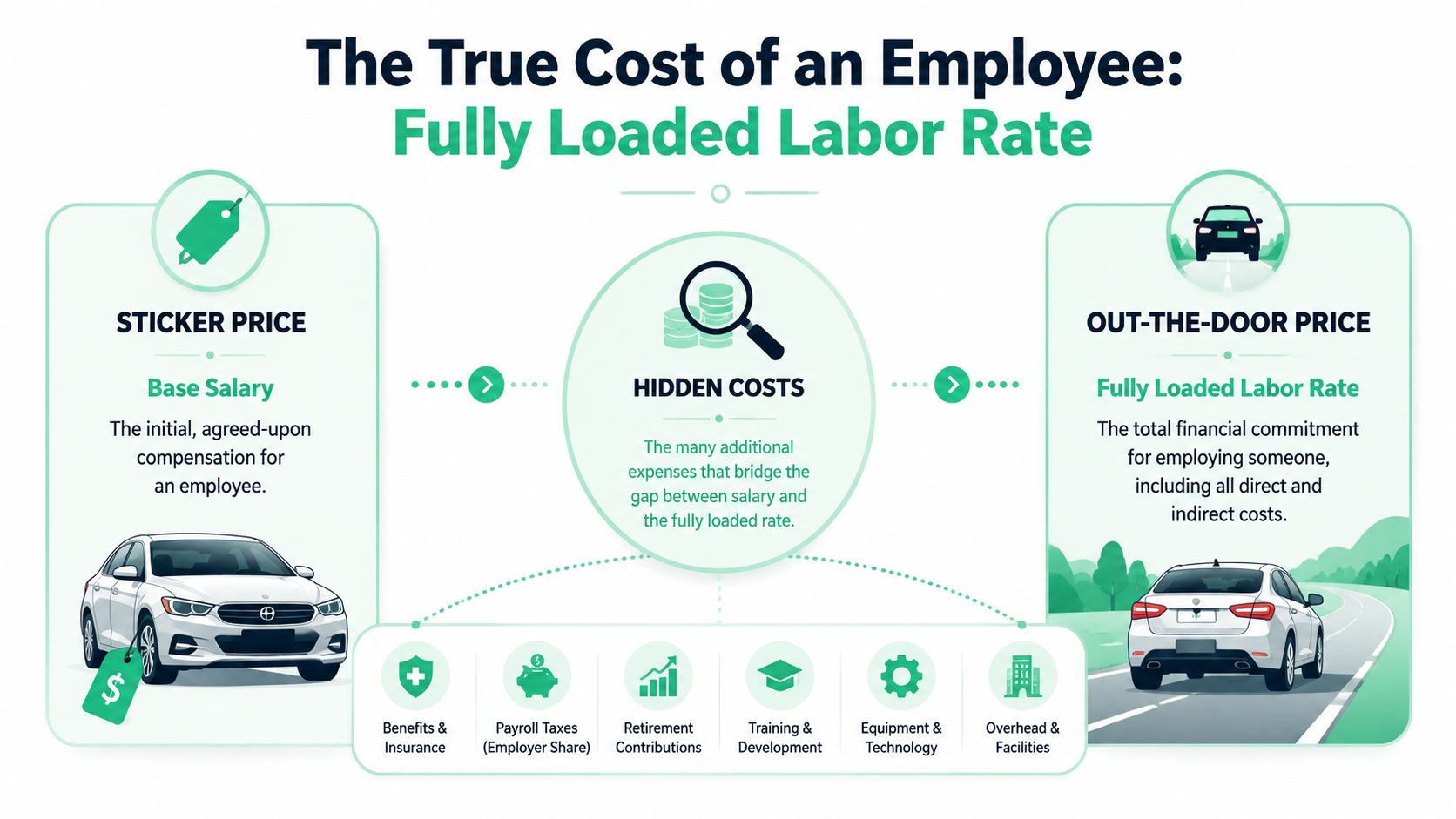
A practical definition from Procore's guide to fully burdened labor rate is refreshingly blunt. A fully loaded labor rate is the worker's total hourly employment cost, not just pay. It combines base wages or salary with employer payroll taxes, workers' compensation, health and retirement benefits, PTO, training, equipment, and allocated overhead. It also gives a common formula: “((labor burden costs + gross payroll labor cost) ÷ production hours)”.
That last part matters because it turns fuzzy expenses into a real operating number.
If you want another useful breakdown of the non-salary pieces founders miss, this employee cost guide is worth a look.
Because this is your actual cost floor.
If your SDR costs more per productive hour than you thought, your CAC assumptions drift, your payback period gets uglier, and your hiring plan starts eating runway. None of that shows up if you only look at salary.
Here's the blunt version:
Practical rule: If you can't explain a hire's all-in hourly cost, you're not ready to approve the hire.
Founders usually groan at this point. Not because the concept is hard, but because the details are annoyingly real.
You don't get sunk by one giant surprise. You get sunk by a pile of medium-sized “oh right, that too” costs. Individually, each one looks survivable. Together, they turn a tidy salary into a much heavier number.
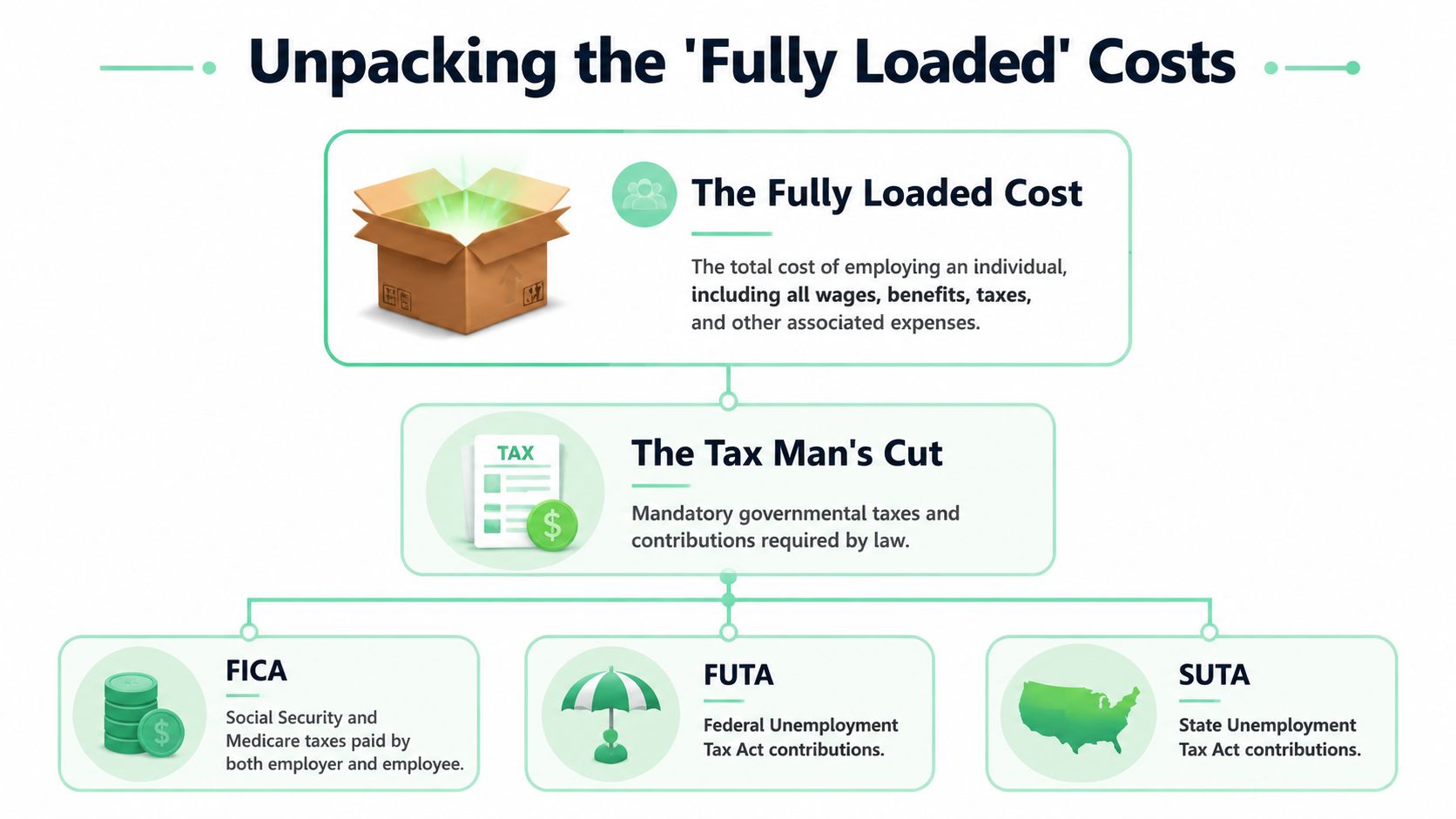
Payroll taxes are the vegetables of hiring. Nobody wants them, but they're on the plate.
In the U.S. West region, the Bureau of Labor Statistics reported average hourly wages and salaries of $35.56, which made up 69.9% of total compensation costs. Benefits averaged $15.29 per hour and represented 30.1% of compensation. Put differently, that compensation package added $15.29 on top of $35.56 in direct pay, a burden of about 43% relative to wages alone.
That's not a tiny rounding error. That's a different financial reality.
Some costs are obvious only after the person starts.
Health benefits, retirement contributions, workers' compensation, paid leave. None of these feel dramatic in isolation. They feel “normal.” That's exactly why they get undercounted.
Your SDR isn't working with a pen and heroic optimism. They need a laptop, email, CRM access, sequencing tools, data tools, call software, meeting software, and often some onboarding material you paid somebody to assemble at midnight six months ago.
Think Salesforce, HubSpot, Apollo, Salesloft, Outreach, Zoom, Slack, LinkedIn, and whatever odd sales enablement software your team swears it can't live without.
Even remote teams have overhead. Maybe not office rent and an overfed snack cabinet, but definitely admin time, payroll processing, compliance support, device management, and management bandwidth. Founders love calling remote hiring “lean” right up until they realize lean still costs money.
There's also the ugly pre-start cost. Recruiting. Screening. Interview time. Reference checks. Offer management. Onboarding. Ramp.
These costs don't always show up under compensation, but they're still part of what it takes to get one productive SDR into seat. If your process is sloppy, those costs swell. If your hiring cycle drags, they swell more.
A useful mental model:
| Cost bucket | What founders usually think | What actually happens |
|---|---|---|
| Salary | “This is the cost” | It's only the visible part |
| Taxes and benefits | “We'll add them later” | They materially change total cost |
| Tools and equipment | “Minor stuff” | They stack fast across each hire |
| Recruiting and onboarding | “One-time expense” | Still real cash, still part of hiring |
| Management and admin | “Already covered” | New hires create more of it |
Cheap hires are often expensive employment packages wearing a low-salary disguise.
Let's skip the fantasy spreadsheet and use a benchmark that already captures the punchline.
In practice, loaded rates can sit well above base pay. SmartBarrel's example notes that when base wages are around $35/hour, the fully burdened rate often lands between $50 and $70/hour once payroll taxes, insurance, benefits, and overhead are included. The same source also shows an $80,000 salary becoming $110,000 in total annual employment cost, or $52.88/hour when divided by 2,080 hours.
That's the kind of gap founders need tattooed onto their hiring plan.

A lot of people see a figure like $110,000 and think, “That seems high.”
Wrong reaction.
The right reaction is, “Good. Now we're finally using a number I can operate the business with.”
Salary tells you what the employee earns. Fully loaded labor rate tells you what the company pays to make that employee possible. If you're deciding whether to hire one SDR or two, whether to build outbound in-house or distribute it, or whether a rep needs to hit a certain productivity level to justify the role, the loaded number is the one that matters.
Run every new SDR hire through three questions:
If your team can't answer those in one pass, you're still budgeting off vibes.
And vibes are great for brand strategy. They're terrible for payroll.
Don't compare one rep's salary to another rep's salary. Compare one rep's total employment system to another rep's total employment system.
That's where true tradeoffs live.
The conversation gets useful.
Most guides treat the fully loaded labor rate like a universal law of nature. It isn't. It shifts with geography, employment model, and compliance. A remote SDR in one market can carry a very different total cost profile from a remote SDR in another, even when the job description looks nearly identical.
That's not an accounting footnote. It's a hiring strategy.
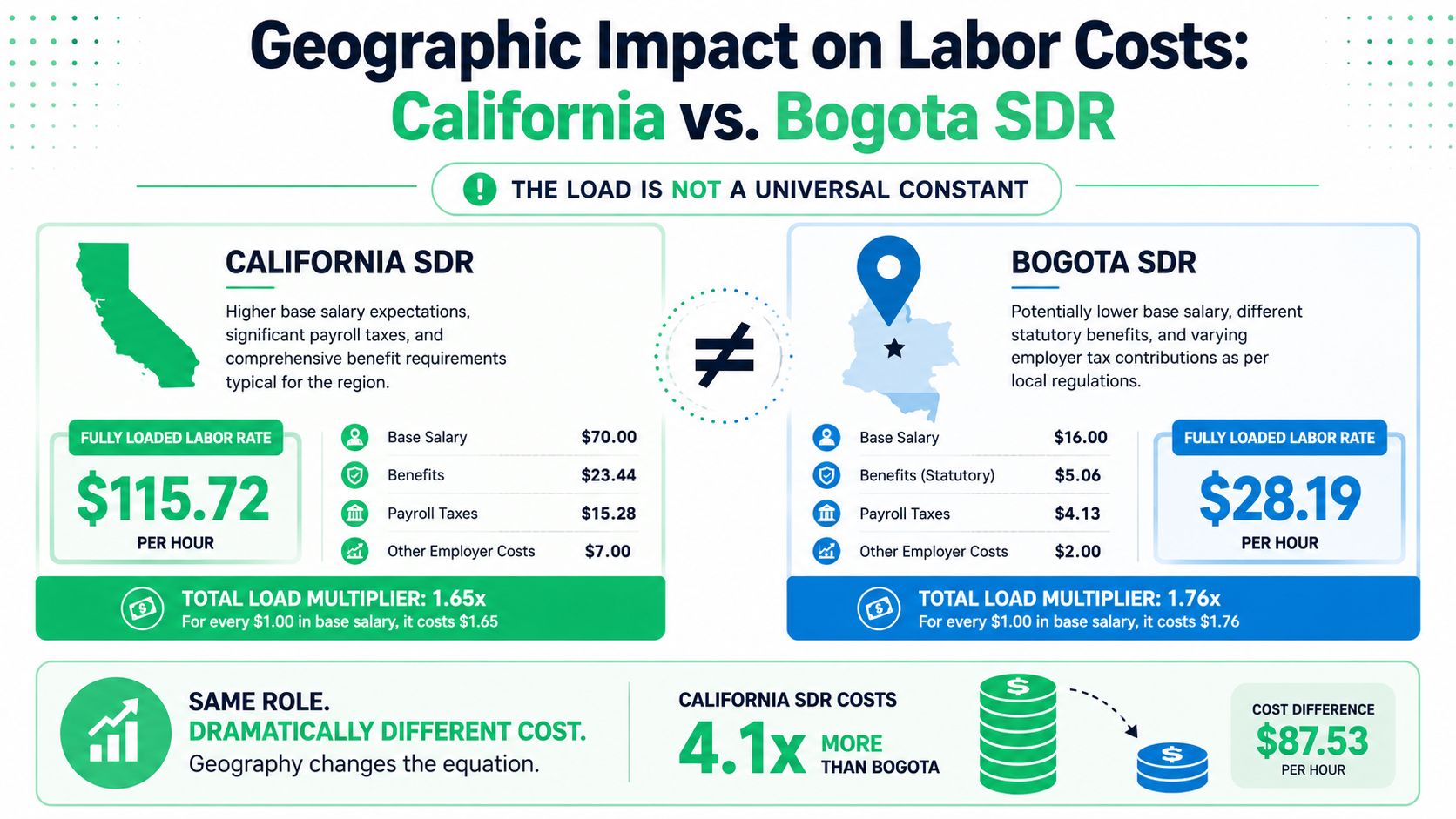
Miter's write-up on fully burdened labor costs makes the key point most U.S.-centric content skips. Coverage often treats fully loaded labor rate as a universal concept, but in practice it is increasingly shaped by geography, employment model, and compliance costs, especially for globally distributed teams. Their blunt framing is the right one: the question is often less “What is the average fully loaded rate?” and more “What is the fully loaded rate for this role in this country under this employment structure?”
That's the whole game for remote-first founders.
If you're hiring an SDR in Bogota instead of in a high-cost U.S. market, the base pay may differ, yes. But that's only part of it. The statutory benefits differ. The employer contributions differ. The healthcare setup differs. The overhead assumptions differ. The compliance path may differ depending on whether you hire directly, use an employer-of-record model, or work through a recruiting and payroll partner.
For cross-border basics, this guide to hiring international employees lays out the practical side founders usually underestimate.
The mistake is assuming “remote” means one generic discount.
It doesn't.
Remote hiring can lower office-heavy overhead. It can also introduce payroll, legal, classification, and local compliance complexity. Some locations improve the total cost picture dramatically. Others look cheap at salary level and get messy once the employment setup catches up with you.
That's why smart founders stop asking, “What's the average SDR cost?” and start asking questions like these:
SDRs are one of the best roles to evaluate globally because performance depends heavily on process, coaching, and consistency, not proximity to your office fridge.
If you can access excellent sales talent in a lower-cost market, your fully loaded labor rate becomes a lever. That can let you hire more coverage, extend calling hours, test segmentation faster, or keep burn under control without squeezing compensation into something insulting.
That's not “cheap labor.” It's better labor design.
You don't need to slash salary to improve your fully loaded labor rate. In fact, cutting pay is often the laziest and dumbest option. It hurts quality, slows hiring, and usually buys you turnover with a side of resentment.
There are smarter levers.
Founders love adding tools because every demo promises more pipeline. Then six months later you're paying for overlapping software while reps still export CSVs into spreadsheets like it's a school project.
Clean it up.
A slow recruiting process raises cost before the rep sends a single email.
Every extra interview, every vague scorecard, every week of indecision adds hidden labor cost through recruiter time, manager time, and delayed ramp. If you want a lower real cost per SDR, tighten the process.
A focused recruiting partner can help here. If you want a shortcut, outsourced recruiting services like this SDR recruiting option exist for exactly that reason.
This is the big one.
Industry references consistently define fully burdened labor rate as base pay plus payroll taxes, benefits, and overhead. Runway's glossary notes that several sources place the added cost at roughly 20% to 40% above salary, while other examples show it can be as high as 58.9%, which tells you one thing clearly. The variance is enormous.
That variance is your opportunity.
If you hire the same role in a different market with a better cost structure, you're not merely shaving salary. You're changing the burden itself. Different taxes. Different benefits frameworks. Different overhead assumptions. Potentially a much healthier all-in rate.
The best way to lower employment cost without lowering pay is to redesign where and how you hire.
That's the founder move. Not penny-pinching. Architecture.
Many treat the fully loaded labor rate like an annoying finance term. That's a mistake.
Used properly, it becomes one of the sharpest decision tools in the company. It tells you what growth costs. It shows whether your hiring plan is grounded or delusional. It helps you compare roles, markets, and employment models without fooling yourself with salary headlines.
And for SDR teams specifically, this matters even more because the role sits so close to pipeline generation. When you know the true cost of one rep, you can get a lot sharper about coverage, ramp expectations, and productivity targets.
The founder who knows the fully loaded labor rate hires with intent. The founder who ignores it hires with hope.
Hope is not a hiring strategy. It's a coping mechanism.
If you want fewer surprises, better unit economics, and a hiring model that doesn't eat your runway, make this number part of every headcount decision from now on.
If you want to build an SDR team without getting blindsided by the full cost of hiring, hireSDR.io is worth your attention. They help founders and revenue leaders find pre-vetted remote SDRs fast, with built-in support for global hiring, payroll, and compliance. That means less spreadsheet theater, fewer expensive hiring mistakes, and a faster path from “we need pipeline” to “we have reps in seat.”

You're probably here because you need to hire revenue talent, you searched sales executive salaries, and Google handed you a neat little number that looked...

Stop hiring “sales ninjas” and start building a real team. You need to hire a salesperson. Sounds simple until the applicants start calling themselves Growth...

Most advice about the difference between inbound and outbound sales is technically correct and practically useless. Yes, inbound is pull and outbound is push. Wonderful....

Tell us who you need. We'll have pre-vetted candidates in your inbox within 72 hours. No commitment until you hire.