
You finally hired that killer remote SDR in Bogotá, Nairobi, or Manila. They crushed the interview, your pipeline problem looks fixable, and for about six minutes you feel like a genius.
Then payroll enters the chat.
Now you're dealing with worker classification, tax withholding, statutory benefits, local payslip rules, data privacy, payment timing, and a weirdly urgent question about whether commissions can run on the same cycle as base pay in that country. This is the part nobody brags about on LinkedIn. They post the “we're now global” screenshot. They don't post the part where finance, HR, and ops are all guessing.
I learned this the expensive way. Hiring internationally is the fun part. Global payroll compliance is where your systems either grow up or embarrass you.
If you're still figuring out streamlining global talent acquisition, great. Just don't confuse “we found the person” with “we can employ them safely.” And if you're comparing different effective methods for paying global contractors, do that before your first payment run, not after somebody asks why their invoice structure suddenly looks illegal.
The first international hire usually starts with adrenaline. You found someone great. They speak your customers' language, they can sell, and they cost less than a local hire in San Francisco or London. Toot, toot. Founder brain says you've achieved global arbitrage.
Then reality shows up wearing reading glasses.
Your SDR wants a contract. Finance wants to know whether they're a contractor or employee. Your ops person wants to know what platform to use. Your accountant asks whether there's local registration involved. Somebody says, “Can't we just pay them through Deel, Remote, or a wire?” That's usually the moment the room starts confusing payment with compliance.
They are not the same thing.
In 2025, 57% of global payroll professionals identified local compliance as their single biggest challenge, while 42% of organizations lacked any formalized compliance framework. That's from Rise's global payroll compliance report, and it matches what I've seen in the wild. This isn't a niche problem. It's the main event.
You can recover from a slow hire. Recovering from cross-border payroll mistakes is uglier, slower, and a lot more expensive.
One hire becomes three. Then one country becomes four. Then someone on your team promises a start date before anyone has validated local rules. That's how small shortcuts turn into structural nonsense.
A typical failure pattern looks like this:
If you're a founder hiring remote sales talent, get this straight early. Recruiting solves access to talent. Payroll compliance protects the business you're building.
Global payroll compliance sounds like one job. It isn't. It's three overlapping jobs, all of which change by country. This involves dealing with a labor office, a tax office, and a compensation rulebook at the same time, for every person you hire.
Here's the simple version worth remembering.
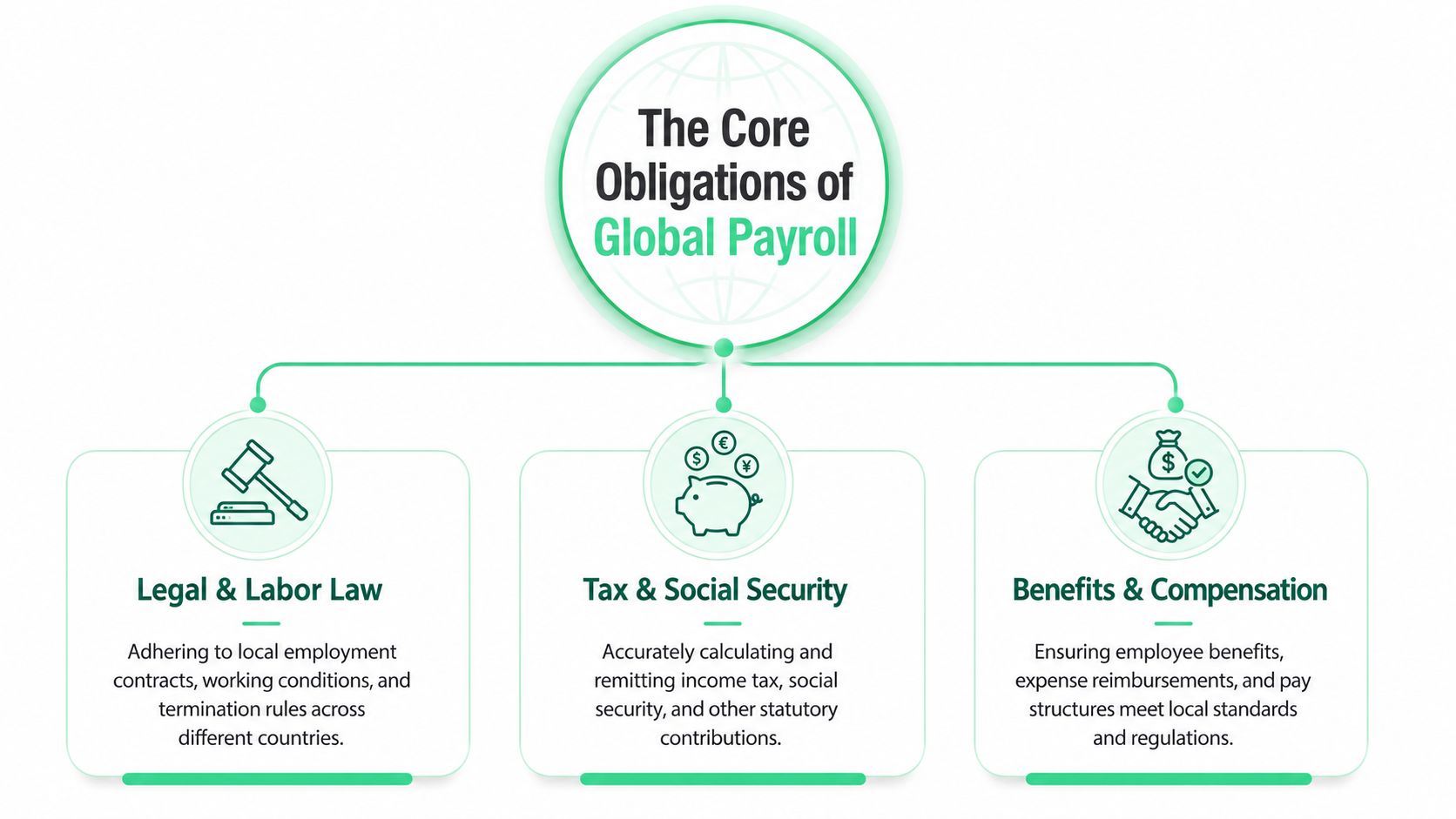
This is the contractor-versus-employee trap. It's the oldest mess in the book, and teams still fall into it because “contractor” feels faster.
Misclassifying employees as contractors is the number one compliance failure, and over 30 countries updated their payroll or benefits rules between 2025 and 2026, according to EasyStaff's framework overview. That means the shortcut gets riskier while the rules keep moving.
What sits in this bucket?
If your SDR has fixed hours, mandatory meetings, manager oversight, and revenue targets, calling them a contractor just because it's convenient is how you end up funding a regulator's good mood.
Founders discover that “gross pay” is the easy part. The hard part is everything hanging off it.
Payroll has to account for income tax, employer contributions, employee contributions, remittance timing, and whatever local filing logic that jurisdiction expects. And yes, each country has its own quirks. Some want detailed earnings categories. Some are particular about formatting. Some punish errors like you keyed them in with your feet.
A few practical checks matter here:
Founders love to think compensation is “salary plus maybe bonus.” Regulators tend to disagree.
Benefits, statutory minimums, reimbursement handling, and local pay structures all sit inside payroll compliance. So do record retention duties. In many jurisdictions, you need to keep payroll and employment records for years after the person leaves.
Practical rule: If compensation has a label, a timing rule, or a tax implication, it belongs in your payroll compliance process.
And one more thing. By 2026, payroll compliance had moved beyond back-office admin into a broader control function tied to tax, labor law, reporting, digital infrastructure, and data security, as outlined in this payroll compliance update from IRIS Global. If your setup still treats payroll like bookkeeping with a nicer interface, it's behind.
A lot of founders hear “compliance risk” and mentally translate it to “annoying fine.” Cute. That's not how this goes in the harsher jurisdictions.
Sometimes the consequence is money. Sometimes it's legal exposure. Sometimes it's both, with interest.
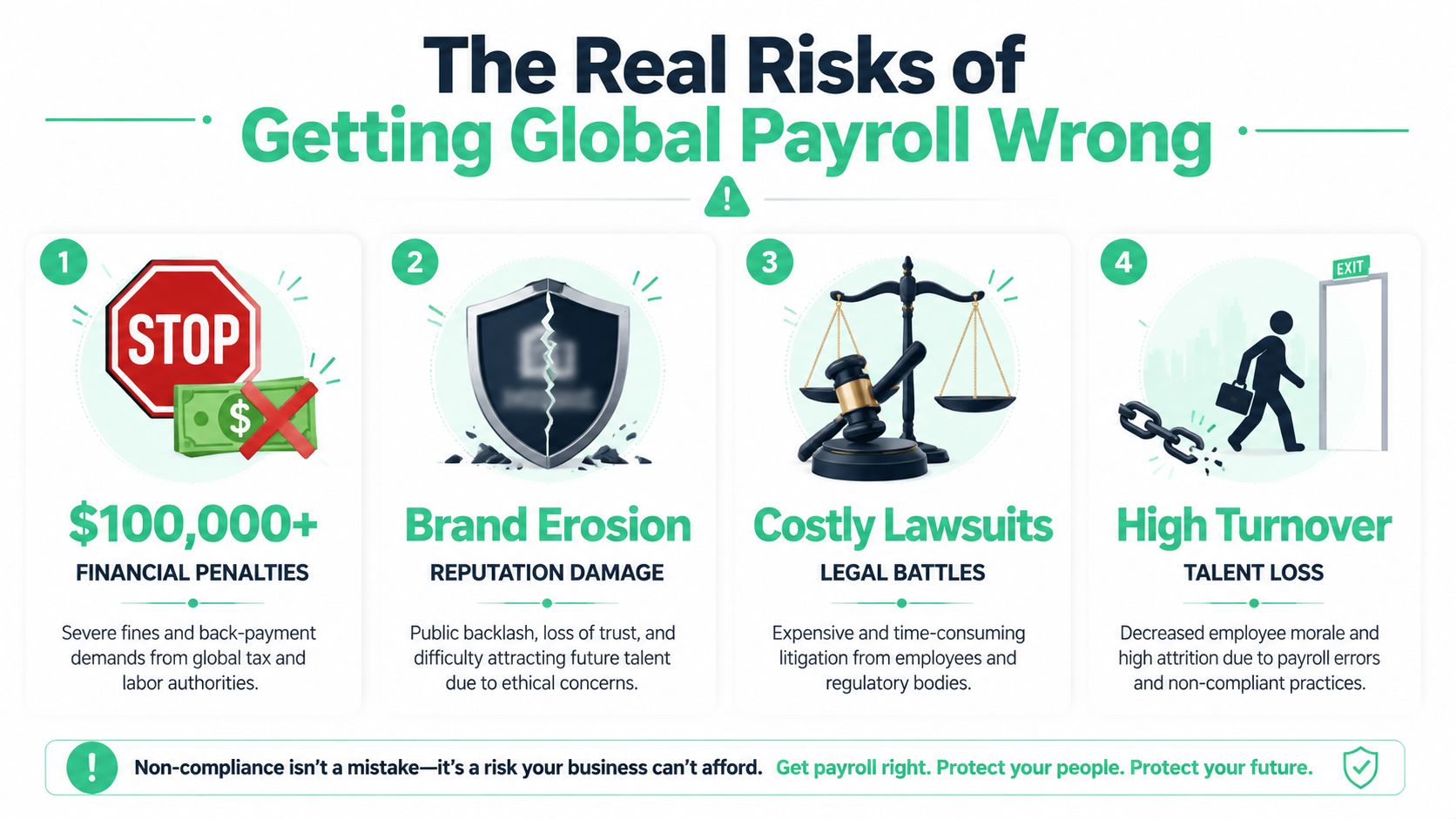
The cleanest example is deadline failure. Miss a payroll-related obligation in the wrong country and you're no longer dealing with a paperwork issue.
A missed payroll deadline in Colombia can lead to fines up to $12M and 4 to 9 years of imprisonment. In China, late social security or PAYE filings can trigger 0.05% daily interest plus a 200% to 300% fine, according to Payroll Central's overview of global payroll penalties.
That's not “ops friction.” That's a board-level problem.
The legal penalties are dramatic, but the operational damage is usually what lands first.
When payroll is wrong, people notice immediately. Your SDR doesn't care that your vendor had a sync issue between systems. They care that their pay, commission, or deductions look wrong. Trust drops. Managers get dragged into cleanup. Finance wastes cycles on reversals and explanations.
Here's what tends to happen after a payroll miss:
Missed payroll doesn't just create an accounting problem. It creates a credibility problem.
Founders usually don't get taken down by one dramatic mistake. They get taken down by a chain of lazy assumptions.
You classify one hire loosely. You reuse the same contract in another country. You run commissions manually. You store payroll data across too many tools. Then a regulator, employee, or local advisor asks one simple question and the whole setup starts wobbling.
This is why I'm blunt about it. Global payroll compliance is not boring admin. It's business armor.
You do not need perfection. You need a system that sane adults can follow under pressure.
Treating payroll compliance like a monthly task often leads to failure. It's not. It's an operating system. If the system is weak, the mistakes keep reproducing themselves.
Start with a central global payroll policy. One owner. One source of truth. One set of core rules for classification, approvals, documentation, payment timing, commissions, reimbursements, and record storage.
Then add local country addenda. That's where you handle jurisdiction-specific rules.
Most global payroll failures come from fragmentation. Different providers, different files, different assumptions, different people “kind of” owning the process. Central policy gives you consistency. Local addenda keep you from doing something stupid in-country.
A workable policy should answer:
The nastiest errors hide in off-cycle runs, commissions, bonuses, corrections, and one-off reimbursements. Those are exactly the places where teams still reach for spreadsheets and Slack threads.
That's a mistake.
The main gap in most setups isn't timely payment. It's the lack of continuous, localized compliance auditing, especially around changing regulations and nonstandard pay runs. Thomson Reuters' write-up on payroll compliance challenges also highlights the hidden risk created by spreadsheet-based processes. That warning is boring right up until your bonus file causes a classification or filing problem.
Audit rule: Review compliance every pay cycle where variable or off-cycle pay appears. Annual review alone is too late.
You need local expertise. You do not need local chaos.
That means having an in-country advisor, specialist, or accountable provider who can flag rule changes, validate local assumptions, and review edge cases. But keep internal ownership clear. A vendor can support the process. They shouldn't be the process.
My preferred operating model is simple:
If your current setup depends on “Sarah in finance usually remembers,” you don't have a process. You have folklore.
In this scenario, founders get sold fairy tales.
One fairy tale says you should build everything in-house because control is king. The other says an EOR or global vendor makes compliance basically disappear. Both stories are convenient. Neither is true.
Running payroll in-house can work if you have strong internal finance and legal ops, low country count, and the patience to build a real compliance machine. You'll own the workflows, data model, provider choices, and escalation paths.
You'll also own the mess when something breaks.
If you're hiring in multiple jurisdictions, decentralized providers and fuzzy ownership are usually what cause payroll failures in the first place. Safeguard Global's guidance on international payroll rules gets this part right. The fix is a centralized policy and a single accountable operating model, whether that sits internally or with one accountable partner.
An Employer of Record helps when you need speed, local employment infrastructure, and less entity setup pain. For early-stage teams, that can be the right trade. Especially if you're hiring one or two people in a market and don't want to build a legal and payroll stack around them.
But don't romanticize it.
Some EORs are excellent. Some are just polished middlemen with better branding and slower support. If you're evaluating how these setups fit into a broader HR stack, this piece on EOR for Microsoft 365 HR is a useful lens on operational integration, not just legal structure. And if you're pressure-testing providers while looking at broader talent operations, HireSDR is part of the wider conversation around getting remote hiring done fast without creating downstream chaos.
| Factor | DIY In-House | Employer of Record (EOR) |
|---|---|---|
| Speed to hire | Slower, especially in new countries | Faster when local infrastructure already exists |
| Control | Highest control over process and data | Less direct control, depends on provider quality |
| Compliance burden | Sits heavily on your team | Shared, but never fully outsourced in practice |
| Scalability | Strong if you invest early and standardize | Strong for quick expansion, weaker if vendors fragment |
| Cost structure | Potentially efficient at scale, painful upfront | Easier to start, can become expensive or rigid |
| Best fit | Mature ops teams with clear ownership | Early-stage teams moving fast into new markets |
If you're early and hiring across a few markets, use an EOR or one accountable partner. If you're larger, concentrated in stable markets, and have proper internal operators, in-house can make sense.
Just don't build a patchwork. One country on one provider, another on a local bureau, another on spreadsheets, and commissions in a Google Sheet is how founders accidentally create their own compliance escape room.
Sales hiring makes payroll compliance nastier than anticipated. SDRs look simple on paper. In practice, they trigger some of the highest-risk issues: variable comp, aggressive management oversight, and fuzzy contractor logic.
That combo causes trouble fast.

Founders see a remote rep in another country and assume “contractor” is the lightweight option. But an SDR usually works from your script, your CRM, your meeting cadence, your activity targets, and your manager's daily oversight. That starts looking a lot like employment in many jurisdictions.
And commissions make it worse.
If your SDR has quotas, variable incentives, and structured performance management, you need to pressure-test classification before day one. Not after the first quarter payout.
Base salary is manageable. Variable pay is where the cracks show.
Some countries require different handling for commissions, bonuses, or off-cycle incentive payouts. If you run global sales hiring, you need one compensation design that can be localized without breaking payroll every month.
I'd keep it simple:
The moment you let every country improvise commission logic, your payroll team becomes a clean-up crew.
A lot of global guides act like the US is the simple default. It isn't.
US payroll complexity has risen 17% since 2023, now ranking 6th globally, with over 51 jurisdictions creating unique burdens for remote-first teams, according to Strada's payroll complexity index update. So if you're hiring remote SDRs across states and assuming your home market is the “easy one,” that assumption needs to go in the bin.
For a practical companion read, this guide for SMBs on remote worker compliance does a good job of grounding multi-state risk in actual operating realities. And if you're serious about Mastering remote SDR hiring, payroll design should sit right next to sourcing and onboarding, not miles behind it.
You don't need to memorize every country's labor code. You do need a checklist tough enough to catch sloppy decisions before they become expensive ones.
Use this before every new country, every new worker type, and every change to compensation.
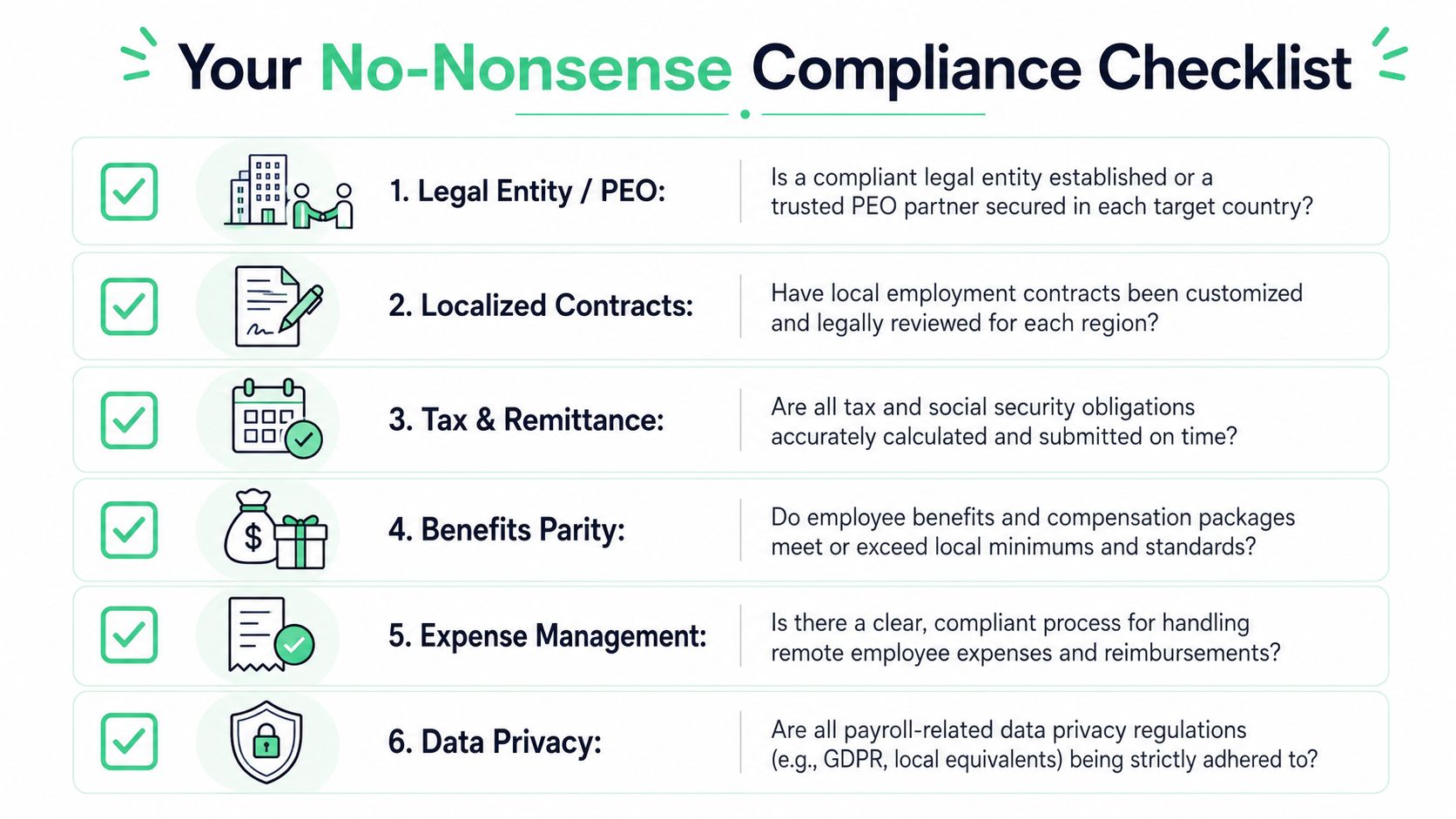
If you use an EOR, PEO, or payroll provider, ask the awkward questions early.
| Check | What to ask |
|---|---|
| Accountability | Who is responsible if classification or filing is wrong? |
| Local expertise | Do they rely on in-country specialists or generic support teams? |
| Audit support | What happens if a regulator asks for records or explanations? |
| Change management | How do they notify you when country rules shift mid-year? |
The standard is a defensible process. Clear ownership. Local validation. Continuous review. Fewer moving parts.
That's how grown-up companies handle global payroll compliance. Not by hoping the tool is magic. Not by outsourcing common sense. And definitely not by pretending payroll is “just admin” while the sales team scales across borders.
Get this right and you protect hiring speed, employee trust, and the company itself. That's not overhead. That's an advantage.
If you need remote SDRs fast and don't want payroll compliance to become your next self-inflicted wound, hireSDR.io is worth a look. They help founders and revenue teams hire vetted remote SDRs quickly, with built-in support for cross-border onboarding, compliance, and payroll logistics, so you can focus on pipeline instead of untangling payment rules at midnight.

Your reps are busy all day, your CRM is full of “activity,” and somehow pipeline still feels anemic. Founders see that and reach for the...

Your burn rate is loud. Your pipeline is not. You posted the SDR role, got a pile of polished résumés, hired someone local, paid a...
You're probably here because local hiring feels like a bad joke. You post for an SDR, get a pile of mediocre applicants, spend weeks interviewing,...

Tell us who you need. We'll have pre-vetted candidates in your inbox within 72 hours. No commitment until you hire.