
Most advice on outsource SDR companies is backward.
It tells you to compare agency logos, skim a few case studies, and haggle over price per meeting like you're shopping for office chairs. Then everyone acts shocked when the pipeline is trash, the AEs revolt, and the founder ends up sitting through “qualified” calls with people who should've been filtered out three emails ago.
The ugly truth is simpler. Outsourced SDRs don't fail because outsourcing is broken. They fail because buyers reward the wrong thing. They buy activity. They should buy outcomes.
I've hired outsourced SDR teams that looked polished in discovery, sent gorgeous decks, and then proceeded to stuff calendars with low-intent tire-kickers. I've also seen outsourced setups work well when the model, metrics, and management were right. That's the difference. Not charisma on the sales call. Not the logo slide. Not the promise of “we book meetings fast.”
Good. You should be skeptical.
Outsourced SDR programs fail all the time, and the reason is usually boring. Buyers pay for activity they can count instead of pipeline they can close. That is how founders end up with full calendars, angry AEs, and zero lift in revenue.
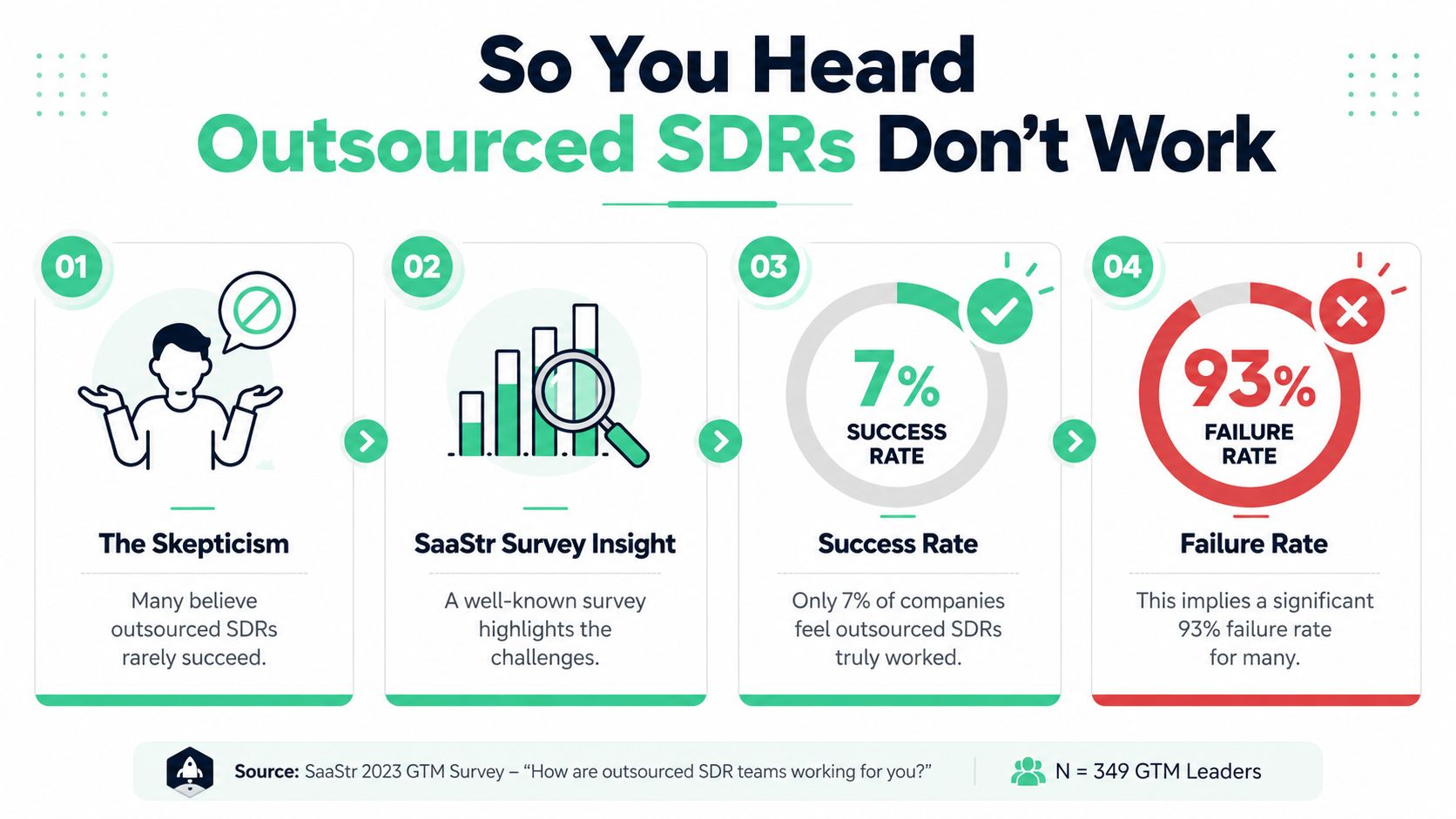
The problem isn't outsourcing itself. The problem is buying the wrong deliverable.
A vendor can book meetings by lowering the bar, widening the list, and hammering prospects until someone says yes. That looks productive in a dashboard. It wrecks ROI. If your account executives keep asking, "Why am I on this call?" your outsourced SDR program is already off the rails.
Analysts at Wise Guy Reports expect the outsourced SDR service market to keep growing, with the category projected to expand steadily through 2035, according to Wise Guy Reports market projections. Companies keep spending here for one reason. A well-run program can create qualified opportunities faster than a sloppy in-house build. A bad one just creates meetings.
That distinction matters more than any pricing model or agency brand.
Use a simple filter. Judge outsourced SDR companies on accepted meetings, sales-qualified opportunities, pipeline created, and closed revenue influenced. Treat raw meeting count as a supporting metric, not the headline. If a firm keeps steering the conversation back to email volume, dial count, or calendar fills, walk.
I learned this the expensive way. The agencies that underperformed were always polished in the pitch and vague in the math. They talked about hustle, activity, and "top-of-funnel coverage." They could not explain how they handled disqualification, AE feedback loops, or opportunity standards. Those are not minor gaps. Those are signs you are about to fund noise.
The agencies that worked treated outbound like a revenue system. They pushed for a sharp ICP, reviewed call outcomes with sales, and accepted that some campaigns should produce fewer meetings if those meetings convert better. That is the standard. If you want a broader operating framework, this guide to sales outsourcing for startups is a useful companion read.
One more rule. Do not let an outsourced SDR partner define success before your sales team does.
If you need a second reference point on execution, this breakdown of outbound strategies for sales teams is worth reading because it focuses on motion design and pipeline quality, not vanity reporting.
The founders who beat the 93% failure pattern do not buy meetings. They buy qualified opportunities and inspect the system hard enough to know the difference.
Outsourcing SDR work is not a panic move. It's a timing move.
The best time to do it is when speed matters more than internal org chart purity. If you need outbound running this quarter, not after a hiring loop, onboarding cycle, and manager bandwidth debate, outsourcing can be the cleaner move.

A useful benchmark: outsourced SDR programs can deliver qualified pipeline within 30–60 days, while building and ramping an in-house SDR team typically takes 90–120 days, according to Callbox's rundown of outsourced SDR timelines. If you're trying to validate outbound or rescue a thin quarter, that time gap matters.
You need to test outbound fast.
Maybe product marketing has the story mostly right, but you still need market proof. An outsourced team can help you test messaging, segments, and channel mix without waiting for a full internal buildout.
You're entering a new market. New geography, new vertical, new buyer. Often, founders overspend on full-time hires too early here. Validate first. Then decide whether to internalize later.
Your pipeline looks like a seismograph.
Some months are busy. Some months are bone dry. Outsourcing can help create consistency when your internal team is getting dragged into demos, renewals, and firefighting.
If you want a broader founder-level framework before committing, this guide to sales outsourcing for startups covers the strategic side well.
This part saves money.
If you don't have a usable ICP, outsourcing won't fix that. It just turns confusion into invoices. If your sales leadership can't define what counts as a qualified meeting, same problem. If your AE team is weak at follow-up, you'll blame the SDR vendor for sins that belong in your close motion.
Here's my blunt filter:
Outsourcing works best when you already know enough to judge quality, but not enough to justify building the whole machine in-house.
That's the trigger. Not desperation. Readiness plus urgency.
Your outsourcing model decides what the vendor will optimize for. Pick the wrong one, and you will get a calendar full of meetings that never turn into pipeline.
That is the core mistake founders make here. They buy activity packaging. They should be buying qualified opportunities, clean handoffs, and a setup that can survive more than one campaign cycle.
Three models dominate this market. They are not equally good.
Pay-per-meeting agencies sell speed and low commitment. Founders like them because the offer feels simple. The problem is simple too. If the agency only gets paid when a meeting lands, it will stretch qualification until your AEs are stuck on calls with people who were never serious buyers.
Dedicated retainer firms charge a monthly fee for a managed outbound function. That usually includes SDR labor, management, tooling, list building, copy, and reporting. This model is better because the vendor has room to improve targeting and messaging instead of chasing a booking quota at any cost.
Talent marketplace or direct-hire-style models give you vetted SDR talent with more direct control. You own more of the day-to-day. You also get fewer excuses, less black-box agency behavior, and a clearer line between effort and outcome.
Here is the blunt comparison.
| Model | Best For | Typical Cost | Biggest Risk |
|---|---|---|---|
| Pay-per-meeting | Founders who want a low-friction test | Variable, tied to meetings | Incentive to book weak meetings |
| Dedicated retainer | Teams that want a managed function | Monthly retainer | Paying for management theater if quality is weak |
| Talent marketplace | Leaders who want control and flexibility | Variable monthly talent cost | Requires more hands-on management from your side |
This model looks cheap because the bad cost sits somewhere else.
Your AEs lose selling time. Your domain gets burned faster because the vendor needs volume. Your brand takes hits from sloppy outreach. Then your team stops trusting anything the program books, which kills follow-up quality even on the rare good meeting.
Use this model only if you have narrow targeting, a hard qualification checklist, and the discipline to reject bad meetings immediately. If you cannot enforce that, skip it.
This is the safest choice when you need execution plus management. A good firm will own research, messaging, sequencing, outbound ops, and SDR coaching. A bad one will bury weak performance under polished client updates.
Judge this model on conversion quality, not activity totals. The Sales Development Playbook team at Salesloft found that SDR success comes from tightly managed process, clear qualification, and close alignment with account executives, not just volume at the top of funnel, as explained in Salesloft's sales development framework.
Ask one question before you sign: what happens after the meeting gets booked?
If the answer gets fuzzy, walk away.
You want reporting on show rate, accepted-opportunity rate, pipeline created, and why AEs rejected meetings. If they stop the story at "meetings booked," they are selling motion, not outcomes.
I like this model more than many founders do, especially if you already know your ICP and message.
You can inspect calls. You can rewrite sequences fast. You can change targeting without waiting for an agency account manager to "take that back to the team." That control matters because outsourced SDR programs usually fail in the first few feedback loops, not in the first week.
The tradeoff is management load. Someone on your side still has to coach, review, and set the standard. If nobody owns that, this model falls apart too.
Founders waste time debating regions before they confirm whether the operator can sell.
Timezone overlap matters. Written English matters. Call clarity matters. Cultural fluency matters. All true. None of it saves you from weak qualification, lazy list building, or generic messaging.
A practical rule works better than regional stereotypes:
Start with operating discipline. Then check region fit.
The model shapes incentives. Incentives shape behavior. Behavior determines whether you get qualified pipeline or a pile of useless meetings.
If you want my default recommendation, start with a dedicated retainer if you need a managed function. Choose a talent marketplace if you already have sales leadership and want tighter control. Avoid pay-per-meeting unless you enjoy paying for calendar spam in a nicer wrapper.
Outsourced SDRs do work. Bad outsourced SDR programs do not.
That distinction matters because vendors love to sell activity, while you need accepted meetings, real opportunities, and revenue you can trace back to the program. If a firm cannot show how its outreach turns into pipeline, keep walking.
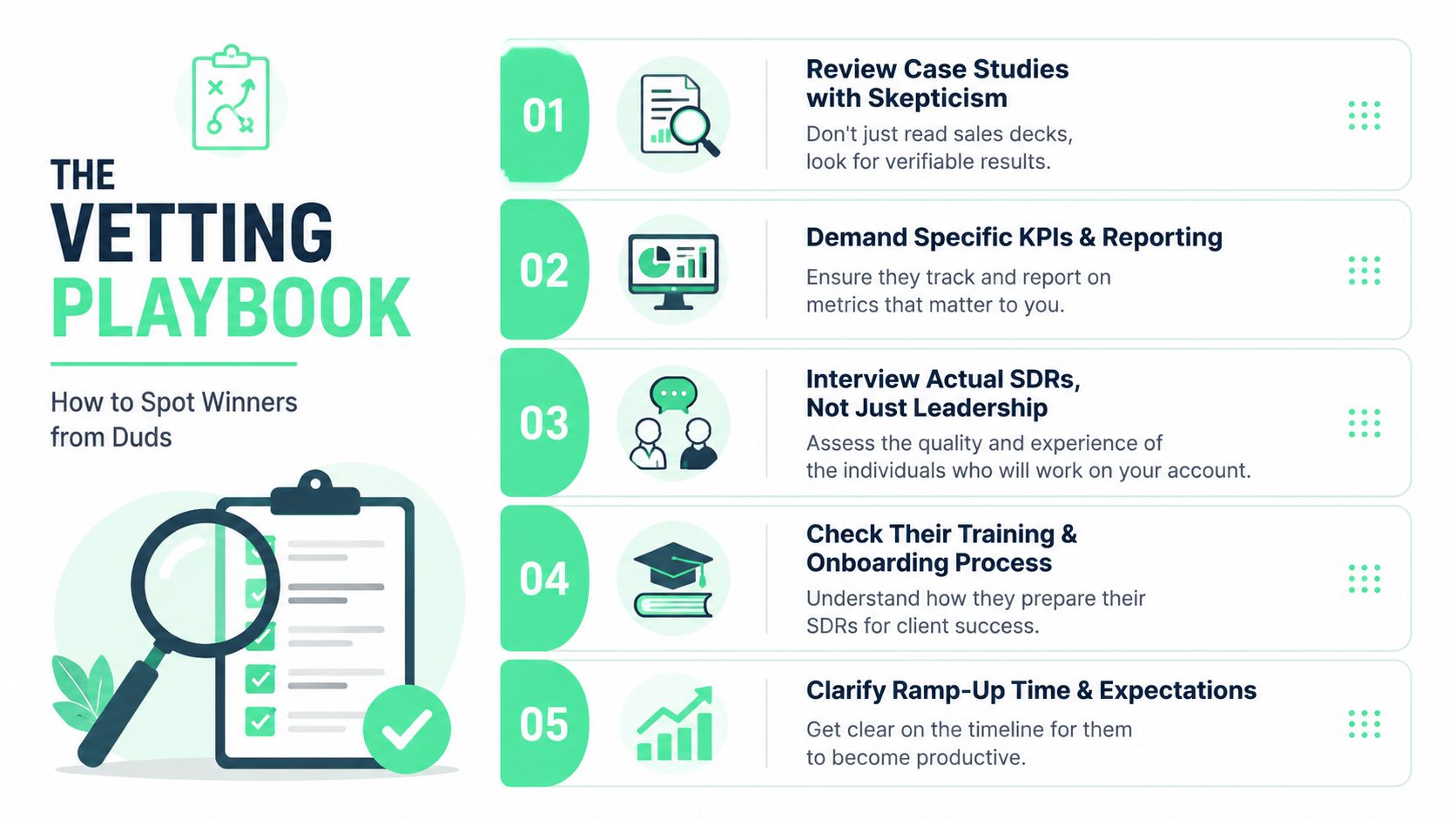
As noted earlier, the failure rate in outsourced SDR is ugly. The common pattern is simple. Vendors optimize for dials, sends, and booked meetings, then call the program a win while your AEs reject half the calendar and pipeline never shows up. Vet for operating discipline and conversion quality. Everything else is theater.
A polished sales deck proves nothing.
Ask to see the live reporting view they use with active clients. If they stall, sanitize the data beyond recognition, or show a report that stops at emails sent and meetings booked, you already have your answer.
You need visibility into four things:
If the vendor cannot report from first touch to accepted opportunity, they are asking you to trust a black box. Do not.
Good vendors answer with specifics. Weak ones hide behind process language.
Show me how you would build my target account list.
Listen for titles, exclusions, buying triggers, firmographics, territory logic, and suppression rules. “We have great data sources” is not an answer.
Walk me through how messaging gets written, reviewed, and revised.
You want to hear who writes copy, who approves it, how fast they test changes, and what happens after a weak first week.
What happens when an AE rejects a meeting?
Serious operators track rejection reasons, retrain reps, and update qualification criteria. Pretenders defend the rep and still count the meeting.
Who owns the CRM records, sequences, domains, and campaign data?
You should own everything created under your name.
Can I meet the SDR and the manager before I sign?
You are not hiring a logo. You are hiring the people doing the work.
A strong founder pitch is irrelevant once the contract starts. The result comes from the rep, the manager, the list logic, the copy, and the QA loop.
If a vendor is really selling email blasts with a thin layer of LinkedIn and a promise to “add calls later,” pass.
Real outbound needs coordinated touches across email, phone, and LinkedIn because each channel does a different job. Email creates scale. Calls test urgency and qualification. LinkedIn adds familiarity and another path to response. Analysts at Belkins explain this well in their review of best outsourced SDR companies. The exact channel mix matters less than whether the vendor can explain how the channels work together.
Ask for a sample sequence. Then push harder.
Ask what the rep says on a call after a prospect opens three emails but never replies. Ask when LinkedIn is used and why. Ask what signal causes them to stop outreach instead of blindly finishing the sequence. Good agencies have clear answers because they have run this play before. Bad ones improvise.
Procurement theater will not save you. A simple scorecard will.
| Category | What good looks like |
|---|---|
| ICP understanding | Can define target accounts, exclusions, and buying context clearly |
| List building | Uses actual selection logic, not vague claims about data access |
| Messaging | Sounds human, specific, and relevant to your market |
| Channel execution | Coordinates phone, email, and LinkedIn with a clear reason for each touch |
| Reporting | Tracks held meetings, AE acceptance, and opportunity conversion |
| Quality control | Has a documented process for rejected meetings, no-shows, and weak early results |
| Team quality | Lets you meet the SDR and manager before signing |
| Data ownership | Gives you control of records, domains, and campaign assets |
One final rule. If a vendor is strong everywhere except transparency, they are not strong. Transparency is the filter that tells you whether the rest is real.
Most founders ask the wrong pricing question.
They ask, “What's your monthly rate?” Fine, but incomplete. A more pertinent question is, “What am I buying, what's excluded, and how expensive is failure if quality is poor?”
Outsourcing gets compelling fast.
Outsourcing SDR functions typically reduces annual expenses by 30% to 50% compared to in-house teams, and a fully loaded in-house SDR can cost $140,000 to $150,000 per representative, according to DemandDrive's breakdown of SDR economics. That's before you price in your own management time, hiring delays, and the delightful surprise of replacing a rep who flames out.
If you need a reality check on hidden payroll and operating overhead, this explainer on the true cost of an employee is useful.
A low sticker price often means one of four things:
That's why cost per meeting is usually a junk metric. It sounds CFO-friendly. It isn't. If the meetings don't become qualified opportunities, the denominator is lying to you.
As Activated Scale argues in its take on outsourced SDR measurement, the north star is cost-per-qualified-opportunity, not raw meeting volume. That's the metric that forces everyone to care about fit, authority, pain, and actual sales value.
If a vendor brags about booked meetings before they ask how your AEs score meeting quality, they're selling motion, not pipeline.
I get especially suspicious when an agency wants a long lock-in before they've proven anything.
Look closely at:
My bias is simple. Start with a structure that allows evaluation before commitment. If someone insists on a long contract on day one, I assume they know something about future performance that I don't.
The first 90 days decide whether your outsourced SDR program becomes pipeline or turns into an expensive calendar-filling exercise.
Founders get this part wrong all the time. They approve the vendor, sign the contract, hand over a stale deck, then wait for meetings to show up. That lazy handoff is why so many programs fail. If you want qualified opportunities instead of noise, onboarding has to be run like a sales process buildout, not a procurement task.
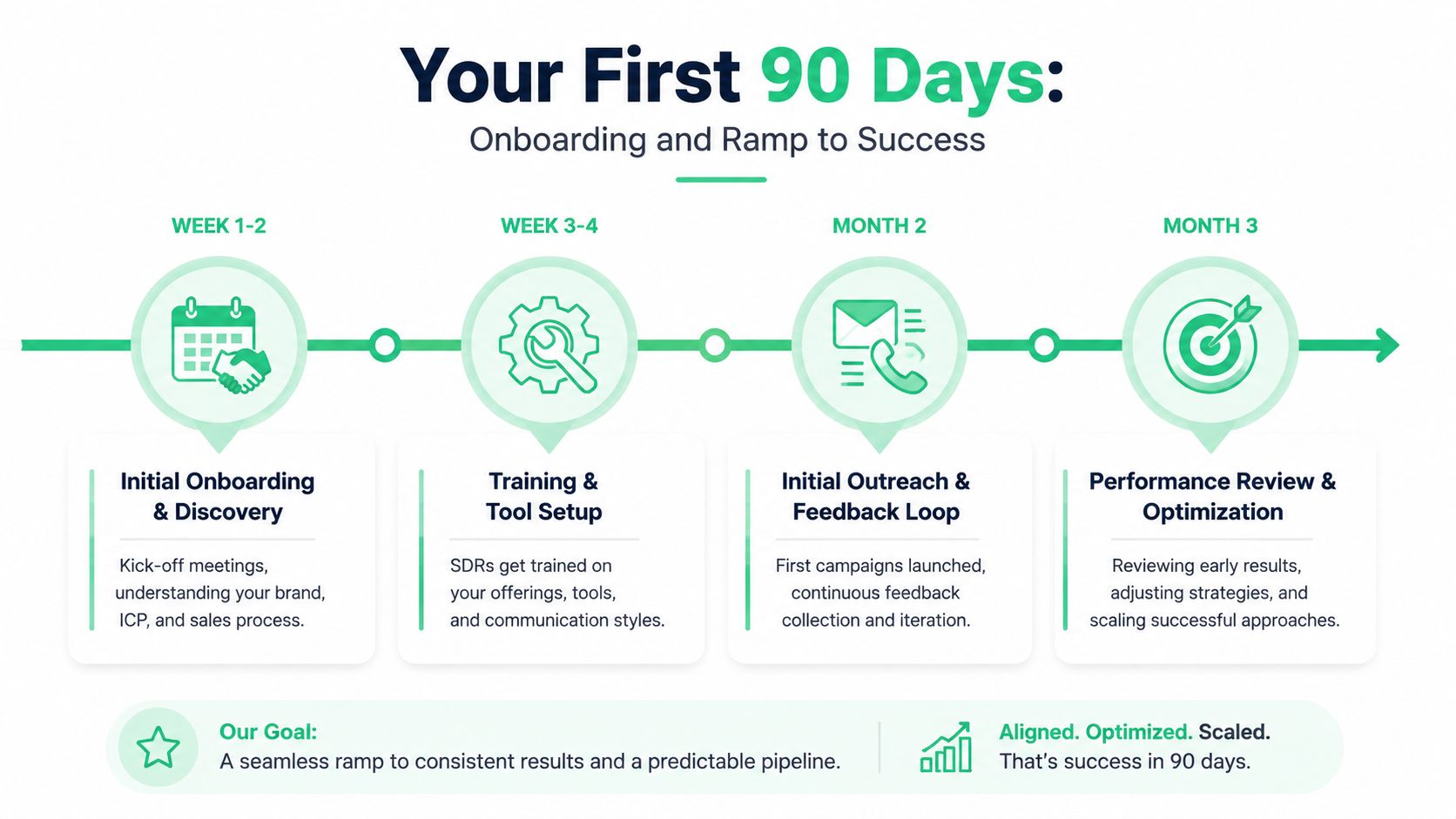
Your job in month one is simple. Remove ambiguity.
The vendor needs access to your systems, a sharp definition of who should never be contacted, examples of real buying signals, and a clear standard for what counts as a qualified meeting. If they work outside your CRM, send updates in slide decks, or hide activity in their own dashboards, stop that immediately. You need one shared operating view.
This guide to vendor onboarding mastery is a useful reference if your internal onboarding process is messy or spread across too many people.
Set up these four things before outbound volume ramps:
Days 31 to 60 are for quality control, not celebration.
A few meetings on the calendar prove almost nothing. Review every early meeting with your AEs. Which ones had real pain? Which ones were curious but irrelevant? Which ones should have been disqualified before they ever hit a rep's calendar? If your vendor reports activity totals before they report accepted meetings and pipeline progression, they are training you to look at the wrong scoreboard.
Silence kills outsourced SDR programs faster than bad copy. Reps optimize for whatever gets inspected.
By days 61 to 90, patterns should be obvious enough to make a hard call. You should know which personas reply, which offers create urgency, which objections repeat, and whether booked meetings are turning into qualified pipeline. If you still cannot answer those questions, the program is not early. It is poorly managed.
Use this 30-60-90 framework:
| Window | What should happen |
|---|---|
| First 30 days | Systems are live, targeting is approved, outreach starts, and early reply patterns show up |
| Next 30 days | Qualification gets tighter, weak messaging is cut, and AE feedback changes targeting and copy |
| Final 30 days | You judge accepted meetings, opportunity creation, and whether the program is on a real path to ROI |
At day 90, make an operator's decision. Expand what is producing qualified opportunities. Fix what is close but sloppy. Cut anything that survives on activity screenshots and booked-meeting bragging.
If the motion is working and you need to add capacity without defaulting back to the bloated agency model, Hire SDRs is one option for sourcing vetted talent fast.
Yes. That's often the smartest way to start. One solid rep with a clear manager and tight feedback loop beats a bloated pod nobody really supervises.
You don't need full-day overlap. You need one good overlap window and clean asynchronous communication. Daily updates, fast AE feedback, and a shared source of truth matter more than pretending everyone lives in the same city.
There isn't a universal number worth trusting. It depends on market size, ACV, sales cycle, offer strength, and how narrow your ICP is. If someone gives you a clean benchmark without understanding those variables, they're guessing or selling.
Swap fast. Don't spend weeks rationalizing weak performance. Good providers should have a clear replacement path and a clean handoff process.
Yes. Not forever in the weeds, but definitely through the early learning period. Founder insight sharpens messaging faster than any generic “industry playbook.”
Vanity metrics. The second a vendor steers every conversation back to activity volume and booked meetings, assume they are preparing to explain away poor pipeline quality later.
If you want the upside of outsourced sales development without the usual agency theater, hireSDR.io is worth a look. It helps founders and revenue leaders hire vetted SDRs and BDRs quickly, with month-to-month flexibility and global talent options that don't force you into bloated retainers or black-box reporting.

Your burn rate is loud. Your pipeline is not. You posted the SDR role, got a pile of polished résumés, hired someone local, paid a...

You're probably doing sales right now. Between product reviews, investor updates, and the Slack fire drill of the day, you're also writing cold emails, chasing...
You're probably here because local hiring feels like a bad joke. You post for an SDR, get a pile of mediocre applicants, spend weeks interviewing,...

Tell us who you need. We'll have pre-vetted candidates in your inbox within 72 hours. No commitment until you hire.