Your best Account Executive is doing detective work in Apollo, cleaning CSVs, and chasing no-shows instead of closing. Your pipeline has activity, sure, but the wrong kind. Lots of motion. Not enough revenue. Classic founder trap.
That's usually when outsourced SaaS sales enters the group chat.
I get why founders hesitate. “Outsourced sales” still sounds like a shortcut sold by someone with a shiny slide deck and a mysterious accent-neutral script. You imagine random meetings, bad-fit leads, and awkward handoffs where your closer opens the CRM and asks, “Why is this person even here?”
I've been there. I've hired the charming in-house SDR who interviewed like a future CRO and performed like a very motivated intern. I've also signed the black-box agency retainer that looked efficient until I realized I was paying for noise with calendar invites attached. Toot, toot.
The lesson was simple. Outsourcing sales isn't the problem. Outsourcing without a system is the problem. Done right, outsourced SaaS sales gives you flexible pipeline capacity, faster execution, and a cleaner path to scale. Done wrong, it becomes an expensive pen pal program.
The companies that win with outsourced SaaS sales usually start in the same place. Their closers are prospecting. Their founder is still rewriting outbound copy at midnight. Marketing says the leads are warm. Sales says they're fiction. Everyone is technically busy, which is the most dangerous stage because busyness looks a lot like progress from far away.
Then someone says, “Maybe we should outsource SDRs.”
Good instinct. Bad framing.
If you treat outsourcing like a cheap substitute for building a sales engine, you'll get exactly what you paid for. If you treat it like an operating model, things get interesting. One market forecast projects the outsourced sales service market will grow from USD 3.37 billion in 2026 to USD 4.89 billion by 2035, a 4.2% CAGR, which tells you this isn't some temporary panic move. It's becoming a real go-to-market category with established vendors and room for specialization in SaaS teams that need fast top-of-funnel capacity (outsourced sales market forecast).
The first mistake is assuming outsourced means hands-off.
It doesn't. It means someone else executes part of the motion, while you still own the strategy, messaging, ICP, and quality bar. If those are fuzzy, outsourcing won't save you. It will amplify the fuzziness at scale. Great. Now your bad positioning has a calendar link.
The second mistake is buying meetings instead of buying a process.
Practical rule: Never hire outsourced sales to “figure it out for you” unless you're comfortable paying tuition in missed pipeline.
You want a system that starts with a clear ICP, sharp buying signals, and a real handoff plan. Not “let's see who responds.” That approach belongs in 2019 with your “growth hacker” and Notion template stack.
The good version is boring in the best way. The outsourced team verifies data, runs outreach, qualifies urgency, books meetings with context, and routes qualified opportunities into your internal sales motion. That's not glamorous. It is effective.
And yes, there's still baggage around outsourced sales for a reason. Some of it is earned. But the answer isn't avoiding outsourcing. The answer is learning how to run it like an adult company.
Most founders talk about outsourced sales like it's one thing. It isn't. It's a menu. And if you pick the wrong model, you'll blame outsourcing when the actual issue was mismatch.
Here's the spectrum.
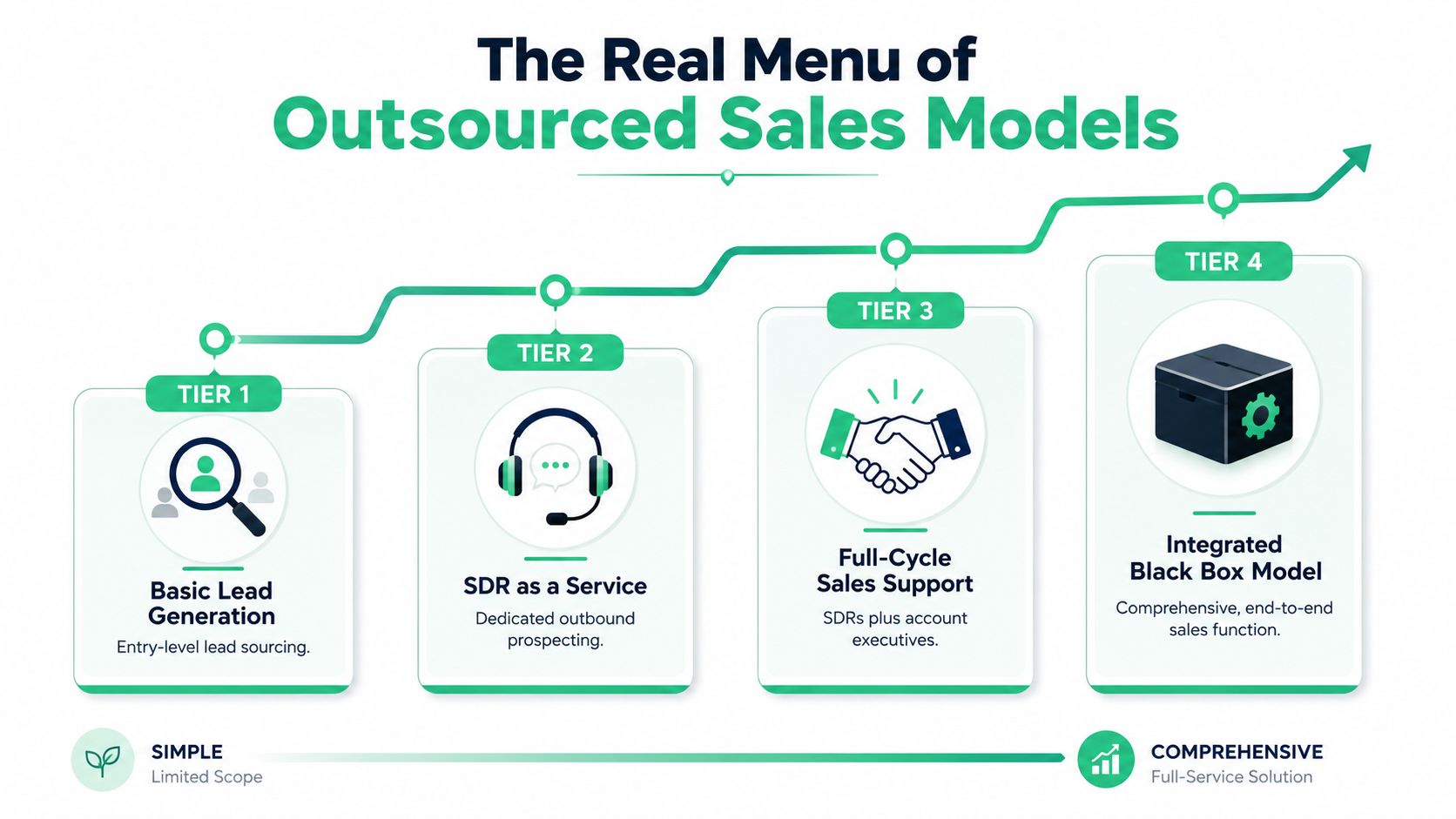
| Model | What you get | What works | What breaks |
|---|---|---|---|
| Black-box agency | A provider runs outreach and sends meetings | Fast launch, low internal lift | Weak visibility, generic messaging, shaky accountability |
| Freelancers | Individual SDRs or BDRs sourced independently | Flexibility, direct control | Inconsistent vetting, fragmented ops, management overhead |
| Curated marketplace | Pre-vetted reps you manage directly with sourcing and compliance handled | More control, cleaner hiring, easier scaling | Still requires onboarding discipline |
This is the “just give us the target market and we'll handle it” pitch.
Sometimes that works. Usually when your offer is simple, your market is broad, and you don't mind sacrificing control for speed. But most SaaS companies care a lot about messaging, handoffs, and brand nuance. That's where black-box setups get wobbly. You see meetings on the calendar, but not enough context on why they booked, what the buyer wants, or whether the rep is creating a future churn machine.
If you're hands-on about GTM, this model will make you itch.
Freelancers are the wild west. You can absolutely find killers there. You can also find someone whose entire “SaaS outbound experience” was sending fifty messages a day for a crypto startup that no longer exists.
The upside is direct management and flexibility. The downside is that you become the system. You source, vet, onboard, monitor, handle compliance questions, and fix performance drift. If you already have a strong sales manager and operational discipline, fine. If not, you've just created a part-time job for yourself.
This is the modern middle ground, and in my opinion, the most sensible option for a lot of startup and mid-market SaaS teams.
You still manage the rep like part of your team. But the sourcing, initial screening, and cross-border admin get handled for you. That matters more than people admit. The fastest way to waste a quarter is spending three weeks sorting through “experienced SDRs” who can't explain their own funnel metrics.
If you're evaluating outsourced inside sales teams, this is the bucket worth studying carefully.
Don't buy “outsourced sales.” Buy the level of control your team can actually support.
One more thing. Public projections show steady expansion in this category, not a hype spike. That matters. It suggests buyers are using outsourced sales as a repeatable operating model, not just a stopgap with a fancy invoice.
Most founders do outsourced sales math like this: “Agency costs less than hiring, so let's try it.”
That's lazy math.
You don't need cheaper activity. You need efficient pipeline creation. There's a difference, and it's expensive when you ignore it.
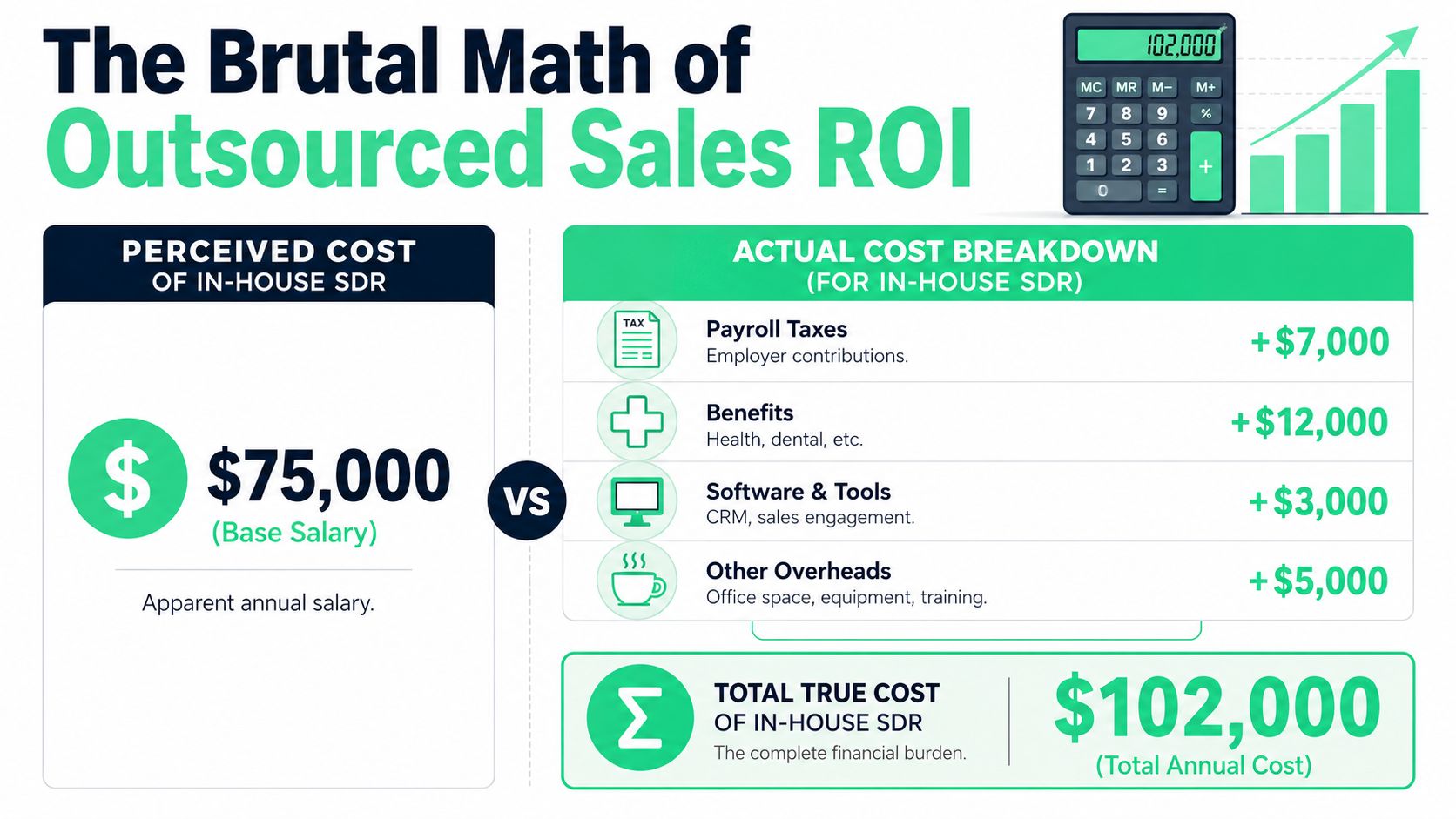
Independent industry commentary reports that companies using outsourced sales teams can reduce operating costs by 30% to 50%, achieve 63% faster lead response times, see a 72% improvement in lead quality, and spend 41% less on customer acquisition (sales outsourcing economics and response-time data).
Those numbers matter for SaaS because pipeline isn't just about volume. It's about speed-to-lead, qualification quality, and whether your closers spend their week with real buyers instead of polite tourists.
The same source notes outsourced inside sales reps can cost USD 25 to 30 per contact, compared with USD 300 to 500 for field salespeople. That gap explains why so many software companies moved toward remote SDR and BDR models for outbound execution. It's not only cheaper. It fits how SaaS selling operates.
A lot of “cheap” outsourced sales is expensive in disguise.
If the rep books junk meetings, your Account Executive pays the price. If the handoff is sloppy, your close rate drops. If the prospect wasn't qualified properly, your CRM fills up with fantasy pipeline. The invoice might look efficient. Your forecast won't.
Here's the cleaner lens.
If you want a more grounded view of hidden employment costs, this cost of employee breakdown is a useful reference point.
Good outsourced SaaS sales ROI looks like this:
Your internal closers stop doing entry-level prospecting. Outreach volume becomes consistent. Lead response gets faster. Qualification improves. Meetings show up with context. Forecast calls get less theatrical.
If your outsourced team creates activity but your closers still complain about junk, you do not have ROI. You have outsourced admin work wearing a sales costume.
That's the test. Not “did we save money?” but “did we create better pipeline per dollar and free our closers to close?”
Most of the market collapses at this juncture.
A SaaStr survey of more than 1,200 SaaS leaders found only 7% said outsourced SDRs worked well, while 26% said they “sort of worked” (SaaStr survey summary on outsourced SDR performance). That means mediocre is common and strong outcomes are rare.
That doesn't tell me outsourced sales is broken. It tells me vetting is usually terrible.
Founders love confidence. Sales people know this. Dangerous combination.
Start with the things that reduce execution risk.
If you want a marketplace-style option, hireSDR.io is one example that pre-screens SDR and BDR candidates for outbound, inbound, closing, English fluency, and cross-border compliance support.
Resumes are theater. Questions create stress. Stress reveals operating level.
Try these:
Walk me through a campaign that failed.
Good reps talk about list quality, messaging mismatch, timing, and what they changed next. Weak reps blame “bad leads” and wait for the next script.
Show me how you decide if a meeting is worth booking.
You're listening for judgment. Not enthusiasm.
Tell me about a product you had to learn fast.
If they can't explain how they learn positioning, use cases, and objections, they'll struggle in your motion.
What numbers did you own directly?
If they can't describe their metrics clearly, they probably didn't own them.
Some misses are fixable. These usually aren't.
| Red flag | Why it matters |
|---|---|
| You can't meet the actual rep before signing | You're buying a promise, not a person |
| They avoid specifics on prior campaigns | They may have followed scripts without owning outcomes |
| Everything sounds “full-cycle” | Broad claims often hide shallow skill depth |
| They resist your CRM process | Sloppy data kills outsourced sales faster than bad copy |
Founder filter: If a provider sells you certainty before asking sharp questions about your ICP, they're selling confidence, not competence.
You need to vet outsourced reps with more rigor, not less, than in-house hires.
That feels backwards until you remember what's at stake. You're asking someone outside your walls to represent your product, your team, and your first impression in market. This is not the place for hopeful shortcuts.
A strong hire can still fail in a weak system. That's why the first stretch matters more than the contract.
Many providers say they can deliver qualified meetings in 30 to 60 days, and strong teams watch weekly metrics like reply rate, meeting-booked rate, and show rate, with 85%+ show rates cited as a top benchmark (qualified meeting timelines and show-rate benchmark). That benchmark is useful because it forces you to care about meeting quality, not just booking volume.
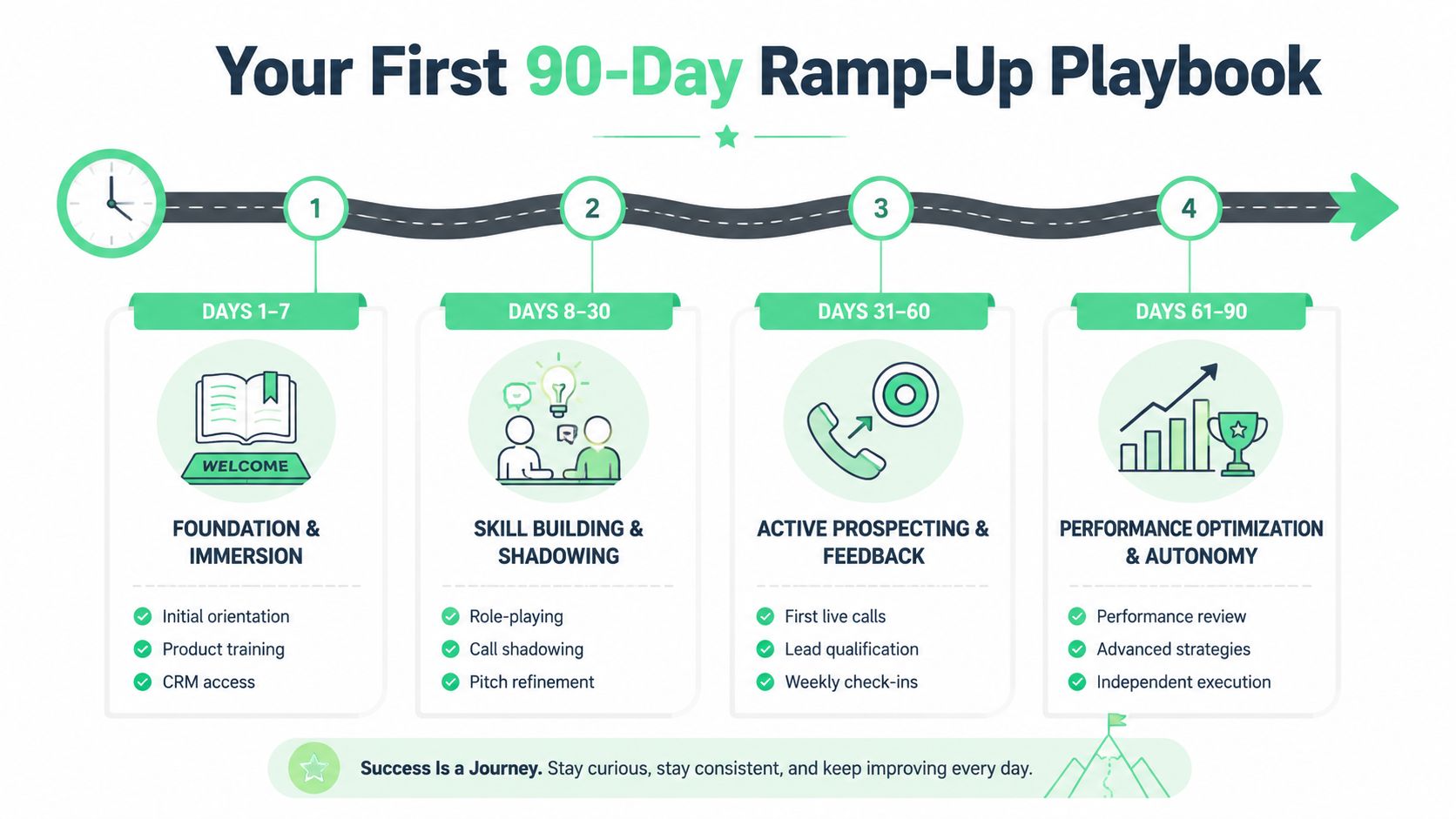
The first week is for immersion, not “light onboarding.”
Give them access to your CRM, product demos, objection notes, recorded calls, customer stories, and current outbound sequences. Make them explain your ICP back to you in plain English. If they can't, don't let them touch prospects yet.
Your rep should leave week one knowing:
Here, training turns into muscle memory.
Run role plays. Review emails in Google Docs. Listen to calls together. Tighten the opener. Tighten the CTA. Tighten the qualification standard. You're looking for consistency before scale.
A simple operating rhythm works well:
| Weekly touchpoint | What to review |
|---|---|
| Daily async updates | Activity, blockers, notable replies |
| Weekly 1:1 | Messaging, objections, funnel quality |
| Pipeline review | Which booked meetings progressed and why |
| Sequence review | Where copy, targeting, or timing is breaking |
For teams trying to sharpen execution, this guide on improving sales productivity is a practical companion.
Now they go live at real speed.
This is not the moment to vanish and “let them cook.” Review targeting, reply quality, call notes, and meeting context every single week. The rep should be generating enough signal for you to spot patterns. Maybe the list is right and the copy is wrong. Maybe the emails work but the call opener falls flat. Maybe meetings book but no-shows creep in.
Fix the bottleneck you can see. Don't rewrite the entire playbook every Friday because one founder had a bad espresso.
A great outsourced rep with a bad onboarding process won't become strategic. They'll become confused, polite, and expensive.
By this stage, autonomy should increase and supervision should get sharper, not louder.
The rep should own their workflow, surface issues early, and understand which meetings deserve escalation. Your focus shifts from “are they active?” to “are they creating qualified pipeline and clean handoffs?”
Use a simple scorecard:
If those are improving, the machine is working. If they aren't, don't hide behind activity metrics. Activity is what people point to when outcomes are awkward.
Outsourcing is not a personality trait. It's a timing decision.
Some companies should outsource now. Some should wait. Some should keep top-of-funnel external and everything downstream internal. If you don't know which bucket you're in, use a litmus test instead of vibes.
You're still changing target market every two weeks. Your founder pitch changes depending on caffeine levels. Your CRM is messy. Nobody agrees on what counts as qualified. In that situation, outsourced SaaS sales won't create clarity. It will expose the absence of it.
Outsourcing works best when you already know what “good” looks like and need more of it.
This is the more interesting question.
Some providers can handle more of the sales cycle, including technical and commercial discussions, trials, and framework-agreement stages. But that move requires deeper product knowledge, stronger onboarding, and tighter governance, especially in enterprise SaaS (strategic guidance on expanding outsourced SaaS sales beyond prospecting).
My opinion is simple. Expand outsourced scope only when the motion is narrow enough to control.
For example:
If your team still argues about pricing logic on internal calls, don't outsource demos. Fix home first.
The biggest mistake is treating outsourced reps like a disposable utility. They're not a Zapier workflow. Put them in Slack. Invite them to pipeline reviews. Let them hear customer language directly. If they're good enough to represent you to prospects, they're good enough to hear what your company sounds like.
The second trap is paying for meetings without caring what happens after the meeting. That compensation structure invites calendar stuffing. Tie incentives to downstream quality, not just booked volume.
The third trap is founder absenteeism. People outsource because they want to amplify their efforts. Fair. But “set it and forget it” is how decent reps turn into confused order-takers. You still need weekly review, message refinement, and handoff scrutiny.
I've made all three mistakes. Most founders do once. The smart ones only do them once.
If you need outsourced SaaS sales capacity fast, hireSDR.io is built for founders and revenue teams that want pre-vetted SDR and BDR talent, cross-border hiring support, and a quicker path from “we need pipeline” to actual outreach.
You need more pipeline. Your calendar says “growth.” Your bank account says “please relax.” So you do what every founder does at some point: open...

Your global talent search is broken. Let's fix it. A founder posts an overseas role on Monday, gets 86 applications by Friday, and still has...

Your first marketing hire will probably be wrong. That's not an insult. It's a rite of passage. Founders love writing fantasy job descriptions for a...

Tell us who you need. We'll have pre-vetted candidates in your inbox within 72 hours. No commitment until you hire.