
You know this movie.
A candidate walks in with the polished resume, the familiar logos, the neat little ladder of “progression,” and everyone in the interview loop relaxes. Must be good. Look at the pedigree. Look at the titles. Look at the years.
Then they start the job and suddenly your “can't-miss” hire can't write a decent cold email, can't handle rejection, can't learn your pitch, and can't turn activity into pipeline. Now your manager is babysitting. Your team is covering gaps. Your forecast gets weird. And you're left wondering how someone who looked so right on paper could be so wrong in the seat.
That's the problem skills-based hiring is trying to fix.
If you're searching for what is skills based hiring, the short version is simple: it means hiring people based on demonstrated ability, not resume theater. For SDRs and other revenue roles, that matters a lot because the job isn't theoretical. They either prospect well, communicate clearly, stay coachable, and execute consistently, or they don't.
I've seen this too many times with sales hires.
Someone has the “right” background. Maybe they came from a known SaaS brand. Maybe they have the right degree, the right buzzwords, the right LinkedIn profile photo where they somehow look both hungry and enterprise-ready. Everyone nods. Offer goes out. A few weeks later, you realize you bought a story, not a performer.
That isn't bad luck. That's a broken filter.
Traditional hiring treats resumes like evidence. Most of the time, they're just proxies. A degree is a proxy. A past title is a proxy. Years of experience are proxies. Sometimes those proxies point to capability. Plenty of times they don't.
For SDR hiring, this gets expensive fast. The role is repetitive, high-pressure, and brutally clear in its demands. Can this person handle rejection? Can they personalize outreach without turning it into creative writing hour? Can they take feedback without spiraling? A resume can hint at those things. It can't prove them.
Good companies lose good candidates because they're still hiring for credentials that look safe instead of skills that actually drive performance.
The shift is already underway. TestGorilla's 2025 data shows 85% of companies are using skills-based hiring, up from 73% in 2023, and SHRM found that 27% adopted it in just the previous 12 months, which points to a real structural change rather than a passing trend, according to SHRM's analysis of the rise of skills-based hiring.
That matters because it changes the baseline. This isn't an experimental HR side project anymore. It's becoming normal hiring behavior.
Skills-based hiring means defining the actual skills needed for success in a role, then evaluating candidates against those skills directly. Not vibes. Not logo collection. Not “I just have a good feeling about them.”
For an SDR, that usually means things like:
If you're tired of expensive hiring mistakes, stop asking whether the resume looks impressive and start asking whether the candidate can do the work.
Credential-based hiring is the old game. Skills-based hiring is the adult version.
Consider the example of hiring a pilot. Credential-based hiring says, “Great school, right certifications, nice career path, welcome aboard.” Skills-based hiring says, “Fine. Now get in the simulator.”
One approach bets on proxies. The other looks for evidence.
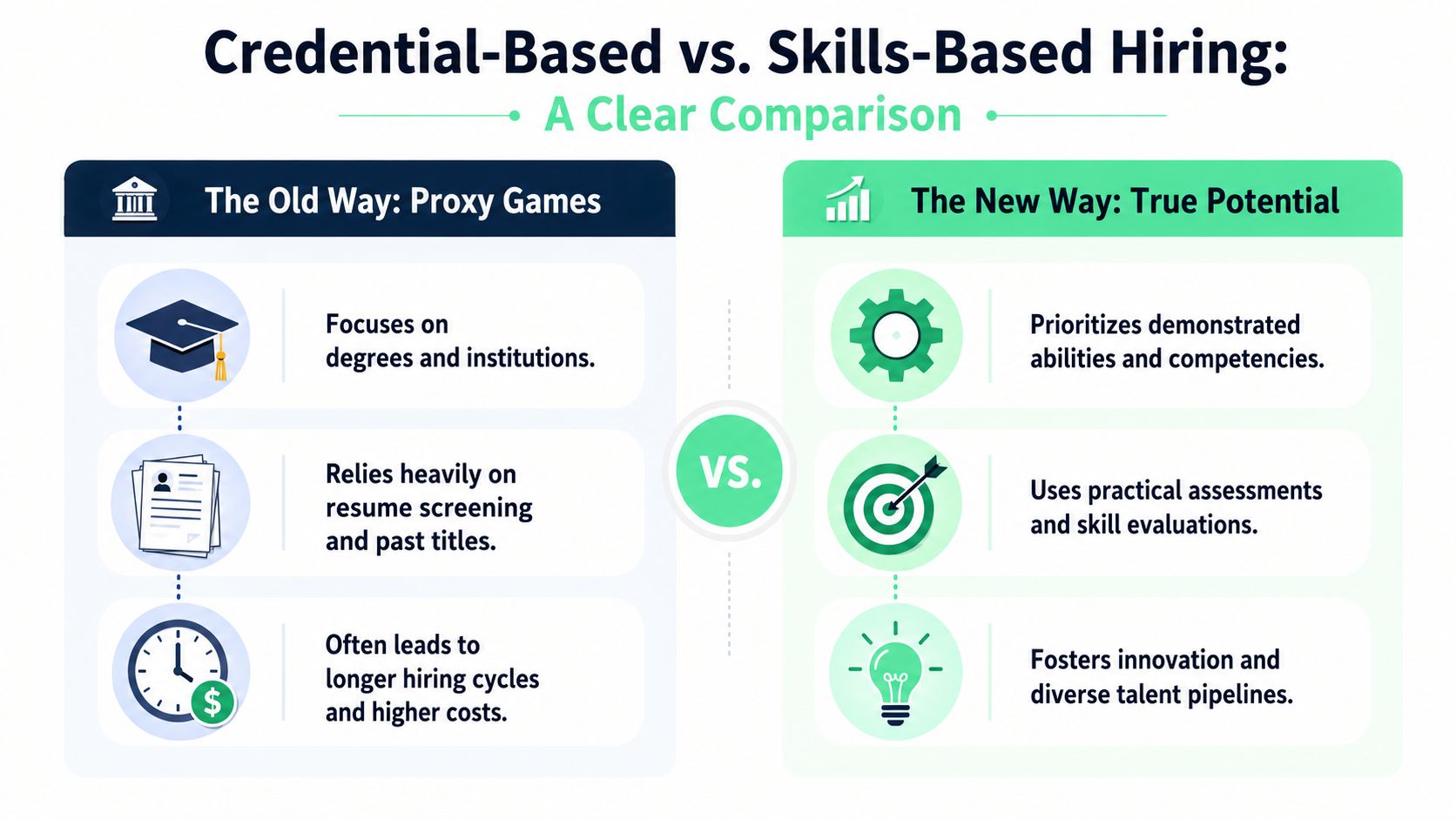
Credential-based hiring leans on signals that feel efficient:
Those things aren't useless. They're just weak substitutes for actual capability. Hiring managers use them because they're easy to scan, easy to compare, and easy to defend in a meeting.
“Why did we hire this person?”
“Well, they checked all the boxes.”
That sentence has launched a lot of regrettable hires.
Skills-based hiring starts with the role, not the resume. What does someone need to do well here, in this seat, with this manager, under these conditions?
Then you test for that.
According to operational guidance summarized by Pin's breakdown of skills-based hiring, the process usually involves defining 3 to 8 core skills per role, replacing early resume filtering with a skill gate, and scoring candidates against the same observable criteria. That's what makes it more repeatable and less biased.
Here's the simplest comparison:
| Hiring style | Main signal | Core question | Typical risk |
|---|---|---|---|
| Credential-based | Degree, title, tenure | “Do they look qualified?” | Confusing pedigree with performance |
| Skills-based | Work sample, structured interview, rubric | “Can they do this job well?” | Poor implementation if the process is sloppy |
If you want a practical example of how revenue teams structure this, skills-based SDR hiring workflows show the difference clearly.
The strongest argument isn't philosophical. It's predictive.
BCG reports that a skills-based hire is five times more likely to predict job performance than an education-based hire, as cited in NACE's coverage of skills-based hiring for entry-level roles.
That's the point. You're not trying to reward someone for having the right backstory. You're trying to predict whether they'll perform.
Practical rule: If a requirement can't be tied to actual on-the-job success, it probably doesn't belong in the hiring process.
Your VP Sales wants headcount. Your recruiters say the pipeline is full. Then three months later, one new SDR is gone, one never ramped, and one looked great on paper but couldn't write a decent cold email. Finance gets the bill for all of it.
CFOs care about that bill. They care about hiring methods that reduce waste, fill revenue seats faster, and lower the odds of paying twice for the same role.
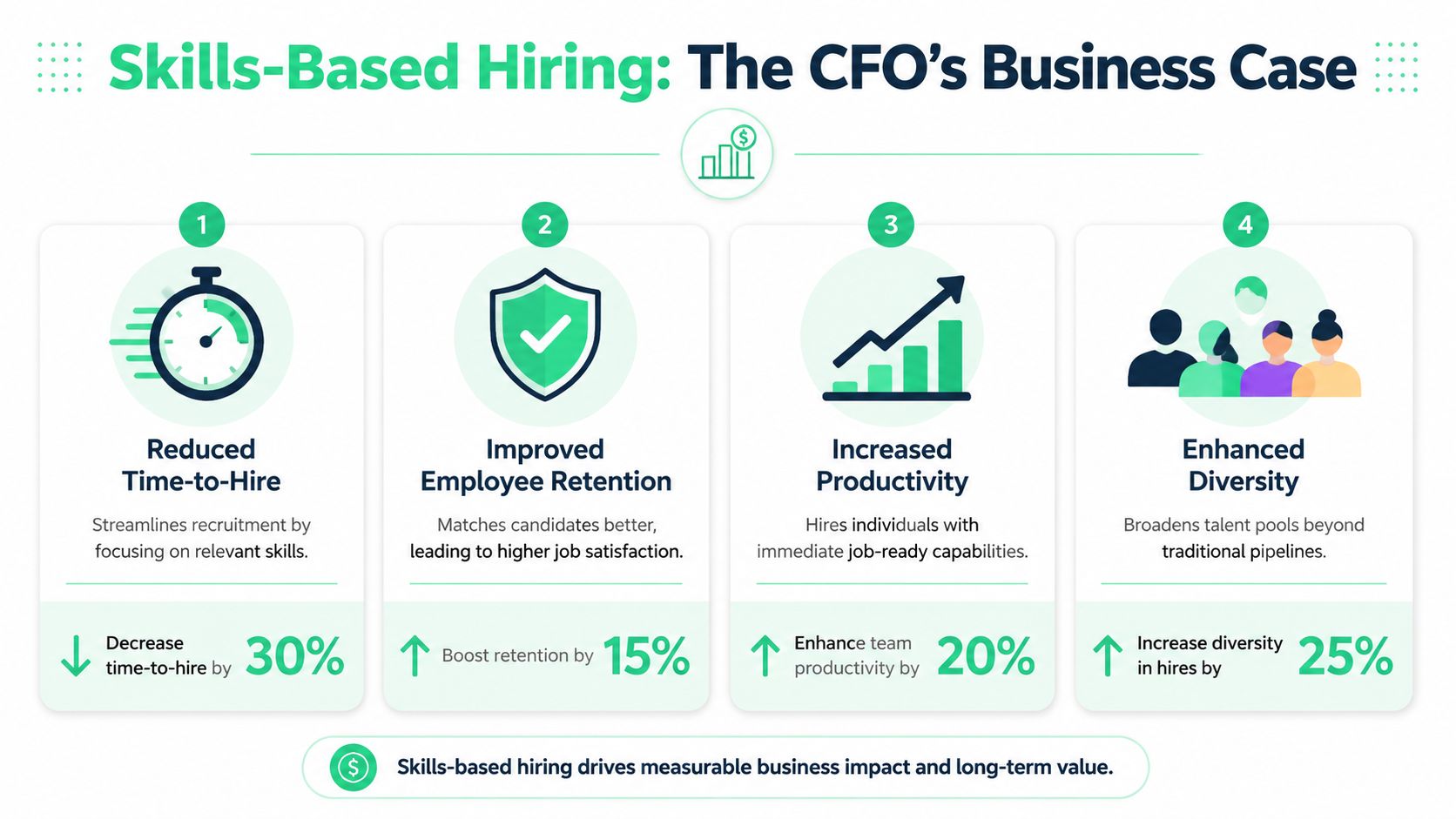
Skills-based hiring gives you more shots on goal.
Industry reporting summarized by Testlify's skills-based hiring statistics found that dropping degree filters can expand the talent pool nearly 19 times, open access to more than 70 million capable U.S. workers, reduce time-to-hire by up to 50%, cut mis-hires by 88%, and improve retention, with skills-based hires staying 9% longer.
That matters a lot in SDR hiring. Strong entry-level sales talent often comes from retail, hospitality, customer support, athletics, recruiting, or founder-led side projects. Resume screens miss these people because they do not match the usual template. A work sample catches them fast.
Your standard should stay high. Your filter should get smarter.
A bad SDR hire is expensive in ways recruiting dashboards rarely show. Salary is the obvious piece. The bigger hit comes from onboarding time, manager attention, sales tools, lost meetings, missed pipeline, and the time spent reopening the role.
If you've ever looked closely at the full cost of an employee, the case is simple. Hiring for proven ability is cheaper than hiring for polish and replacing people who cannot perform.
This is why CFOs tend to support skills-based hiring once the process is concrete. It replaces vague judgment with signals tied to output.
This approach is especially useful in high-turnover, high-impact roles. SDRs affect pipeline early, wash out quickly when the fit is wrong, and show their strengths or weaknesses fast.
A finance leader does not need a theory-heavy explanation. They need to know whether your process helps you:
That is the pitch.
Skills-based hiring is not an HR branding exercise. For SDR teams, it is a practical way to protect budget, improve output, and stop paying premium prices for resumes that never turn into pipeline.
Organizations often screw this up by making it either too loose or too complicated. Too loose means “we added one roleplay question and called it skills-based.” Too complicated means a giant competency matrix nobody uses.
Keep it tight. Four steps.
Don't start with a job description. Start with the work.
For an SDR, I'd usually identify a small set of essential requirements:
Written communication
Can they write clearly, briefly, and persuasively?
Coachability
Do they improve after feedback, or defend their first draft like it belongs in a museum?
Resilience
Can they handle repetitive rejection without losing energy?
Research and relevance
Can they find enough context to tailor outreach?
That's enough to build around. You do not need a 25-skill taxonomy for an entry-level sales role. That way lies nonsense.
A real test beats a clever interview.
Give the candidate a short brief. Example: “Here's our product one-pager and a target persona. Write a three-touch outbound email sequence and record a short voicemail.” That's job-relevant, fast to review, and hard to fake.
According to AIHR's guide to skills-based hiring, companies most often use skills-based techniques during interviewing (87%) and screening (65%), but the key is using them as part of a system rather than as a one-off add-on. That's exactly right. The test is useful because it sits inside a repeatable process.
Most hiring funnels still do this backward. Resume first. Calls second. Real evidence later.
Flip it.
Use a lightweight skill gate early, before your team burns time on long intro calls with people who merely look qualified. This is especially helpful when applicant volume is high or when the role attracts candidates with wildly mixed backgrounds.
A resume tells you where someone has been. A work sample tells you what they can do on Tuesday morning.
If three interviewers all use different standards, you don't have a hiring process. You have organized improvisation.
Use a rubric with observable criteria. For an SDR email task, you might score:
Keep scoring simple. Use the same rubric for everyone.
If your team doesn't have the bandwidth to build and run this consistently, use tools or services that already structure the process. That can include ATS workflows, assessment platforms, or specialized recruiting partners.
One example is outsourced SDR recruiting, where candidates are pre-screened through a defined evaluation flow rather than handed over as a pile of resumes. The value there isn't magic. It's process consistency.
That's what most hiring teams are missing.
Theory is cute. Templates are better.
If you want to use skills-based hiring tomorrow, start by rewriting the job ad, then give candidates a work sample, then score it with a plain-English rubric. Done.
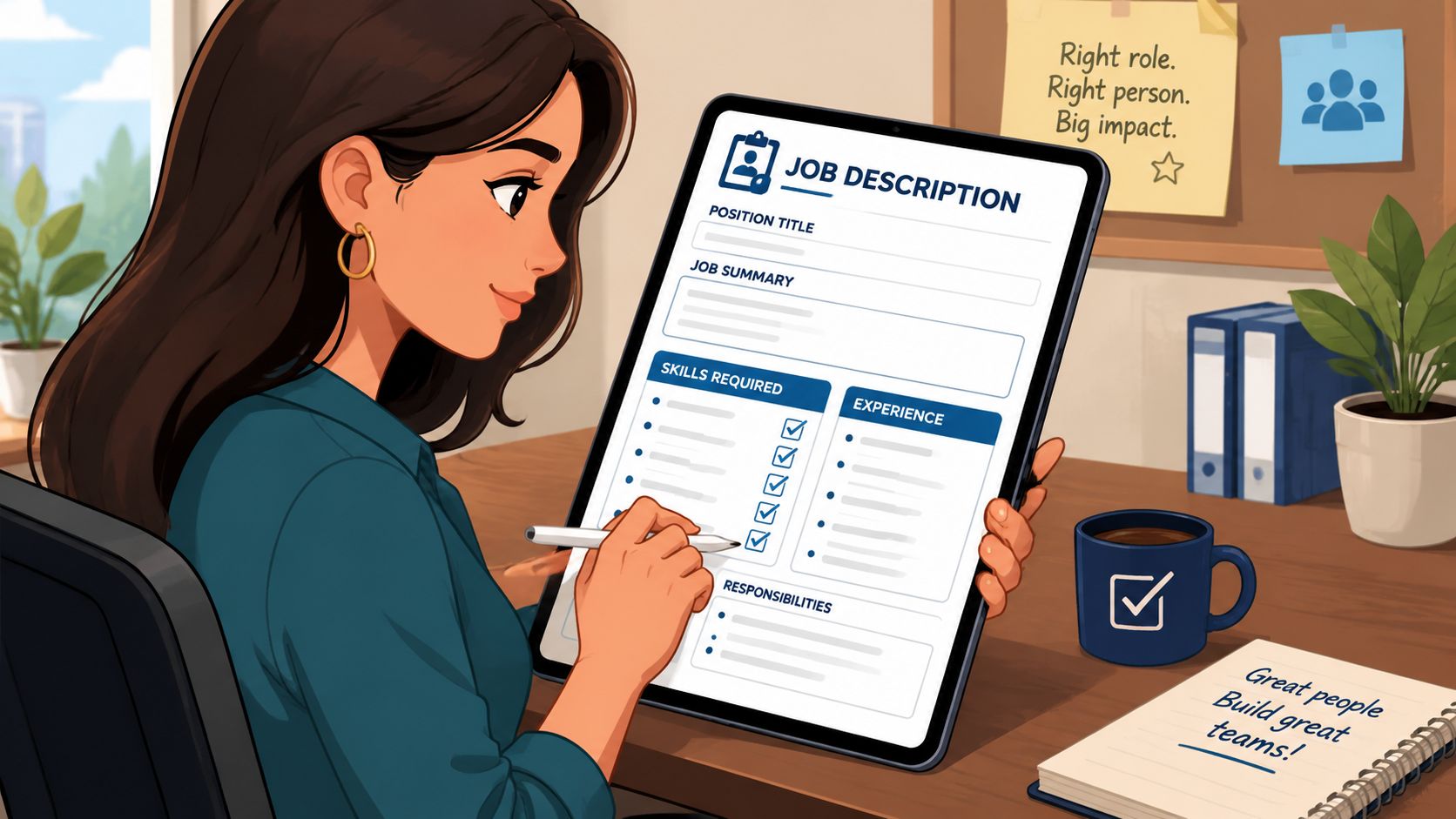
Most SDR job posts read like ransom notes assembled by committee. “Must have 2 to 3 years of SaaS experience, bachelor's degree preferred, strong communication skills, entrepreneurial mindset, self-starter, team player, strategic thinker.” Nobody knows what that means.
Try this instead:
Role
Sales Development RepresentativeWhat you'll do
Prospect target accounts, write outbound messages, qualify interest, and book meetings for Account Executives.What success looks like
You communicate clearly, learn fast from feedback, stay consistent under rejection, and can tailor outreach to different buyer profiles.What we'll evaluate
Written communication, research ability, coachability, verbal clarity, and consistency of execution.What we won't over-index on
Specific degrees, perfect title history, or whether your resume looks like everyone else's.
That tells adults how they'll be judged.
Here's a simple SDR assessment you can send in one email:
This tests writing, research, adaptation, and coachability in a format that mirrors the job.
| Skill area | What good looks like | What weak looks like |
|---|---|---|
| Written communication | Clear, concise, easy to scan | Wordy, vague, awkward |
| Personalization | Uses relevant account context | Generic filler with token customization |
| Value framing | Connects message to buyer pain | Talks about product without relevance |
| Coachability | Improves materially after feedback | Ignores feedback or makes cosmetic edits |
You don't need fancy language. You need consistent judgment.
If your interview team can't explain why one candidate scored higher than another, the process is still running on gut feel.
Skills-based hiring is better than credential screening. It's not automatically good.
Teams still mess it up all the time, usually because they bring old habits into a new framework and call it innovation. That's how you end up with a process that sounds modern but still produces the same bad decisions.
A lot of companies remove degree requirements, then immediately overvalue “worked at Salesforce” or “came from a top startup.” Congratulations. You replaced one prestige filter with another.
The fix is obvious. Score the work, not the logo.
Some leaders hear “skills-based” and build an elaborate framework worthy of a government procurement process. They define too many competencies, create too many interview stages, and bury the hiring team in admin.
The result is predictable. Nobody follows it properly.
Use a small, role-specific skill set. Especially for SDRs. You're hiring for a focused execution role, not selecting a new pope.
For SDR hiring, teams often over-test the visible stuff, like email writing or product recall, and under-test the traits that decide survival. Coachability. Consistency. Resilience. Those aren't fluffy extras. They're part of the job.
If you don't test for them, you'll hire people who can perform in an interview and unravel in the actual seat.
Legal and operational trouble can emerge. The approach requires more rigor than people assume. Public summaries note that skills-based hiring involves creating job profiles, defining the relevant skills for each role, and using a legally compliant process for setting levels and assessments, as explained in Wikipedia's overview of skills-based hiring.
That's why partial adoption is so common. Teams like the idea, then underestimate the discipline.
Here's the short version of what to avoid:
The one-sentence fix for all of it is this: define the role clearly, test only what matters, and evaluate everyone the same way.
A rep misses quota for three straight months. Pipeline stalls. Your top AE starts complaining about lead quality. Then you look back at the hire and realize the decision was built on a polished resume, a good school, and an interview process with no real test of the job.
That is the cost of getting SDR hiring wrong.
Skills-based hiring gives you a cleaner way to make the call. For revenue roles with high turnover and fast feedback loops, that matters even more. SDR performance shows up quickly. The wrong hire burns manager time, weakens pipeline coverage, and creates avoidable churn. The right hire earns trust fast and starts producing.
So stop obsessing over the definition of skills-based hiring and focus on the only question that matters: does your process predict performance in the actual seat?
If you want a practical starting point, keep it tight. Choose one role. Define the few skills that drive success. Build one work sample that mirrors real work. Score every candidate with the same rubric. That is how you improve hiring quality without turning the process into theater.
Companies that do this well do not look smarter. They hire better.
And here is the blunt truth. Pedigree feels easier to defend in a meeting. Proof gives you better odds of making the right hire.
If you're ready to apply that discipline but do not have the internal bandwidth to build and run it yourself, there are services built for that.
If you want help putting this into practice for SDR hiring, hireSDR.io gives teams a way to review candidates who've already been screened for role-relevant sales skills instead of starting with a pile of resumes and a prayer.

You need more pipeline. Your calendar says “growth.” Your bank account says “please relax.” So you do what every founder does at some point: open...
You're probably here because local hiring feels like a bad joke. You post for an SDR, get a pile of mediocre applicants, spend weeks interviewing,...
The common 1.25x to 1.4x salary rule is a myth. In practice, an employee's actual cost is often closer to 1.5x to 2.5x salary, especially...

Tell us who you need. We'll have pre-vetted candidates in your inbox within 72 hours. No commitment until you hire.