
Most advice on the candidate screening process is backwards. It tells you to polish the job post, skim resumes faster, and trust your gut in interviews. That's cute. It also explains why so many SDR hires flame out after a few months and leave you with a bloated CRM, a sad pipeline, and one manager muttering about “ramp issues.”
If you're hiring SDRs, you are not filling a seat. You're building the front end of your revenue engine. That means your screening process can't behave like a polite admin workflow. It has to act like a filter for signal, grit, communication, and legal reality. Especially if you're hiring globally.
Teams often miss the obvious part. They screen for skills first, personality second, and compliance last. That's the wrong order for distributed SDR hiring. You need all three running together, or you end up falling in love with a candidate you can't legally or operationally hire. Hope you enjoy spending your afternoons fact-checking resumes and untangling payroll surprises, because that's now your full-time job.
Your current candidate screening process probably feels efficient because it moves candidates from application to interview. That isn't the same thing as predicting success. It just means you're good at moving PDFs around.
The ugly truth is simple. According to Leadership IQ, 46% of newly hired employees fail to succeed in their new roles within the first 18 months, primarily because soft skills, cultural fit, and work ethic were missed during screening. That's not a rounding error. That's a coin flip with a payroll login attached.
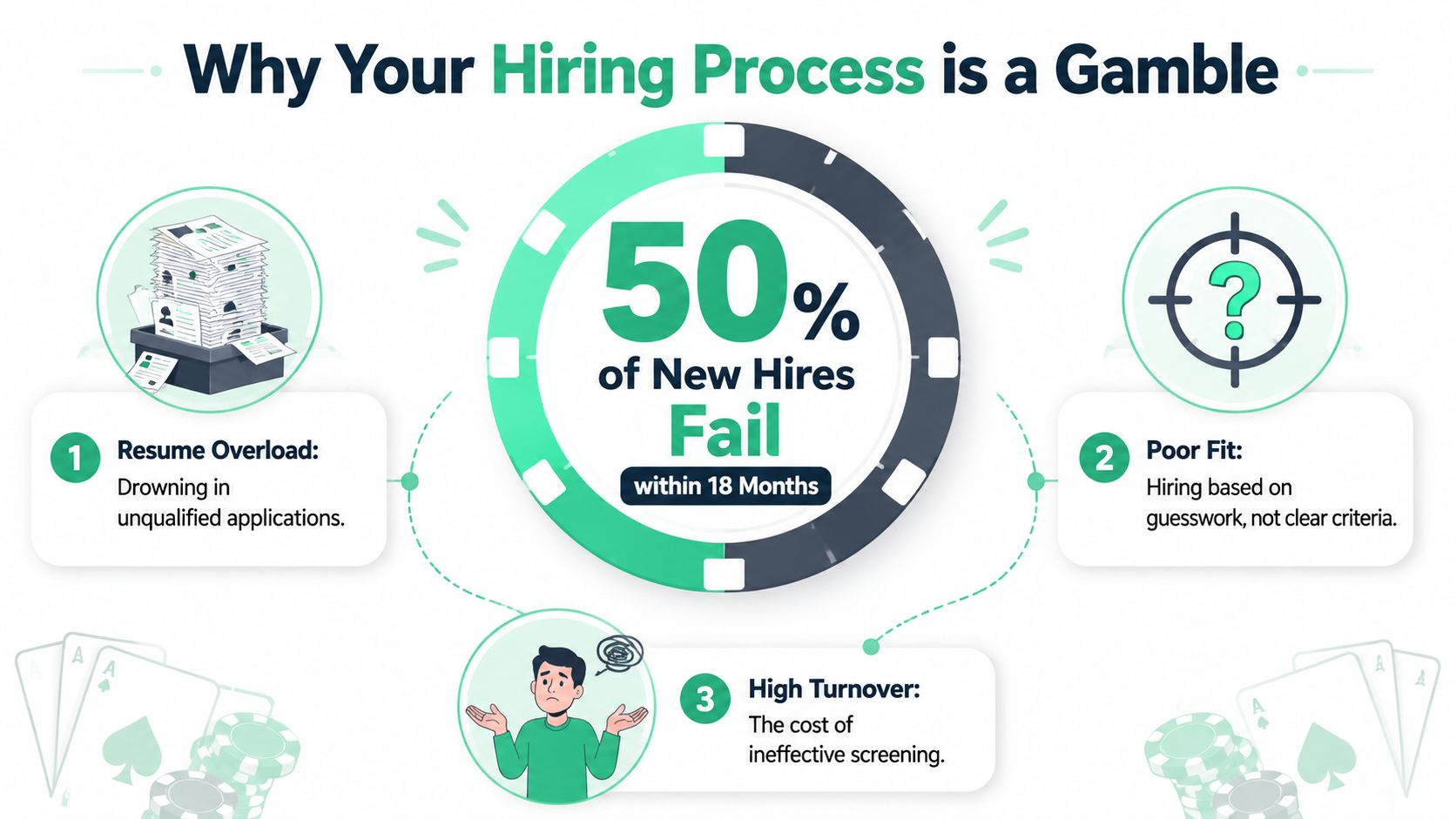
Founders love saying they hire for talent. Then they review resumes like they're reading tea leaves.
An SDR role exposes weak screening faster than almost any other job. The work is measurable, repetitive, rejection-heavy, and brutally unforgiving of low initiative. A candidate can look polished on paper and still freeze on a cold call, crumble under feedback, or disappear when the list runs dry.
Practical rule: If your screening process doesn't test behavior under pressure, you're not screening. You're browsing.
The smartest thing you can do is stop pretending a tidy career story predicts outbound performance. It doesn't. You need evidence that the person can communicate clearly, stay coachable, and keep moving after ten bad calls in a row.
A failed SDR hire doesn't just cost recruiting time. It stalls pipeline creation, drains manager bandwidth, and poisons team morale. One weak rep can turn your top closer into a therapist and your sales manager into a babysitter.
That's why retention and screening belong in the same conversation. If you're cleaning up churn after the hire, you're already late. This situation makes practical resources like Benely HR solutions for retention useful, because retention isn't some separate HR topic. It starts with who you let through the gate.
Here's the position, plain and simple:
Most hiring advice wants to sound balanced. I don't. If nearly half of new hires fail because the screening missed the obvious human stuff, then the traditional candidate screening process isn't “imperfect.” It's broken.
The biggest lie in recruiting is that the process starts with a resume. It doesn't. It starts with noise.
You post an SDR role and get a pile of applications from people who once sent one cold email, watched two sales podcasts, and now call themselves “pipeline builders.” Then your team spends days sorting through fantasy fiction in PDF form. Great system.
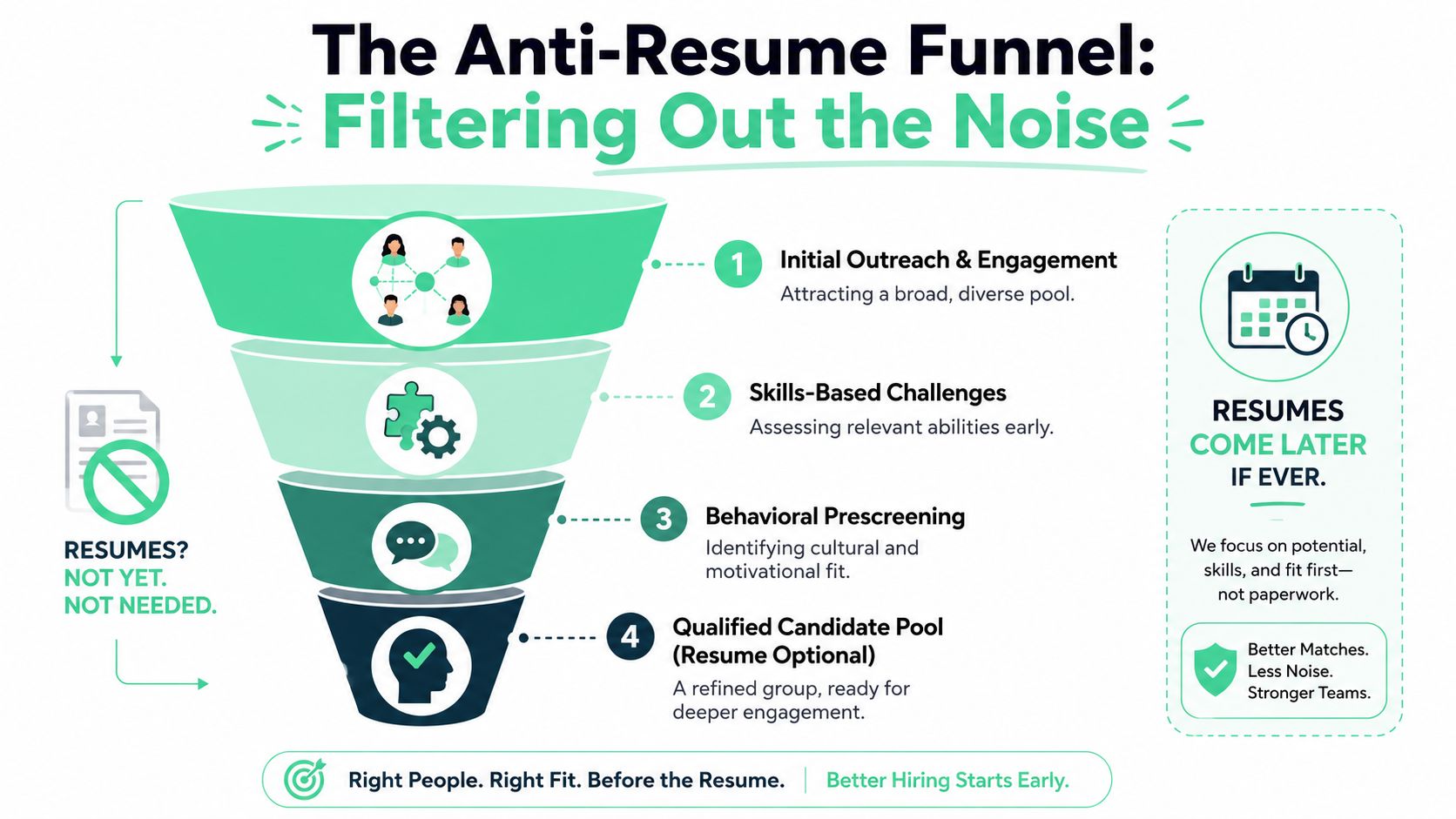
A real candidate screening process for SDRs should begin before anyone reads a resume. Pre-screening exists for a reason. As AIHR's explanation of applicant screening lays out, pre-screening is the automated phase that filters out people who don't meet minimum qualifications before the hiring team gets involved.
That's the right idea. Teams often stop too early and trust keyword filters to do the hard part.
Use knockout questions first. Not vague ones. Hard ones.
If someone fails a mandatory requirement, reject fast. Kindly, but fast. Dragging them into more steps helps nobody.
The broad hiring funnel is absurdly wasteful. For every 100 candidates who enter a typical screening funnel, only about 12 are shortlisted for interviews, and just 1 ultimately accepts the offer. This 1% final acceptance rate from the initial pool shows that most of the process is spent eliminating unqualified applicants.
That should annoy you.
You're not running a talent strategy. You're operating a rejection factory. This is exactly why resumes should move later in the process, not earlier. If you want a good breakdown of why documents miss the full story, Talent Pronto's piece on what documents can't reveal in hiring is worth your time.
Here's the anti-resume funnel I recommend:
| Stage | What you use | What you're checking |
|---|---|---|
| Entry gate | Knockout questions | Minimum viability |
| Signal test | Short skills task | Basic execution |
| Verbal filter | Brief screen call or voice response | Clarity and energy |
| Resume review | Selective, late-stage | Context only |
Most “best practices” unravel at this point. They claim to support skills-based hiring, then still let the resume decide who gets tested.
Don't do that. Put the test first.
A simple SDR entry task works better than an hour of resume review. Ask for a short outbound email, a quick reply to an objection, or a recorded intro explaining how they'd open a cold call. That gives you signal. Resume bullets give you adjectives.
If you want the broader case for this model, here's a useful primer on skills-based hiring.
The goal isn't to process applicants faster. It's to stop wasting human attention on the wrong people.
The anti-resume funnel isn't anti-information. It's anti-noise. Big difference.
Once you've cut the noise, you need assessments that look like the job. Not a generic personality quiz. Not a riddle about golf balls fitting in a school bus. And definitely not one of those assessments that produces a twelve-page report telling you the candidate is “strategic yet collaborative.” Astonishing.
Use tasks that mimic SDR work.

The right assessment tells you whether a candidate can think, write, and recover in real time. That's the job.
Try this mix:
Each one catches a different failure mode. The cold call tests verbal confidence. The email task tests clarity and relevance. The scenario test catches people who only know sales buzzwords.
Hiring managers tend to get sloppy at this point. They say things like “I liked their energy” or “they seemed sharp.” That's not a rubric. That's caffeine.
Structured screening methods reduce bias by 30-40% compared to unstructured reviews because they focus on job-relevant signals. A key metric is the interview-to-hire ratio, which averages 27% with effective screening, versus less than 10% in unoptimized processes.
Use a simple scorecard:
| Skill area | What good looks like |
|---|---|
| Communication | Clear, concise, no rambling |
| Coachability | Adjusts after feedback without getting defensive |
| Objection handling | Stays calm, answers directly |
| Resourcefulness | Uses context, not canned scripts |
| Commercial judgment | Understands why the message should matter to the buyer |
You don't need twelve categories. You need a few useful ones and consistent scoring.
Field note: If two interviewers can't explain why they scored a candidate differently, your rubric is too vague.
Assessment design matters as much as assessment choice. Long, bloated processes kill momentum. Industry data in the verified research notes that prolonged processes can cause up to 89% of potential candidates to drop off. That's what happens when companies confuse “thorough” with “exhausting.”
My rule is simple. Make the first real test short, realistic, and impossible to fake with fluff. If the candidate passes, move immediately. If they don't, cut them quickly and respectfully.
One tactical option here is to use a service that already runs this stack. For example, hireSDR.io includes skills tests, English assessments, reference checks, and cultural fit screening as part of its SDR vetting workflow. That's useful if your internal team doesn't have time to build and score simulations properly.
A candidate screening process should create clarity, not homework. If your test feels like unpaid consulting or a college entrance exam, don't act shocked when good SDRs ghost you.
By interview stage, the candidate has already shown they can do something. Now you need to find out whether they'll keep doing it when the work gets boring, repetitive, and mildly soul-crushing. Welcome to SDR life.
Most interviews become theater. The manager asks generic questions. The candidate gives polished answers. Everyone nods. Then three weeks later you're wondering why your “great communicator” can't recover from a bad morning.
The best SDR interviews sound less like corporate courtship and more like pattern detection.
Don't ask, “What's your biggest weakness?” That's how you get nonsense about perfectionism.
Ask this instead:
Those questions force candidates to reveal habits, not slogans.
A useful moment sounds like this:
Candidate A says, “I kept calling and stayed positive.”
Candidate B says, “I reviewed my opener, noticed I was leading with product language, rewrote it around the prospect's workflow, and booked meetings the next week.”
One of those people has self-awareness. The other has LinkedIn energy.
This is also why AI-only screening is dangerous for SDR hiring. Studies show that 65% of high-performing SDRs are rejected by AI algorithms due to non-standard resume phrasing or lack of specific keywords, a phenomenon known as algorithmic bias against creative talent.
That doesn't surprise me at all.
Some of the best SDRs look messy on paper. Their resume isn't polished. Their titles are inconsistent. Their experience doesn't map neatly to your ATS logic. But put them in a conversation and they have presence, curiosity, and that slight edge that says they won't fold after a rough week.
A machine can help with filtering. It can't reliably detect hunger.
I don't look for perfection in an interview. I look for response patterns.
Green lights
Red flags
Hire people who can describe what they changed after failure. That's the trait you coach. Everything else is cosmetic.
The interview isn't there to validate your first impression. It's there to stress-test motivation, resilience, and honesty. If your candidate screening process doesn't include that human nuance, you'll keep hiring people who interview well and prospect badly.
Here's the part almost every guide skips. You finally find the right SDR. Great English. Sharp in role-play. Solid references. Then someone asks a painfully adult question: can we hire this person, pay them correctly, and stay compliant where they live?
Silence.
That silence is expensive.
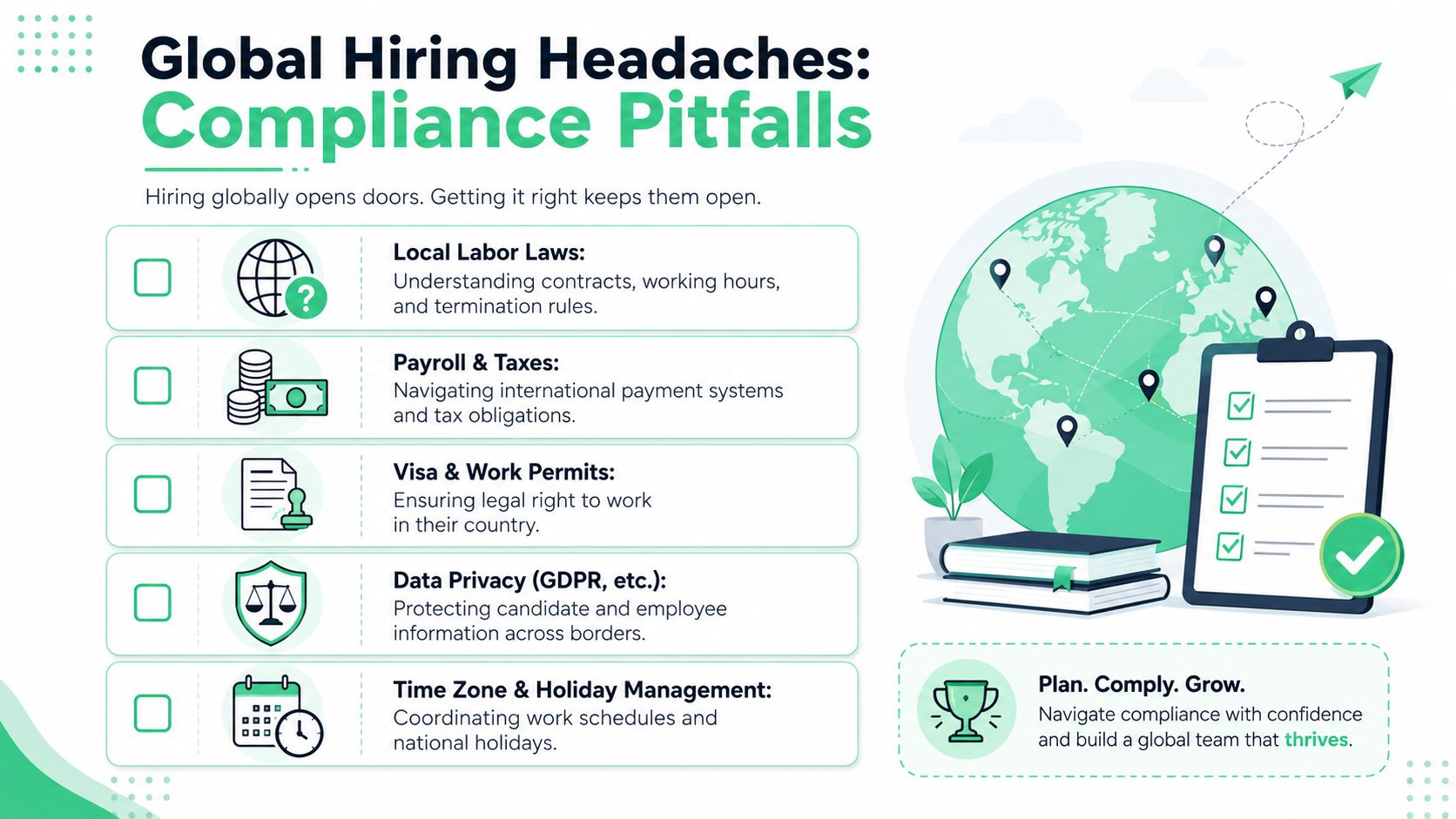
Treating compliance as a final step is one of the dumbest habits in global recruiting. It creates false positives all over your funnel. The candidate looks perfect. The team gets excited. Then legal, payroll, or ops kills the hire after everyone has already invested time.
Most candidate screening guides fail to address the compliance and payroll friction that kills 40% of global SDR hiring initiatives within the first 3 months, according to Forrester's 2025 Global Talent Operations report.
That means compliance belongs inside the candidate screening process, not after it.
You don't need to turn recruiters into lawyers. You do need a checklist.
Use this before final interviews, not after offer approval:
If your team hires internationally with any regularity, this guide on how to hire international employees is a useful operational starting point.
This is the shift needed across organizations. Stop thinking of compliance as back-office cleanup. It is a screening layer.
A practical workflow looks like this:
| Screening lane | What happens |
|---|---|
| Talent lane | Assess outbound skill, communication, coachability |
| Operations lane | Verify country setup, payment path, hiring model |
| Decision lane | Move forward only when both stay green |
That parallel model saves everyone pain. It also changes how recruiters qualify candidates in the first conversation. You don't just ask about experience. You ask where they are based, what kind of work setup they need, and whether they can support the required hours.
The fastest way to waste recruiter time is to treat legal reality like a surprise twist.
The founders who get this right don't seem smarter. They just stopped pretending that global hiring is only a talent problem. It isn't. It's talent plus compliance plus payroll plus timing. Ignore one and the whole hire collapses.
A good candidate screening process doesn't feel like recruiting admin. It feels like system design.
You start with hard filters instead of resume worship. You test real SDR behavior instead of trusting keyword matches. You interview for resilience instead of rehearsed charm. Then you run compliance checks before the team gets emotionally attached to a candidate you can't onboard.
That shift matters because SDR hiring is not a branding exercise. It's throughput. It's consistency. It's whether your team wakes up next quarter with enough qualified pipeline or another set of excuses.
Weak hiring teams think in steps. Strong hiring teams think in conversion points.
They ask:
Those are operator questions. Ask those, and your hiring gets better fast.
If you'd rather not build all of this from scratch, outsourced recruiting is often the cleaner move. This overview of outsourced recruiting is a good place to start if your team needs SDR hiring capacity without adding internal recruiter headcount.
If your current process starts with resumes, delays assessments, runs generic interviews, and leaves compliance for the end, rebuild it.
Not tweak it. Rebuild it.
The teams that hire strong SDRs consistently don't have secret interview questions. They have a disciplined funnel. They remove noise early. They test what matters. They move fast. They check legal reality before making promises.
We're not saying anyone's perfect. Just more accurate more often. Toot, toot.
If you need SDRs fast and don't want to spend the next two weeks sorting resume fiction, hireSDR.io can help. It combines AI-powered matching with human-led screening, including skills tests, English assessments, reference checks, and built-in compliance support for global hires, so your team can spend time interviewing viable candidates instead of cleaning up preventable hiring mistakes.
Your reps are busy all day, your CRM is full of “activity,” and somehow pipeline still feels anemic. Founders see that and reach for the...
Most advice about the difference between inbound and outbound sales is technically correct and practically useless. Yes, inbound is pull and outbound is push. Wonderful....
You're probably reading this because hiring has started eating your actual job. You wanted to build product, close customers, coach reps, maybe sleep once in...

Tell us who you need. We'll have pre-vetted candidates in your inbox within 72 hours. No commitment until you hire.