
You've got pipeline pressure, your local SDR hiring process is dragging, and every “urgent” role somehow turns into a month-long committee project. Meanwhile, the candidates you do like want big salaries, long notice periods, or enough perks to make you consider selling the espresso machine.
So you start searching for recruitment agencies for abroad because global hiring feels like the obvious next move.
Fair. But obvious doesn't mean smart.
Most guides on this topic are stuck in the old world. They obsess over visas, relocation, and office-based roles, while ignoring the fact that 58% of SaaS companies now hire remotely across borders according to Hire with Near's international recruitment agency analysis. If you need SDRs now, not six paperwork cycles from now, that old advice is about as useful as a ping-pong table in a seed-stage burn review.
The first mistake founders make is assuming “abroad” automatically means relocation.
It doesn't.
A lot of buyers looking into recruitment agencies for abroad are really asking a simpler question: can I hire a great rep in another country without moving them, opening an entity tomorrow, or turning my ops lead into an amateur immigration lawyer? That's the core question. And most of the internet answers a different one.
The problem is accessing talent fast enough, vetting it properly, and onboarding without creating a compliance horror show.
You don't need a philosophical debate about global mobility. You need someone who can book meetings, write clean outbound, speak fluent English, overlap with your team, and start without chaos. Preferably this quarter.
Most content about hiring abroad still assumes the candidate must relocate. That's old thinking, and it breaks the moment you need remote-first revenue talent.
The practical shift is this: stop thinking “Which country should I move someone from?” and start thinking “Which market gives me strong SDR talent with the least operational friction?”
That changes everything. Suddenly your shortlist isn't driven by visa pathways. It's driven by timezone fit, English fluency, sales maturity, and how quickly you can get someone productive.
Founders find themselves trapped. They search for recruitment agencies for abroad, get funneled into relocation-heavy firms, and end up buying a process designed for senior expatriate placements instead of remote SDR hiring.
Wrong tool. Wrong speed. Wrong economics.
Before you hire anyone internationally, get your internal house in order too. If your contracts, onboarding flow, and document process are messy, global hiring will only expose the mess faster. A simple checklist like these essential onboarding documents for 2025 helps more than another “top 10 agency” list ever will.
Here's my opinion. If you need one SDR abroad, or a small team, your goal isn't to “go international.” Your goal is to remove drag. Anyone selling you a giant, ceremonial hiring process for an entry-to-mid revenue role is selling yesterday's solution.
International recruitment agencies are the traditional middle layer between you and foreign talent. They source candidates, screen them, coordinate interviews, and often help with relocation, visa admin, or country-specific hiring logistics.
On paper, that sounds great.
In practice, it often feels like paying premium prices for a process that moves at the speed of office carpeting.
To be fair, the old guard exists for a reason. According to CDR General Services' overview of top international recruitment agencies, strong firms are defined by their ability to manage diverse regulatory frameworks, bring industry specialization, and use technology in the process. That matters. If you're hiring a niche leader into a complex market, that infrastructure can help.
But the same source also points out the catch: that global infrastructure can add significant time and cost overhead.
That's the part founders feel in their bones.
You brief the role. They nod seriously.
A week later, they send a polished document. Then another meeting. Then “market mapping.” Then a shortlist that includes one promising person, two maybes, and one candidate who appears to have been selected by a bingo machine.
That's not universal. Some agencies are solid. But the model itself was built for a slower hiring era.
Practical rule: If the role is repeatable, remote-friendly, and tied to speed-to-pipeline, a traditional agency often brings too much ceremony and not enough momentum.
They usually fit best when you need:
They're usually a bad fit when you need:
If you want a broader read on what modern teams are doing to tighten the process, this piece on optimizing talent acquisition is worth your time.
The blunt truth: recruitment agencies for abroad are not broken across the board. They're just often mismatched to startup hiring problems. Founders don't need theater. They need qualified people in seats.
Global hiring has options. Good. Because treating every cross-border hire like a retained search is how startups burn a month, pay a fat fee, and still miss quota.
For SDR roles, the old agency playbook is usually the wrong tool. It was built for relocation, local placement, and long search cycles. Remote-first teams need vetted people who can start selling, not a polished process that eats six weeks.
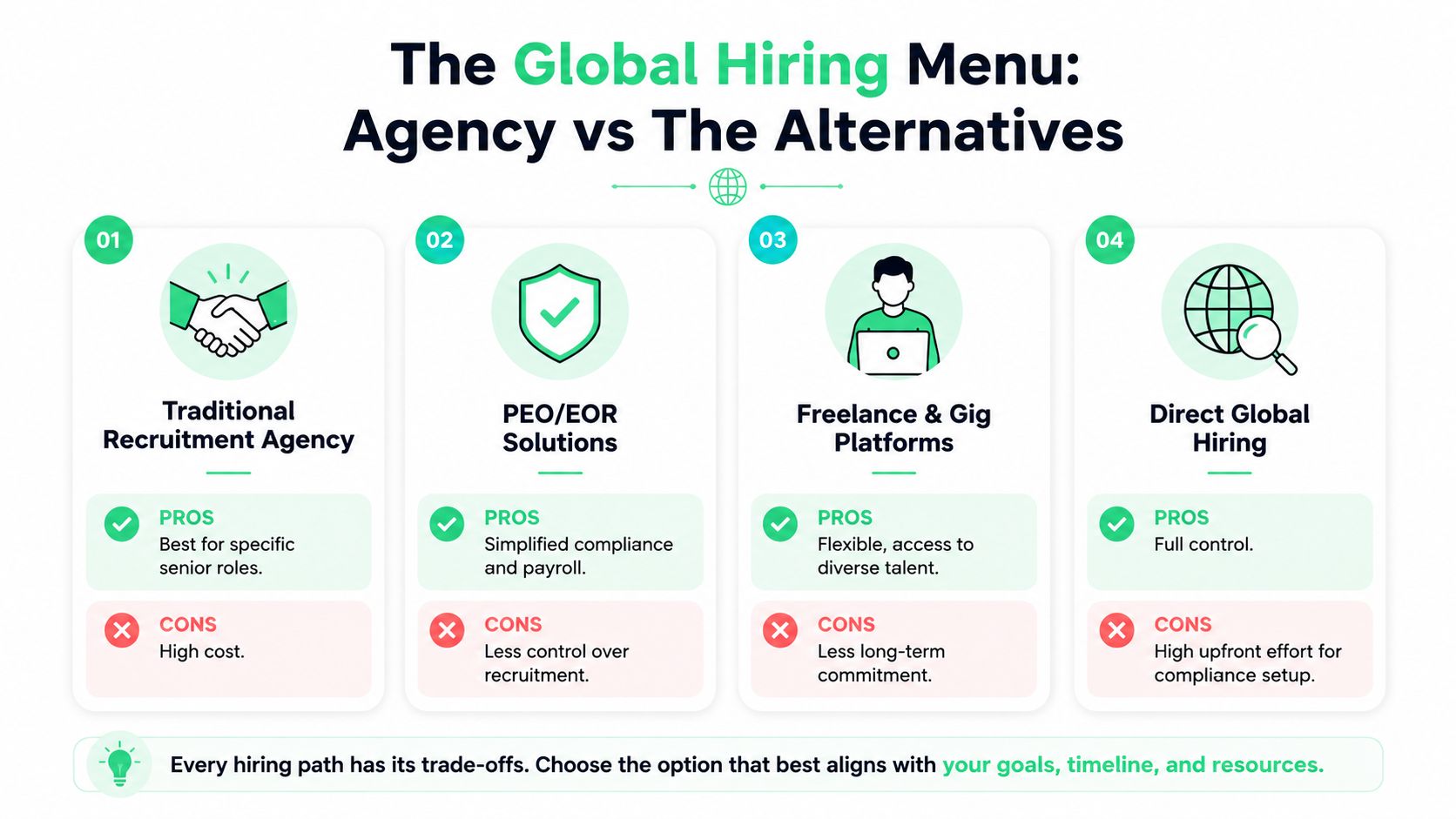
1. Traditional recruitment agency
Use an agency when the role is senior, niche, or tied to serious local market knowledge. That model can work well for leadership search and specialized hiring.
For SDRs, it often drags. You do not need a custom international expedition for a repeatable outbound role. You need a fast shortlist, consistent screening, and candidates who already fit a remote sales environment.
2. PEO or EOR solution
A PEO or EOR handles employment, payroll, contracts, and local admin. Useful? Yes. Recruiting solution? No.
It solves the back office after you find the person. It does not fix weak sourcing, bad screening, or slow hiring decisions.
3. Freelance and gig platforms
These platforms are fast and flexible. They also create a filtering problem. You get volume, but you also get half-committed applicants, recycled profiles, and plenty of people who look better on paper than on a cold call.
That can be fine for project work. It is shakier for SDR hiring, where consistency, coachability, and communication matter every single day. If you're comparing flexible hiring models, this guide to understanding contingent workforce strategies for recruiters is a useful reference.
4. Direct global hiring
Direct hiring gives you full control over sourcing, interviews, offers, onboarding, and team setup. That sounds efficient until your founders or sales leaders start spending prime selling hours reviewing resumes from three time zones.
If you already have internal recruiting muscle and global ops sorted, direct hiring can work. If you do not, it turns into an expensive distraction wearing a low-cost badge.
| Model | Best For | Speed | Typical Cost | Compliance |
|---|---|---|---|---|
| Traditional Agency | Senior or specialized international roles | Moderate to slow | Higher and often layered into search economics | Often supported |
| PEO/EOR | Teams that already identified talent and need legal infrastructure | Moderate | Ongoing service cost | Strong |
| Freelance & Gig Platforms | Short-term or project-based work | Fast | Flexible, but quality varies | Depends on setup |
| Direct Global Hiring | Companies wanting full control | Varies widely | Lower external fees, higher internal effort | Fully on you |
If your real goal is to build revenue teams faster, a search-heavy agency usually is not your best first move.
The better option for remote SDR hiring sits between DIY chaos and old-school agency bloat. You want pre-vetted talent, fast turnaround, and operational support that does not come with the full agency tax.
That is the model startups should be using now. Not because it sounds modern. Because it matches how remote sales hiring works.
Global hiring gets romanticized right up until someone asks, “Cool, so how are we paying this person?”
That's when the mood changes.
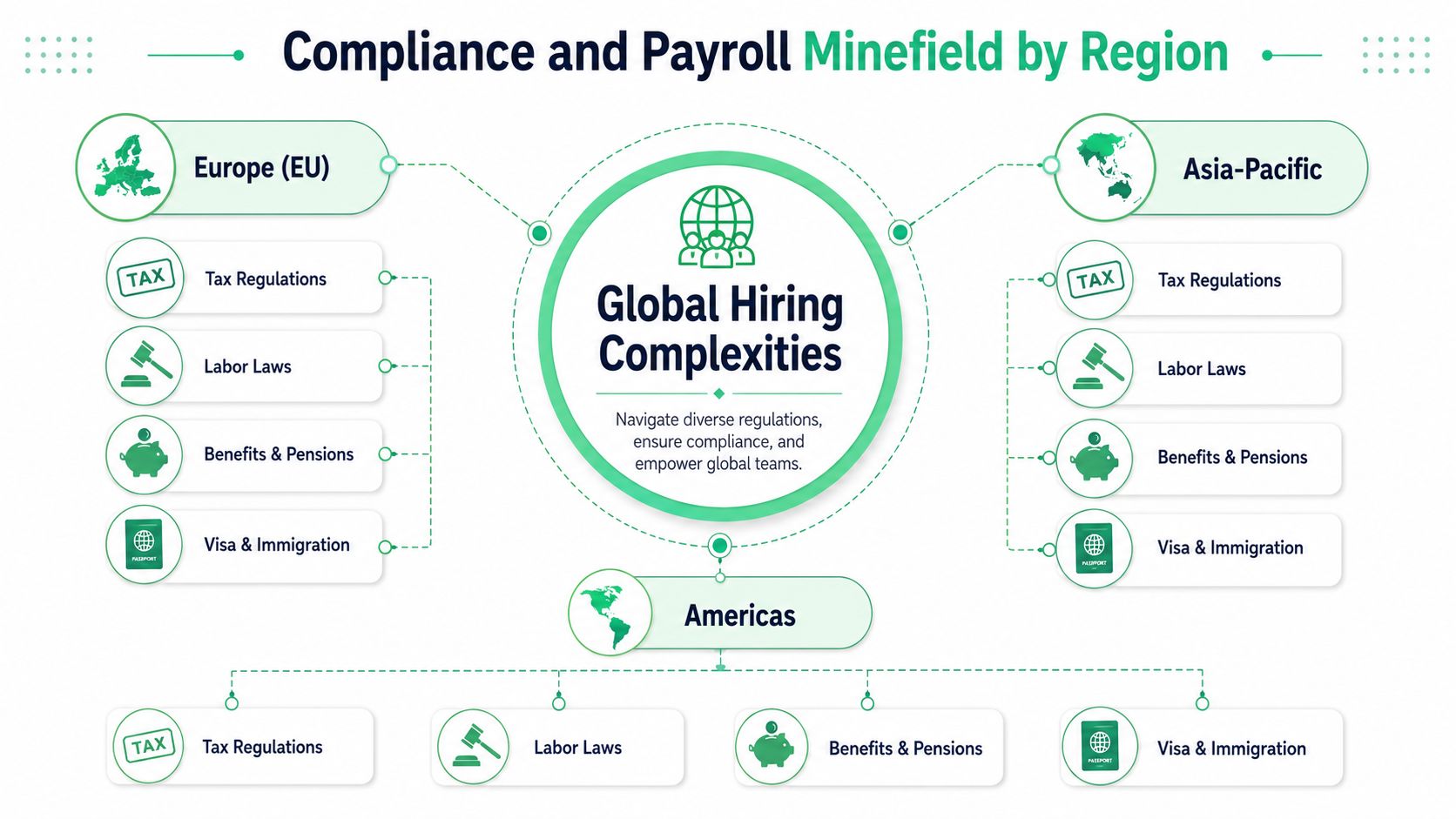
You are not just hiring a person. You are stepping into a local system with its own rules around contracts, tax handling, benefits, termination, and worker classification.
Miss one of those, and your “cost-efficient global hire” starts looking expensive.
The upside is that expert partners can meaningfully reduce the mess. Hire Overseas reports that expert partners for abroad hiring can reduce cross-border risks by up to 80%, while also cutting costs by 80–90% and reducing SDR ramp time significantly in markets across LATAM, Africa, and Southeast Asia.
That's why regional knowledge matters more than slick branding.
The mistake isn't hiring internationally. The mistake is assuming one contract template and a payment app make you “globally compliant.”
Use this short sanity check:
If you need a more practical breakdown before making offers, hireSDR.io's guide for international hiring is a useful starting point.
My view is simple. Don't DIY compliance unless hiring internationally is already a core operating strength inside your company. If it's not, buy the expertise and save yourself the expensive lesson.
Most agency sales calls sound polished because they've had practice. You, on the other hand, only buy this stuff occasionally. That asymmetry is how mediocre partners survive.
So don't ask soft questions. Ask the kind that make vague operators squirm.
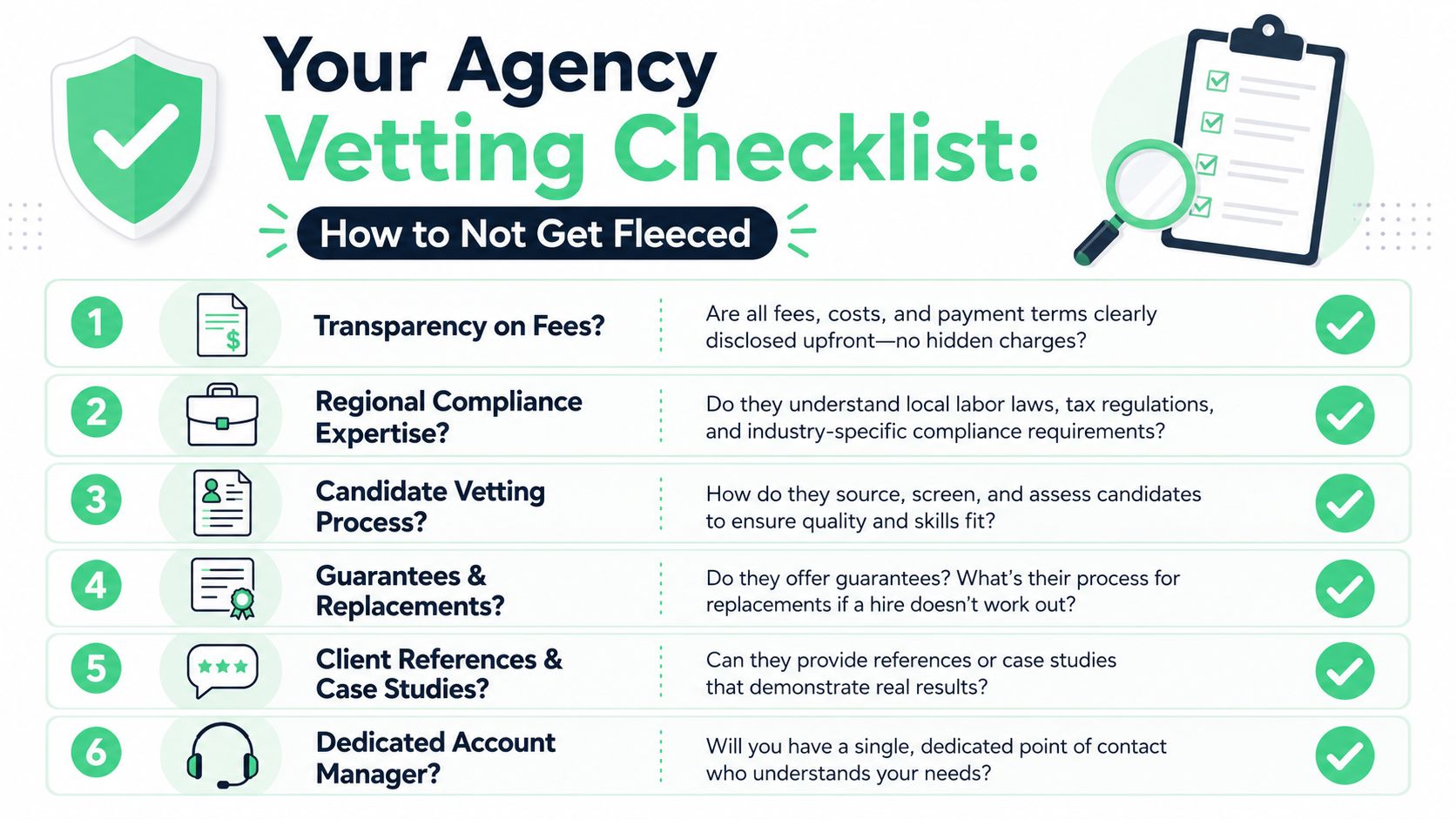
According to McKinsey, most agency guides tell leaders to ask for a “proven track record” but skip the useful part. Leaders should ask for last-quarter medians on time-to-offer and interview-to-offer rates by country, especially with remote hiring up 37% in LATAM and Southeast Asia.
That's the standard.
Not “We have deep expertise in the region.” Not “Our clients love us.” Not a PDF with smiling stock-photo adults.
Ask this instead:
Some warning signs are subtle. Others are wearing a clown horn.
If they can't answer basic process questions cleanly, assume the backend is messy.
If they dodge country-specific metrics, they probably don't have them.
If they say “every market is different” as a reason not to share performance data, smile politely and leave.
Hard-won advice: A real partner can explain exactly how they source, screen, and support hires in a specific region. A weak one hides behind generalities.
A credible partner sounds operational, not theatrical.
They'll tell you how candidates are tested. They'll explain communication flow. They'll show you where they're strong and where they're not. They won't pretend every geography, role, and timeline looks the same.
And yes, ask about replacements. Not because you expect failure, but because adults plan for it.
If I were choosing a hiring partner tomorrow, I'd score them on three things:
| Check | What I want to hear | What worries me |
|---|---|---|
| Metrics | Country-level medians and recent pipeline data | Generic “success rate” talk |
| Vetting | Clear screening steps before client interviews | “We tailor it case by case” with no specifics |
| Operations | Named owner for contracts, payroll, and support | Finger-pointing between vendors |
You don't need to become a procurement robot. You just need to stop buying global hiring on vibes.
If you're hiring SDRs, don't borrow a playbook built for relocating executives.
That's the whole point.
The best modern approach is simple: source from remote-friendly markets, pre-vet aggressively, interview a small qualified slice, and keep compliance wrapped inside the process so your team can focus on ramping reps instead of deciphering paperwork.
A modern playbook does four things well:
That's why remote-first hiring works so well for SDRs. The role is structured, measurable, and compatible with distributed teams when screening is done properly.
Here's what that looks like in practice:
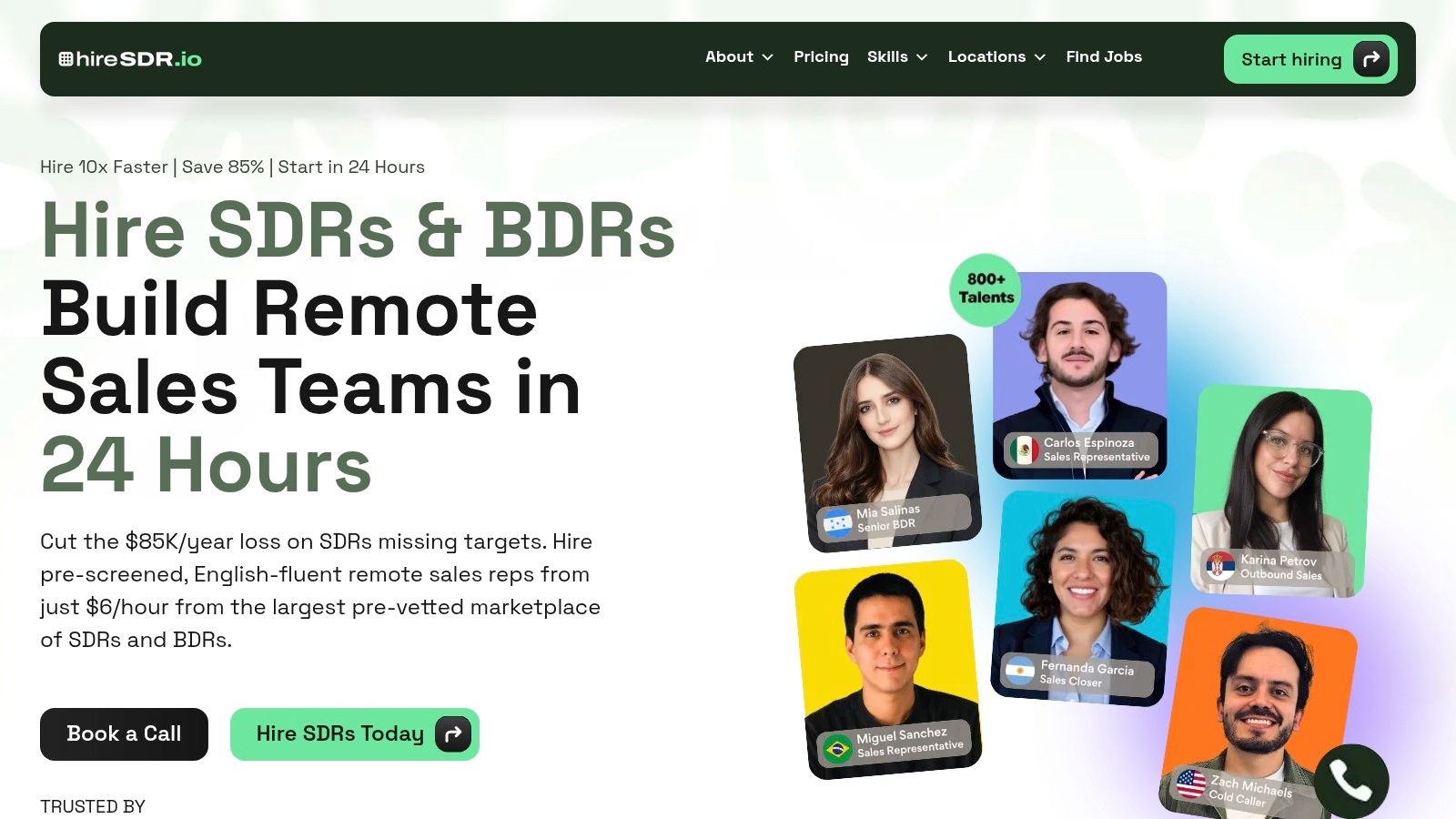
Don't overcomplicate it. For SDR hiring abroad, I'd focus on:
The old agency model often front-loads sourcing and underweights role-specific execution. That's backwards for SDR hiring.
We're not saying every traditional firm is useless. Just that many of them are solving a larger, slower, more expensive problem than the one most startup founders actually have.
The founders who get this right usually stop chasing prestige and start chasing throughput. Toot, toot.
You do not need another month of “international hiring strategy.”
You need a practical first move.
People Managing People's guide to international recruitment agencies notes that international recruitment timelines can span from weeks to months depending on role complexity and country. That's normal for the traditional process. It also notes founders should compare that with modern platforms that can deliver vetted shortlists in under 48 hours.
That contrast matters.
If you're hiring SDRs, the smart move is to define the role tightly, pick a remote-first geography that fits your hours and budget, and use a hiring model built for speed. Not relocation theater. Not endless search retainers. Not a global scavenger hunt dressed up as process.
If you want the shortest path from plan to actual conversations with qualified reps, start with a platform designed for this exact use case, like HireSDR.
That's the difference between researching global hiring and building pipeline.
If you need SDRs abroad without the usual agency drag, hireSDR.io is the cleanest next step. You get pre-vetted remote sales talent, fast shortlists, and built-in support for cross-border hiring without turning your team into an operations help desk.

You need more pipeline. Your calendar says “growth.” Your bank account says “please relax.” So you do what every founder does at some point: open...

Your best Account Executive is doing detective work in Apollo, cleaning CSVs, and chasing no-shows instead of closing. Your pipeline has activity, sure, but the...

The common 1.25x to 1.4x salary rule is a myth. In practice, an employee's actual cost is often closer to 1.5x to 2.5x salary, especially...

Tell us who you need. We'll have pre-vetted candidates in your inbox within 72 hours. No commitment until you hire.