
You're probably in the same place a lot of founders hit sooner than they'd like.
Pipeline is thin. Your account execs are grumbling. You need SDR coverage fast, but hiring in-house feels slow and expensive. Then someone drops two magic words on the whiteboard: outsourcing and offshoring. They sound similar enough to be annoying, different enough to be risky, and vague enough to waste a month of your life if you pick wrong.
I've seen teams burn time on both. One route gives away too much control. The other turns into a mini international expansion project when all you wanted was more qualified meetings. That's the trap. The debate gets framed like a clean either-or choice when it usually isn't.
Most startup hiring decisions don't happen in some polished strategy offsite. They happen on a random Tuesday when CAC is creeping up, outbound volume is down, and your head of sales says, “We need reps yesterday.”
That's when the difference between outsourcing and offshoring stops being academic and starts becoming expensive.
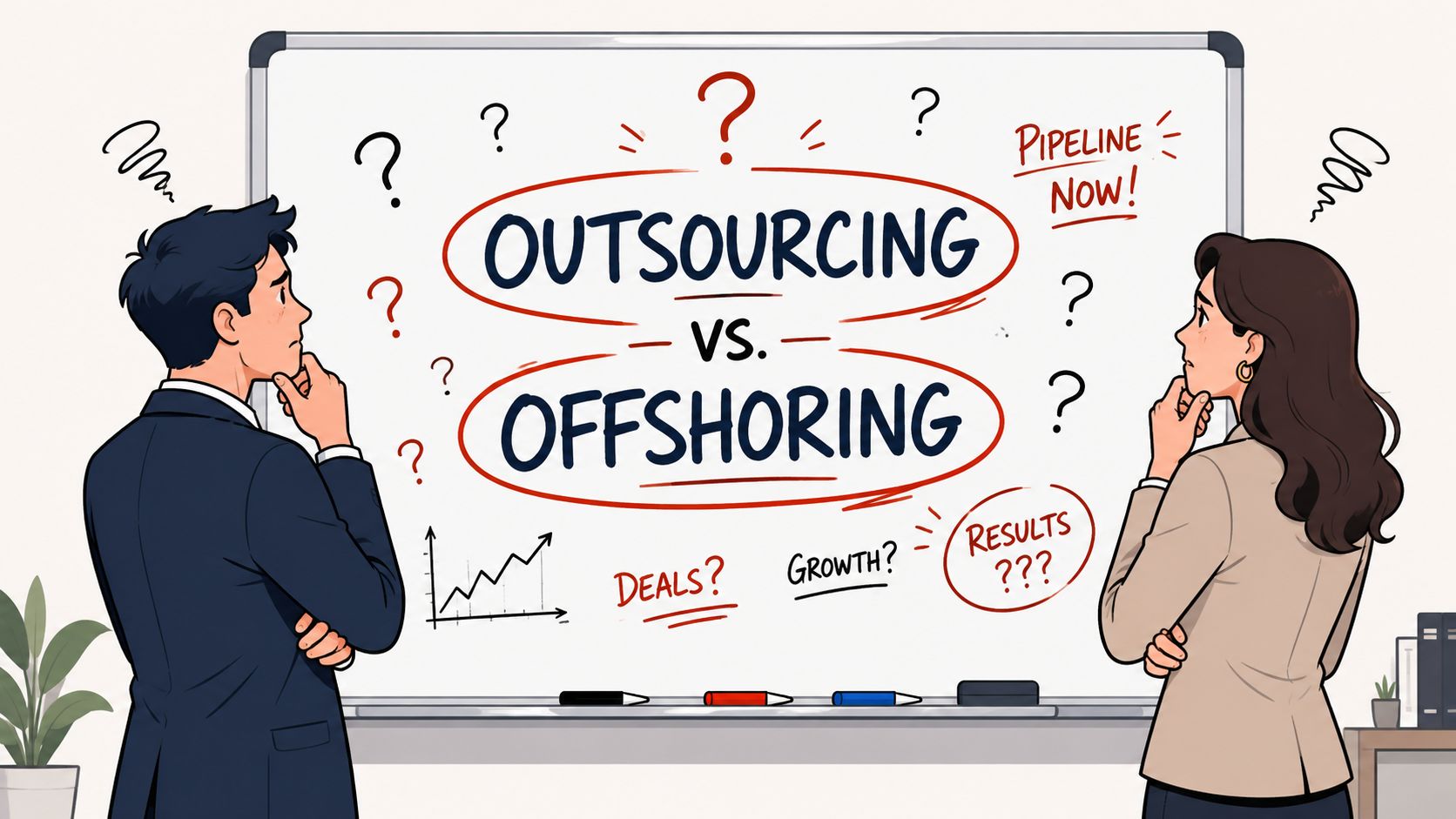
Here's the quick version before the jargon starts clogging the drain:
| Model | Who employs the team | Who manages day-to-day work | Best fit | Main risk |
|---|---|---|---|---|
| Outsourcing | A third-party vendor | Usually the vendor | Fast help on defined work | You lose control |
| Offshoring | Your company in another country | Your company | Long-term team building | You take on the overhead |
| Modern hybrid global hiring | Varies by structure | You stay close to the rep | SDR and BDR hiring with speed and oversight | Quality depends on vetting |
That table alone will save some people three weeks of “alignment meetings.”
If you're building a sales team, your problem isn't just labor cost. It's message quality, call coaching, CRM hygiene, objection handling, English fluency, timezone overlap, manager bandwidth, and whether the rep understands how a US buyer talks. SDR work is not a generic back-office function. It's closer to front-line brand execution.
If you want useful context on messaging, role design, and outbound execution, PitchSmart has a solid library of BDR and SDR resources. Worth bookmarking before you hire someone who can smile on Zoom and still butcher your ICP.
The wrong model doesn't just miss meetings. It creates management debt.
Let's get the formal answer out of the way.
According to NetSuite, outsourcing delegates specific non-core functions to a third-party provider regardless of geography, transferring full ownership of execution, staffing, and quality control to the external vendor, while the client retains only strategic oversight; in contrast, offshoring relocates a business process to another country while maintaining direct ownership and control within the company, integrating the offshore team as internal employees fully embedded in corporate workflows (NetSuite's explanation of outsourcing vs offshoring).
That's correct. It's also where most articles stop being helpful.
The textbook distinction focuses on legal structure and geography. Founders care about something else:
That's why generic explainers feel like they were written for a procurement team in 2009. They tell you who signs the contract, not whether your SDR can handle a pricing objection without sounding like they copied a script from Reddit.
For SDR hiring, “outsourced” often means the rep works for someone else and you get partial attention, recycled training, and a nice dashboard full of excuses.
“Offshored” often means you keep control, but now you're dealing with recruiting, compliance, payroll, onboarding, manager coverage, and process design in another country. Toot, toot. You accidentally became an operator of a small international branch office.
If your sales motion depends on nuance, the real question isn't where the rep sits. It's who controls quality.
That's why the classic difference between outsourcing and offshoring matters less than people think. The categories are real. The decision criteria most founders use are better: control, speed, communication, and whether the setup helps or hurts revenue in the next ninety days.
The slide-deck version of this debate is boring. The actual version is sharper. Founders care about six things because these six things decide whether your SDR hire becomes pipeline or noise.
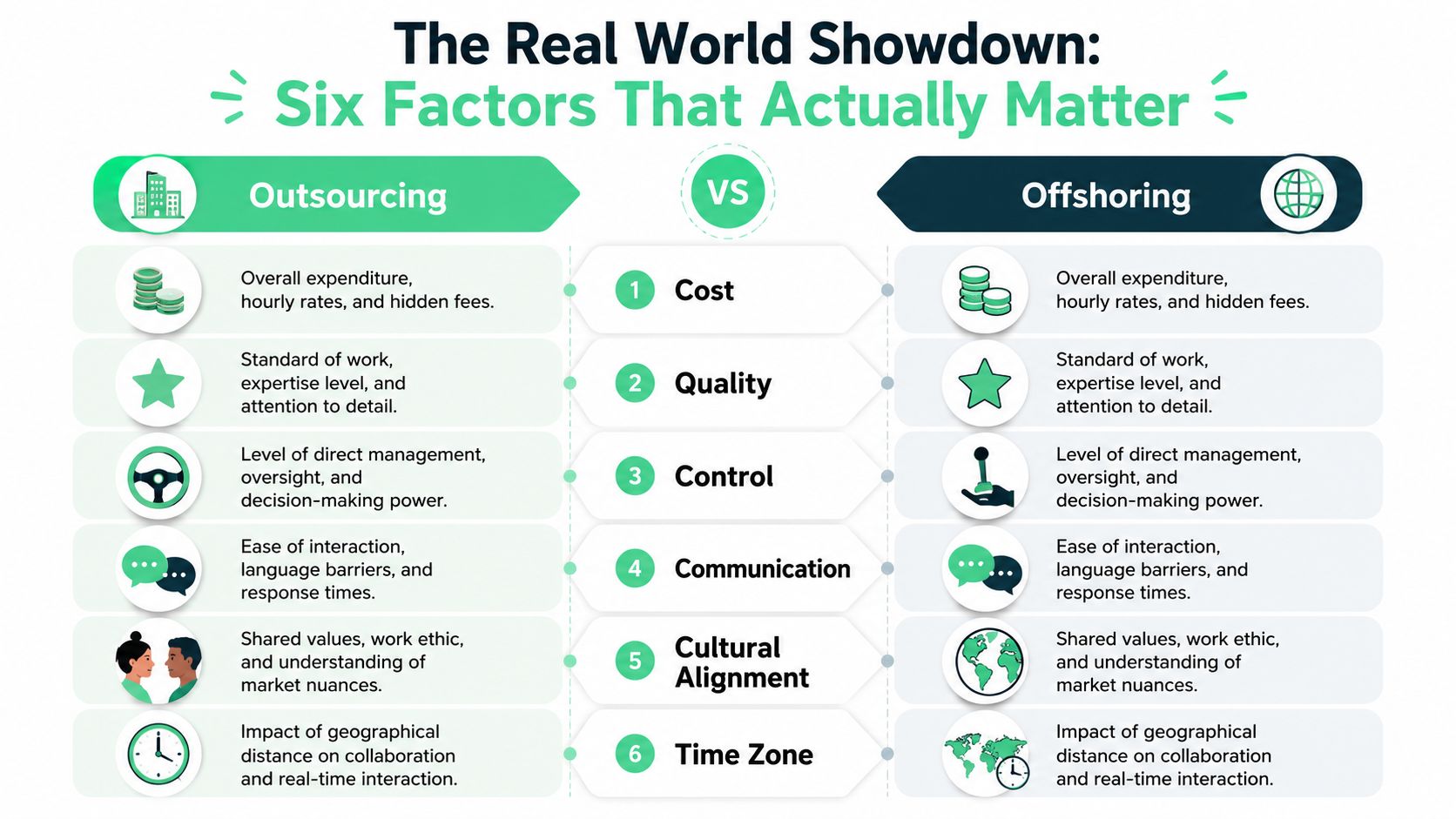
Cost is where everyone starts, and where plenty of teams fool themselves.
Hubstaff notes that outsourcing vendors often charge on a fixed-bid or retainer basis, while offshoring lets companies use wage scales where average salaries can be 70 to 80% lower than in the US and still keep those workers as direct employees (Hubstaff on offshoring vs outsourcing economics). That sounds simple until you remember that cheap labor isn't the same thing as cheap outcomes.
With outsourcing, the invoice may look neat. With offshoring, the salary may look lean. But the hidden line items matter. SDR management time, QA, replacement risk, sales training, tooling access, and wasted leads all count. If you want a grounded view of how employment costs stack up beyond salary alone, this breakdown of the cost of an employee is a useful gut check.
Practical rule: If a model looks cheap but eats manager hours, it isn't cheap.
This is the biggest dividing line.
Outsourcing gives you convenience by handing execution to a vendor. That's also the part that hurts. You don't fully control hiring standards, coaching cadence, or whether your “dedicated” SDR is juggling three clients and one identity crisis.
Offshoring flips that. You control the people, process, and daily work. Great in theory. In practice, that means your leadership team owns the mess if onboarding is weak or if your sales manager can't coach across distance and time zones.
A lot of outsourced SDR programs look polished in the sales call. Nice deck. Nice claims. Nice accent on the account director. Then the actual rep starts sending lifeless outreach and treating your category like it's interchangeable with every other SaaS product on Earth.
Offshoring can produce stronger quality if you build the right training environment because the reps are integrated into your team. But quality only shows up when you have the discipline to coach consistently. No operating system, no quality.
Founders love to ignore compliance right up until finance or legal pulls the handbrake.
With outsourcing, much of the employment burden sits with the vendor. Easier on paper. But your exposure shifts to contract clarity, data handling, and operational transparency. If your vendor is vague, that's not a personality quirk. It's a warning.
With offshoring, you own more of the structure. That can be cleaner long term, but it's heavier. You need actual process, not vibes.
Outsourcing usually wins on speed. A vendor already has people, scripts, and some version of onboarding in motion. If your need is urgent and the task is narrow, that speed helps.
Offshoring is slower because you're building more of the machine yourself. Hiring, process, team integration, management routines. Better for a strategic function you want to own. Worse if your board wants pipeline now.
Fast setup is useful. Fast setup with weak oversight is expensive theater.
SDRs sit close to the buyer. Culture matters more than companies admit.
This isn't about office snacks or fake startup values. It's about whether your rep understands tone, urgency, business context, and what sounds normal to a prospect in your market. Outsourced teams often struggle here because they use generalized playbooks. Offshored teams can do better if you embed them sufficiently, but that takes effort.
Here's the blunt summary:
This is the part founders usually learn the expensive way.
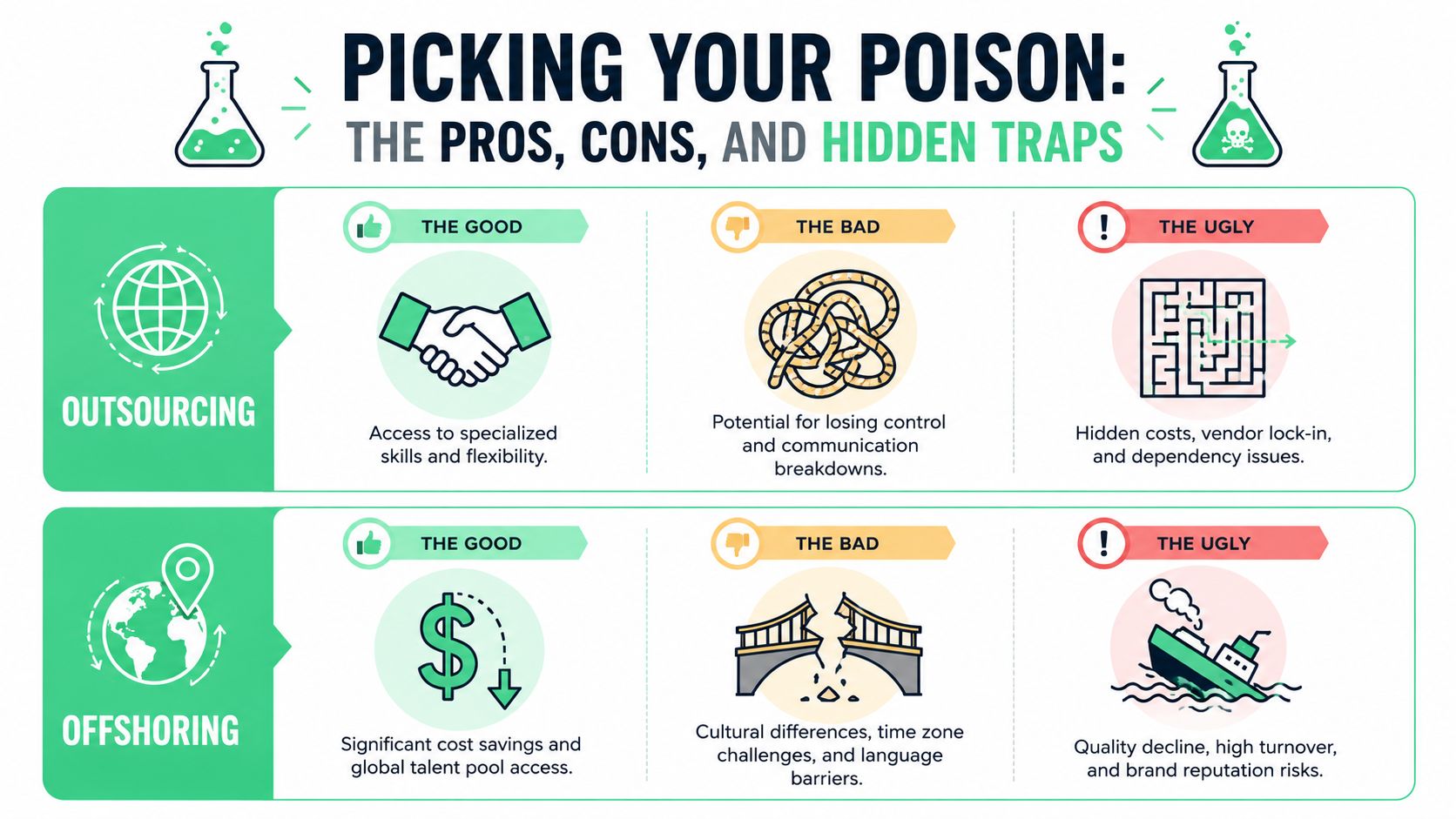
Outsourcing often starts with a seductive pitch. Low commitment. Fast launch. “We already have trained reps.” Lovely. You think you're buying speed.
What you may be buying is distance from the work itself.
The rep isn't steeped in your product. The manager is spread thin. Reporting looks busy but vague. Meetings get booked, then no-show. Prospects reply, but they're the wrong persona. Your team spends more time cleaning the calendar than closing deals.
Zinnov's framing is directionally right: outsourcing is most effective for short-term projects or non-core functions where deep integration is unnecessary, while offshoring is stronger for scaling globally while retaining niche skills and complete process ownership (Zinnov's comparison of offshoring and outsourcing). That's exactly why outsourced SDR work so often underperforms. SDR is rarely “non-core” once you need message-market fit in outbound.
Offshoring sounds smarter to operators who hate giving up control. Fair instinct.
Then reality walks in. You need recruiting support, payroll structure, onboarding documentation, manager coverage, QA routines, and a process for replacing weak hires. Congratulations. You didn't just hire a rep. You started building a remote office without the sign on the door.
That's where teams drift. The offshore reps sit in another rhythm. Sales feedback loops get slower. Coaching gets inconsistent. The reps exist in the CRM but not really in the company. Ghost office.
Offshoring works best when you want to build a real team, not when you want a shortcut dressed as strategy.
The ugly truth is that both models fail when buyers treat SDR hiring like plugging in a commodity.
A better move is to inspect providers with the same skepticism you'd use for any revenue-critical function. If you want a broader benchmark for evaluating talent partners, this guide to best staffing agency services is helpful because it forces you to compare structure, fit, and accountability instead of just rate cards.
And if you're exploring more controlled global team models, reading about dedicated offshore teams can help clarify what ownership should look like before you sign anything.
You don't need another philosophical debate. You need a decision.
Here's the blunt version. Pick the model based on your stage, your management bandwidth, and how much precision your sales motion needs.
If you need activity now and your outbound playbook is already clear, a vendor-led setup can work. That usually fits teams that have messaging nailed down, simple targeting, and a narrow ask. You're buying coverage.
This can make sense when:
If your SDR motion depends on product nuance, call coaching, and fast feedback from account executives, you'll want tighter management. That points toward a model where the reps operate as part of your internal rhythm.
This is usually better when:
| Your situation | Better starting point | Why |
|---|---|---|
| Need outreach launched fast | Outsourcing | Faster setup, less internal buildout |
| Need reps to sound like your team | Offshoring or a tighter hybrid model | More direct control over messaging and coaching |
| Have little manager bandwidth | Outsourcing with caution | Easier operationally, riskier on quality |
| Have strong sales leadership | Offshoring | Better for embedding reps into the workflow |
| Need flexible experimentation | Outsourcing | Lower commitment and quicker swaps |
| Need long-term sales capacity | Offshoring | Better ownership if you can support it |
One caution. Don't confuse “remote” with “detached.” The best remote SDR teams still need scripts, call reviews, CRM discipline, and adult supervision. If you're designing that structure, Salesmotion has practical guidance on building effective remote sales teams that's more useful than the usual culture-deck nonsense.
If you're weighing whether to hand sales development to a partner at all, this page on sales outsourcing for startups is a reasonable checklist for what to pressure-test before making the leap.
The old debate assumes you must choose one pain or the other.
Option one: outsource and give up control. Option two: offshore and take on a pile of operational overhead. That binary is outdated, especially for SDRs.
The sharper question is this: can you get global cost advantages without accepting weak communication, weak hiring, and weird timezone friction? In a lot of cases, yes.
Robert Walters points directly at the gap most generic guides miss. The unanswered question is how to find offshore SDRs who understand US sales culture, and the important nuance is the rise of high-fluency, timezone-aligned talent in LATAM and Southeast Asia that can offer 80 to 90% cost savings with near-native English and 10+ hours of US overlap (Robert Walters on outsourcing, offshoring, and offshore SDR nuance).
That matters because SDR performance lives and dies on live interaction quality. Tone. Follow-up speed. Context. Whether the rep can hear “circle back next quarter” and know if that means real interest or a polite brush-off.
A better model sits between traditional outsourcing and traditional offshoring:
That's why the difference between outsourcing and offshoring is no longer the whole story. The modern winner for SDR hiring is often a hybrid structure that preserves control where it matters and removes admin where it doesn't.
If a rep talks to your prospects every day, you need more than low cost. You need alignment.
Founders who figure this out stop treating offshore hiring like a bargain bin and start treating it like precision recruiting with global reach. That's the right frame.
You don't need a perfect plan. You need a clean one.
Don't judge candidates on charm alone. Give them a short call script, a small target account list, a sample objection, and a CRM task. Then inspect how they write, how they speak, how they follow process, and whether they improve after feedback.
A weak SDR can sound polished for one interview. They can't fake consistent execution for two weeks.
That last one matters more than founders admit. Raw talent helps. Coachability scales.
You're not choosing between buzzwords. You're choosing what kind of management burden, quality risk, and speed tradeoff your company can survive. Pick accordingly.
If you need SDR or BDR talent fast and want the cost advantages of global hiring without the usual chaos, hireSDR.io is worth a look. They match companies with English-fluent, vetted remote sales reps in 24 to 48 hours, with screening, compliance, and payroll support already handled. That means less time buried in hiring ops and more time building pipeline with reps who can talk to your market.
You're probably in one of two modes right now. Mode one: you're still taking first calls yourself, hopping from a product standup to a demo,...

Your global talent search is broken. Let's fix it. A founder posts an overseas role on Monday, gets 86 applications by Friday, and still has...

You finally hired that killer remote SDR in Bogotá, Nairobi, or Manila. They crushed the interview, your pipeline problem looks fixable, and for about six...

Tell us who you need. We'll have pre-vetted candidates in your inbox within 72 hours. No commitment until you hire.