
Your VP of Sales wants more pipeline. Your CFO wants lower burn. You want both, and you're tired of pretending another overpriced SDR hire in New York is a strategy instead of a reflex.
That's usually when Latin America shows up in the group chat.
Someone says the talent is great. Someone else says compliance is a nightmare. A founder friend tells you they found an amazing rep in Medellín. Another tells you they got burned by a contractor setup that turned into a legal mess and three months of cleanup. Welcome to the actual Latin America business experience. Not the glossy version. The version where hiring decisions hit payroll, pipeline, and your sanity at the same time.
I've seen leaders treat LATAM like a magic labor discount aisle. Bad move. The upside is real, but so are the sharp edges. If you want to build a sales team there, you need a point of view, a hiring filter, and a plan for compliance before your “quick expansion” becomes a very expensive hobby.
You're probably here for one reason. SDR costs in the US have become absurd.
You post a role, get a stack of resumes, and then spend weeks sorting through people who can talk about sales but haven't really done the work. The ones who can do it are expensive, over-recruited, or already halfway out the door. Meanwhile, pipeline targets don't care about your feelings.
That's why founders start looking south.
Latin America makes immediate sense on paper. Timezone overlap. Strong English in the right pockets. Ambitious talent. Better economics than major US metros. And if your team sells into North America, real-time collaboration matters more than people admit. You don't want your SDR team waking up when your AEs are already wrapping the day.
The pitch is seductive because some of it is true.
A well-built LATAM team can give you responsiveness, coverage, and cost control without turning your org into a sleep-deprived relay race. That's the promise behind a lot of Latin America business expansion plans, and it's why more operators are building playbooks around regional hiring instead of defaulting to domestic only.
If you're evaluating that route, a good starting point is understanding how LATAM SDR hiring models actually work in practice. Not the fantasy version. The operational one.
Practical rule: If your whole LATAM plan fits on one slide and says “same timezone, lower cost,” your plan is too shallow.
Because they confuse access with execution.
They assume anyone with solid written English can sell to US buyers. They assume contractor paperwork is “good enough for now.” They assume all of LATAM is one big, interchangeable talent pool. Then they wonder why hiring drags, onboarding sputters, and early reps miss quota.
That's not a LATAM problem. That's sloppy leadership wearing a globalization costume.
The companies that win here don't treat the region like a shortcut. They treat it like a serious hiring market with real differences by country, role, and compliance setup. Do that, and the upside is substantial. Skip it, and you'll spend your afternoons fact-checking resumes and untangling payroll nonsense instead of building pipeline.
Your US sales manager is running a live call review at 2 p.m. Your SDR in Medellín is on. Your AE in Mexico City is on. RevOps is fixing a routing issue while the team is still dialing. That is why LATAM works when it works.
Cost gets too much attention. Operating speed matters more.
If your team shares working hours, coaching happens in the moment, handoffs stay tight, and managers can correct bad habits before they harden into pipeline problems. That is a sales advantage, not a finance footnote.
The broader market supports that case. Business travel spending in Latin America is projected to reach $63.9 billion in 2025, up 3.2% year over year, with the region representing about 4% of the global total and Brazil ranking as the 10th largest market globally, according to GBTA's coverage of Globe Travel Park data. Companies spend on cross-border travel when they are opening markets, managing partners, and chasing revenue.
Here's the visual version.
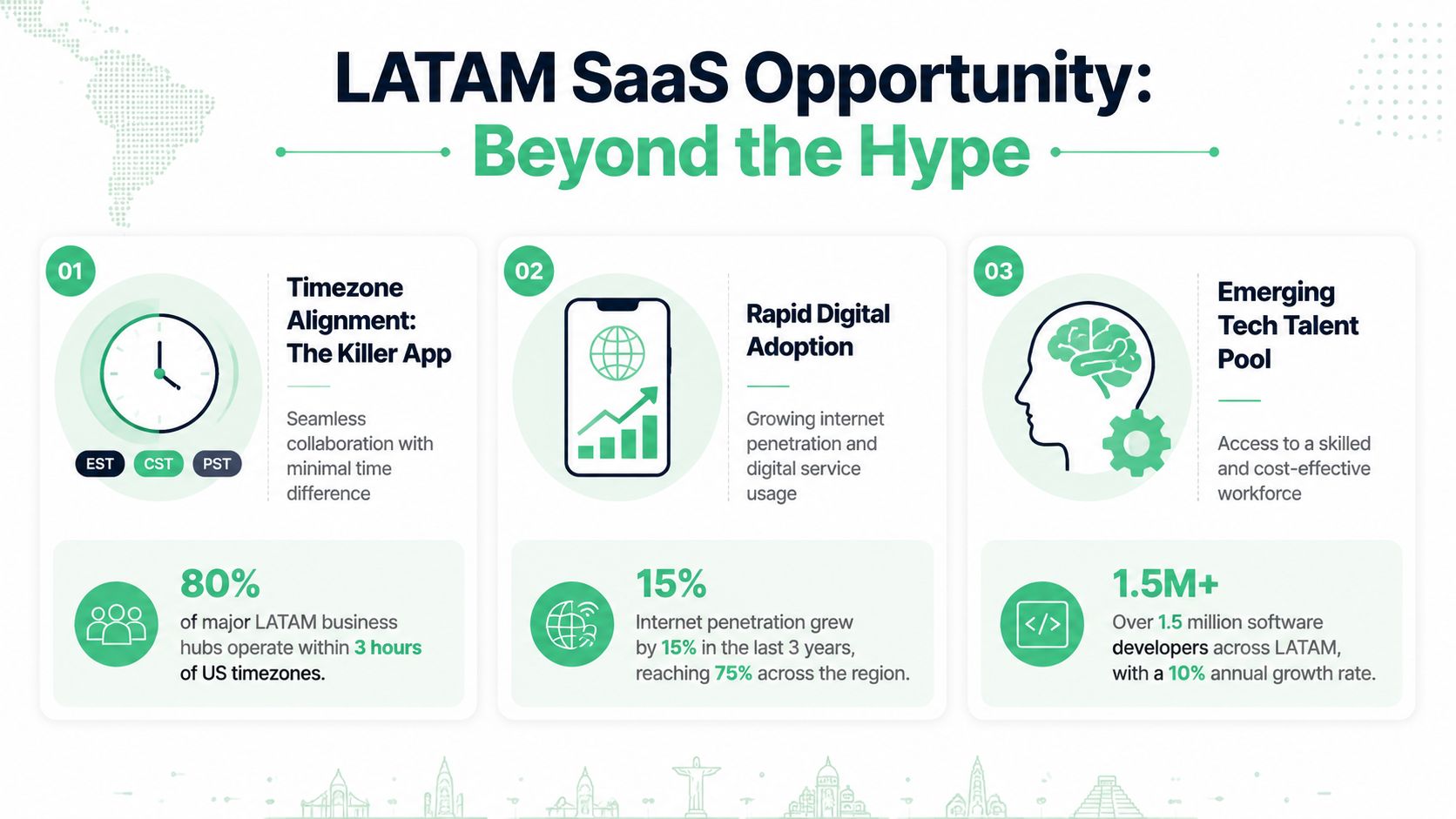
You still need good hiring judgment and tight management. No GDP chart will save a sloppy sales org. But the backdrop is stronger than many operators assume.
Latin America is projected to grow by 2.5% in 2025, above the 2.1% recorded in 2024 and above the decade-long average of 0.9%; inflation across the region fell to 3.4% in 2024 from a peak of 8.2% in 2022; and 52% of Latin Americans say they're optimistic about their personal economic future, in Americas Quarterly's summary of IMF, World Bank, and Latinobarómetro data.
That shows up in hiring. Strong candidates start asking better questions. They care about training, manager quality, variable comp they can trust, and whether your company will still be serious about the region in 12 months. That is a healthy market signal.
The strongest signal is not lower salary bands. It is rising capability.
Morgan Stanley projects AI adoption could close the productivity gap in Latin America by 22% by 2030, and its 2026 Bull Case Report says the MSCI Latin America Index could rise more than 90% by 2030, in its Latin America bullish outlook. If you sell into global markets, that matters. You want talent coming from ecosystems that are getting sharper, more technical, and more commercially mature.
Communication quality is part of that equation. If you want teams selling across borders without creating friction in discovery, handoff, and follow-up, review Translate AI insights on global communication.
My advice is simple. Stop shopping for “affordable reps.” Build a team people with options would join. That means clear scorecards, real onboarding, documented sales process, competent frontline managers, and payroll that runs cleanly every month.
Hire people who want a career, then give them a system worth betting on.
Use LATAM where it gives your org more control and more speed.
Cheap headcount is a weak strategy. A faster, better-managed sales machine is the stronger one.
If your country strategy is “Latin America,” that's not a strategy. That's a continent-shaped shrug.
The region has very different labor markets, tech ecosystems, business norms, and language realities. If you lump everything together, you'll make bad hiring calls and even worse assumptions about ramp speed.
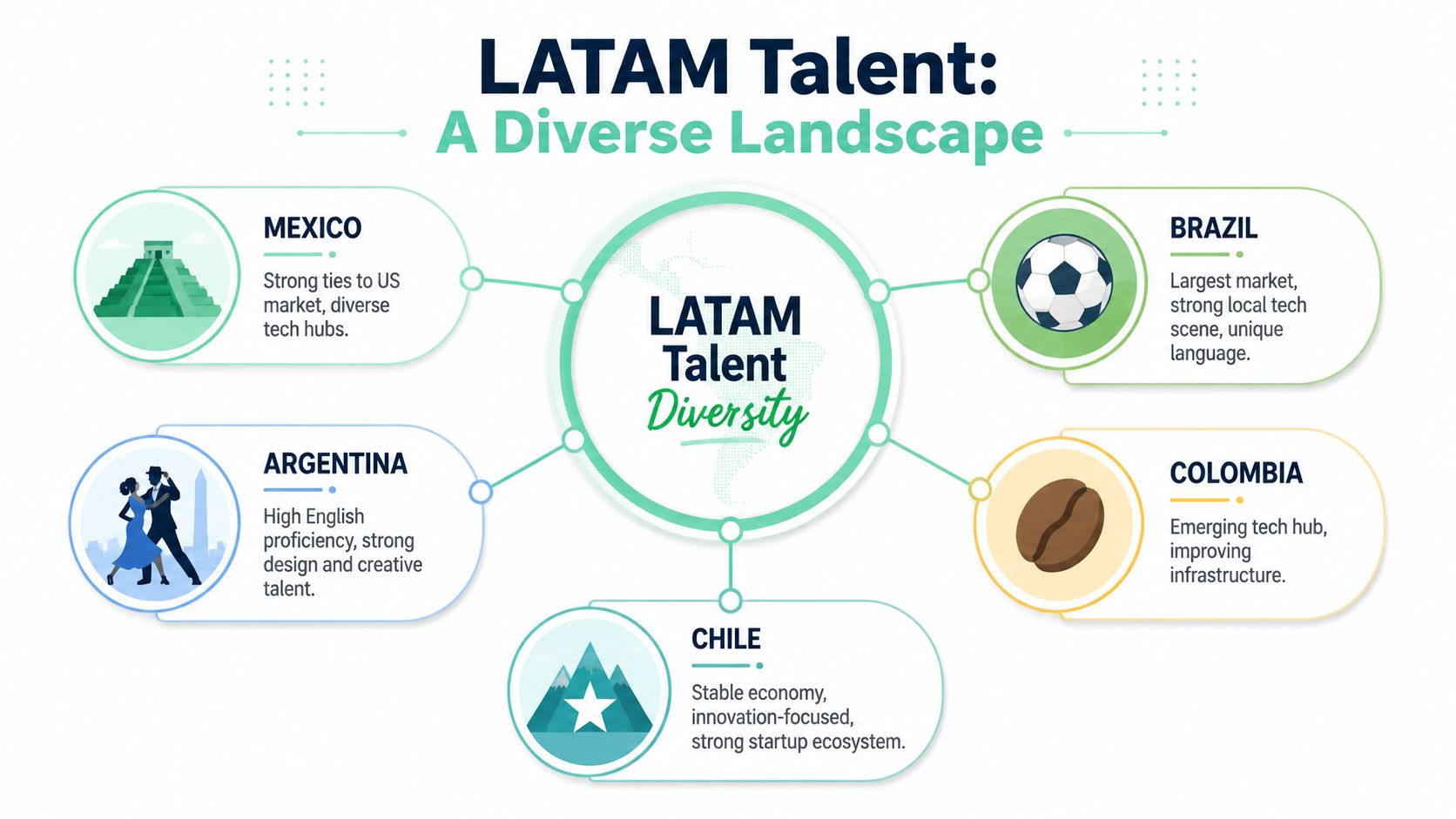
I'd break the market into functional buckets.
| Tier | Countries | My take |
|---|---|---|
| Powerhouses | Mexico, Brazil, Colombia | Big talent pools, stronger market depth, more competition for top performers |
| High-potential players | Argentina, Chile, Costa Rica | Excellent talent pockets, often strong professionalism, but you need local nuance |
| Tread carefully | Bolivia, Haiti, Venezuela | Hard mode for hiring, compliance, and long-term reliability |
Mexico is the easiest mental bridge for many US companies. Brazil is massive but comes with language and market-specific complexity. Colombia keeps producing strong commercial talent and deserves serious attention.
Argentina and Chile can be excellent if you know what you're looking for. Costa Rica punches above its weight in professionalism and business readiness. These are not “cheap alternatives.” They're distinct markets.
Some founders convince themselves they've found a hidden gem market because rates look lower. That's usually when the pain starts.
Bolivia, Haiti, and Venezuela sit at the bottom globally for business friendliness, as noted in the St. Louis Fed discussion of business opportunities and challenges in Latin America. If you're trying to build a stable SDR function there, you're not being scrappy. You're gambling with payroll, retention, and day-to-day execution.
Cheap talent in a broken business environment often turns out to be expensive chaos.
There's also a bigger geopolitical layer people ignore. China's share of Latin American exports rose from 3% to 13% between 2005 and 2024, while the US share fell from 50% to 44%, according to Deloitte's Latin America economic outlook. That shift matters in countries like Brazil, Chile, and Peru because trade relationships shape investment patterns, executive priorities, and the business culture your future hires operate inside.
And yes, communication style changes by country too. If your managers need a better framework for that, this guide to Translate AI insights on global communication is worth a read. Not because cross-cultural nuance is trendy, but because a rep who sounds polished in an interview can still struggle under a manager who gives feedback like a hammer.
My advice is simple. Pick countries on purpose. Don't “source in LATAM.” Source in specific markets for specific reasons.
Posting a role and waiting for magic is how you end up screening people at midnight and wondering why everyone looked better on LinkedIn than they do on Zoom.
The hard part of hiring in LATAM isn't finding applicants. It's separating polished profiles from actual revenue talent.
A candidate can write a beautiful message and still freeze the moment a prospect interrupts them.
For SDR roles, I care less about formal grammar and more about whether the person can:
Run live roleplays. Use cold call mock scenarios. Ask them to recover from a bad opener. If they can't regain control in practice, they won't regain control with prospects.
Generic “LATAM talent” advice falls short because only Costa Rica, the Dominican Republic, and Mexico are identified as economies that have diversified into medium- and high-tech sectors. Outside those three, tech skills are described as rare, and offshore sourcing without rigorous vetting is a gamble, based on the OECD Latin American Economic Outlook 2025 overview.
That doesn't mean you can't hire great salespeople elsewhere. You absolutely can. It means you shouldn't assume SaaS fluency, process maturity, or vertical familiarity just because someone speaks strong English and wants a remote role.
When I'm hiring SDRs in the region, I look for signals in this order:
Structured sales exposure
BPO experience, outbound cadence discipline, CRM hygiene, and comfort working to activity expectations.
Coachability under pressure
Give feedback mid-interview. See if they adjust immediately or defend every bad habit like it's family heirloom china.
Commercial sharpness
Can they ask good follow-up questions? Can they summarize value clearly? Can they think on their feet?
Role seriousness
Is this a real career move for them, or just another remote job tab open in the browser?
Hope you enjoy spending your afternoons fact-checking resumes and running interviews, because that's exactly what the DIY route becomes if your filter is weak.
If you need a cleaner path, use a process with screening depth and compliance baked in. That might mean your own recruiter, a specialist agency, or a marketplace that pre-vets for outbound ability and English fluency. If you need the legal side mapped too, this breakdown of how to hire international employees is a useful operating guide.
And yes, one option in the market is hireSDR.io, which screens SDR and BDR candidates for English, sales skills, references, and cultural fit before companies interview them. That model makes sense when your leadership team needs speed but doesn't want to become an international recruiting department by accident.
Monday morning, your new SDR in Colombia is already in your CRM, on your Slack, and reporting to your US sales manager like any other employee. Friday afternoon, your finance lead asks the question you should have answered before the offer letter went out. Who employs this person, how are they getting paid, and what local obligations did you just create?
That mess is common. It is also avoidable.
Founders love to delay this work because payroll and labor setup feel slow, legal, and boring. Then they hire revenue staff as “contractors,” control their hours, assign quotas, require attendance in team meetings, and act surprised when the arrangement starts looking like employment under local law.
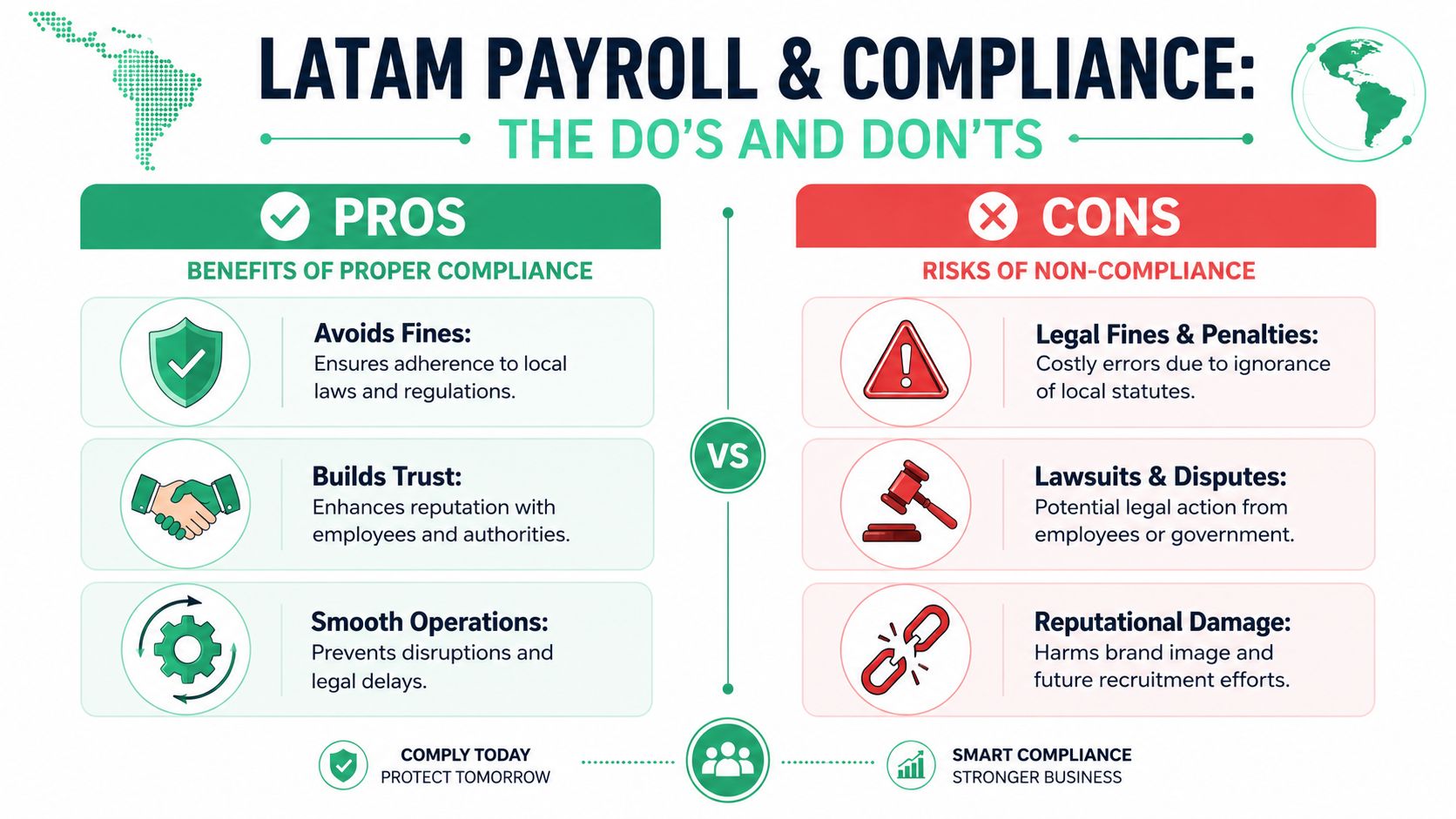
For early expansion, you usually have two realistic paths. Hire the person as a contractor, or use an Employer of Record.
| Option | Good for | Watch-outs |
|---|---|---|
| Contractor | Short-term, clearly independent work | Misclassification risk, weak control, murky local obligations |
| Employer of Record | Core team members, early market entry, lower compliance burden | Higher admin cost than pure contractor setups |
Here's the rule I use. If the person is carrying quota, working inside your systems every day, joining your team cadence, and answering to your manager, stop trying to save a few bucks with a contractor agreement. Use an EOR.
That advice gets ignored all the time, usually by teams trying to move fast. Then the hidden costs show up. Contract rewrites. Payroll fixes. Termination problems. Tax questions nobody can answer with confidence. Management time disappears into cleanup.
Aon's 2025 Global Risk Management Survey found that regulatory and political volatility ranked as the second most significant risk in Latin America for 72% of executives, and business interruption was a leading operational threat for 68% of firms, according to Aon's regional top risks report.
That tracks with what operators deal with in the region. Rules change. Enforcement changes. A payroll shortcut that looks harmless in month one can become a legal problem when you need to terminate someone, issue back pay, explain benefits, or defend your worker classification.
This is not theory. It hits during the least convenient moments.
For your first few hires in LATAM, keep the structure boring and defensible.
If you want the mechanics spelled out, read this guide to payroll compliance for international teams before you send a single offer.
You can coach a rep out of a bad discovery habit. You cannot talk your way out of sloppy cross-border employment setup once the paperwork and payment trail say otherwise.
The mistakes here are boringly predictable. Founders still make them.

A laptop, a login, and a calendar invite are not onboarding.
Your new rep needs call examples, product positioning, objection handling, CRM standards, escalation paths, and clear expectations for the first month. If you throw them into the deep end and refer to it as granting autonomy, don't act shocked when activity is high and results are mush.
This one causes quiet damage.
A rep can be excellent and still need coaching on tone, directness, escalation, or how aggressively to challenge a prospect. Likewise, US managers often mistake politeness for passivity, or confidence for overpromising. The issue isn't talent. It's interpretation.
Strong English reduces friction. It does not erase cultural context.
This move has wrecked plenty of supposedly clever expansion plans.
Teams hire fast, improvise contracts, send money in whatever way seems easiest, and then discover they built a legal structure out of duct tape and crossed fingers. That's not being lean. That's borrowing trouble.
If your entire strategy depends on finding the lowest possible rate, you'll attract people optimizing for the exact same thing. They'll leave the moment someone offers a little more, and you'll be back in interview hell muttering about retention.
The better play is to build a fair package, a sharp hiring bar, and a manager who coaches. Simple but effective, I know.
You don't need another inspirational framework. You need a launch plan.
Define the role like an adult. Territory, KPI expectations, call volume reality, reporting line, required English level, industry exposure, and whether the rep is pure outbound or hybrid.
Then choose your hiring path. Internal recruiter, agency, talent marketplace, or referral network. At the same time, lock down your legal route so offers don't stall in the final mile.
Run a disciplined interview process.
Use live roleplays. Test written follow-up. Have the hiring manager assess coachability, not just charisma. Once you hire, onboard with structure: product training, call shadowing, CRM workflow, messaging, and daily standups. If your team needs to tighten the broader process to turn leads into revenue, do that now, before the rep inherits a broken funnel.
Now they sell.
Review calls. Inspect CRM hygiene. Coach to message, not just activity. Fix bottlenecks fast. Early-stage LATAM hires fail for the same reason many US hires fail. Weak management, fuzzy process, and wishful thinking dressed up as trust.
If you do this well, your first LATAM hire won't feel like an experiment. They'll feel like the start of a more efficient revenue engine. Toot, toot.
If you want a faster route, hireSDR.io helps companies build SDR and BDR teams with pre-vetted talent, screening for English fluency, sales ability, and cross-border hiring practicality so leaders can spend less time sorting resumes and more time building pipeline.

Your burn rate is loud. Your pipeline is not. You posted the SDR role, got a pile of polished résumés, hired someone local, paid a...
You know the scene. Your VP Sales is reviewing resumes between forecast calls. Your best AE is “helping” with interviews instead of closing deals. Your...

Your best Account Executive is doing detective work in Apollo, cleaning CSVs, and chasing no-shows instead of closing. Your pipeline has activity, sure, but the...

Tell us who you need. We'll have pre-vetted candidates in your inbox within 72 hours. No commitment until you hire.