You're probably reading this because hiring has started eating your actual job.
You wanted to build product, close customers, coach reps, maybe sleep once in a while. Instead, you're reviewing SDR resumes at night, chasing interview feedback in Slack, and wondering why every “urgent hire” somehow takes forever. That's the part nobody puts in the glossy recruiting deck. Hiring drag compounds fast, especially when your best operator becomes your accidental recruiter.
That's where RPO enters the chat.
If you've been asking what is RPO recruitment, the clean answer is simple. It's outsourcing some or all of your recruiting process to a specialist partner. The messy answer is more useful. Sometimes it's a smart way to add recruiting horsepower. Sometimes it's an overpriced bureaucracy machine with nicer slides.
Let's talk about the difference.
The classic startup mistake is easy to spot because it looks responsible.
A founder says, “We can handle hiring internally for now.” Then the Head of Sales spends chunks of every week sourcing candidates, writing scorecards nobody follows, scheduling interviews, and pinging hiring managers who forgot they even had an open role. Congratulations. Your most impactful people are doing admin with a LinkedIn tab open.
That's not scrappy. That's expensive.
Recruitment efforts rarely falter due to interviewing skill. Instead, they unravel when system ownership is lacking. Job descriptions drift. Candidate outreach gets inconsistent. Screening changes depending on who had coffee. One manager wants “hustle.” Another wants “enterprise polish.” A third says, “I'll know it when I see it,” which is always a sign that the process is about to become interpretive dance.
For SDR hiring, this gets worse. You're usually hiring for speed, coachability, communication, and activity tolerance. Those things require a repeatable screen. Without one, you end up rewarding resume cosmetics over actual prospecting ability.
Practical rule: If your top performers are spending real chunks of their week doing first-pass recruiting work, your hiring process is already too expensive.
That's why RPO got big. Not trendy. Big.
The global RPO market was valued at USD 10.9 billion in 2024 and is projected to reach nearly USD 68.9 billion by 2034, according to Market.us research on the recruitment process outsourcing market. Different market forecasts vary, but the direction is obvious. RPO is no longer some enterprise-only side dish. Plenty of companies now use it because the old “we'll just wing hiring internally” approach stops working under pressure.
RPO sounds like relief because, in theory, it is.
You hand off sourcing, screening, scheduling, funnel reporting, maybe even offer coordination. Your internal team gets breathing room. Your hiring managers stop drowning in the weeds. Someone finally treats recruiting like an operating system instead of a heroic side quest.
The trap is assuming any outsourced model automatically fixes the problem.
Sometimes it does. Sometimes you just outsourced chaos to people with a better CRM and a stronger account manager. If your process is broken, RPO can bring structure. If the provider is weak, you've added another layer between you and the candidate.
A little cheeky, but true. Plenty of companies don't need a full recruiting department for rent. They need a narrower, faster fix for a specific hiring bottleneck.
That distinction matters a lot more than most sales decks admit.
Let's strip the jargon out of it.
RPO recruitment means an outside provider takes responsibility for some or all of your recruitment lifecycle and owns the process design and execution. That's the technical line that separates RPO from staffing, where the provider is mostly responsible for delivering candidates rather than running the whole machine, as explained by PeopleScout's overview of recruitment process outsourcing.
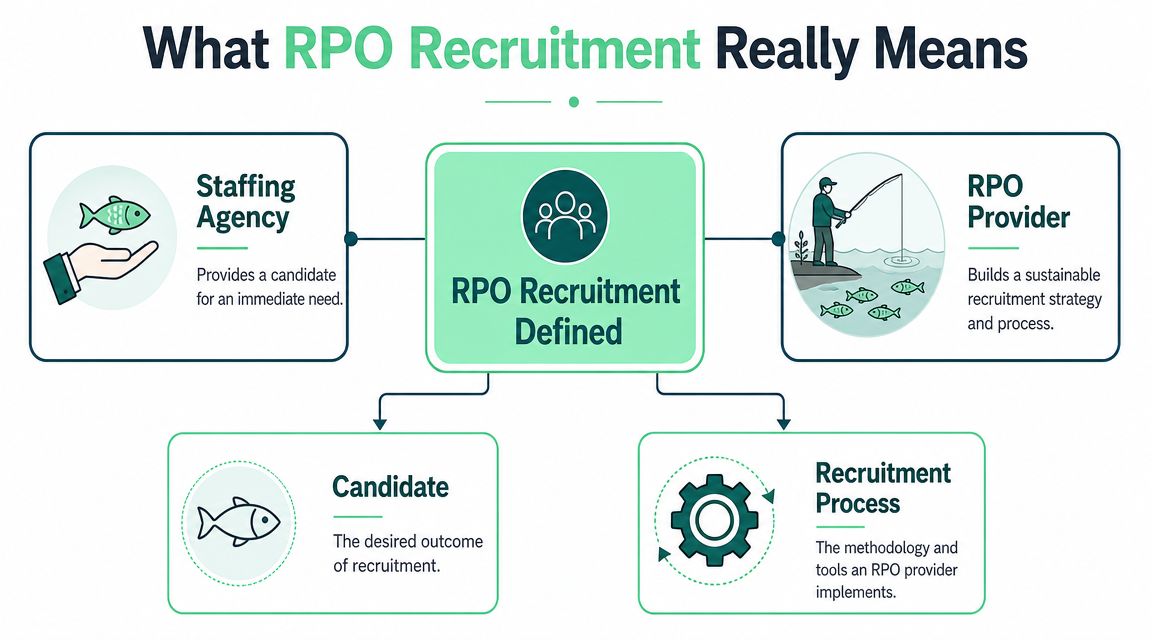
A staffing agency hands you a fish.
An RPO provider builds the pond, trains the fishing team, documents the process, tracks how many fish got away, and then sends you a weekly dashboard about net efficiency. That's useful if you need a system. It's overkill if you just need dinner.
Here's the plain-English difference:
| Model | What you get | What they own |
|---|---|---|
| Staffing agency | Candidates | Candidate delivery |
| RPO | Recruiting process plus candidates | Process design, execution, reporting |
| Contractor recruiter | Extra hands | Usually only the tasks you assign |
A real RPO partner often acts like a rented recruiting department.
They may use your ATS, or bring their own stack. They'll usually help with intake, sourcing, screening, interview workflows, offer management, and reporting. The better ones also enforce consistency across hiring managers, which is more valuable than founders admit. Process variance kills speed.
A recruiter can fill a role. An RPO partner is supposed to make filling roles repeatable.
That's why I don't treat RPO as “just recruiting help.” It's an operating model decision.
If you're asking what is RPO recruitment because you need two SDRs next month, don't confuse “can help” with “right fit.” RPO makes the most sense when the problem is broader than one req. You need structure, process ownership, and a system that can handle uneven hiring demand without hiring a full internal recruiting team.
If you don't need that, buying the whole machine can be wasteful.
Once you sign with an RPO provider, the practical work starts. It is then that the good ones look operational. The bad ones look theatrical.
Most engagements follow a familiar pattern. Intake. Process mapping. Tech setup. Sourcing. Screening. Coordination. Reporting. Optimization. None of that is magic. The value comes from whether they can run those steps cleanly and show you where candidates are leaking out of the funnel.
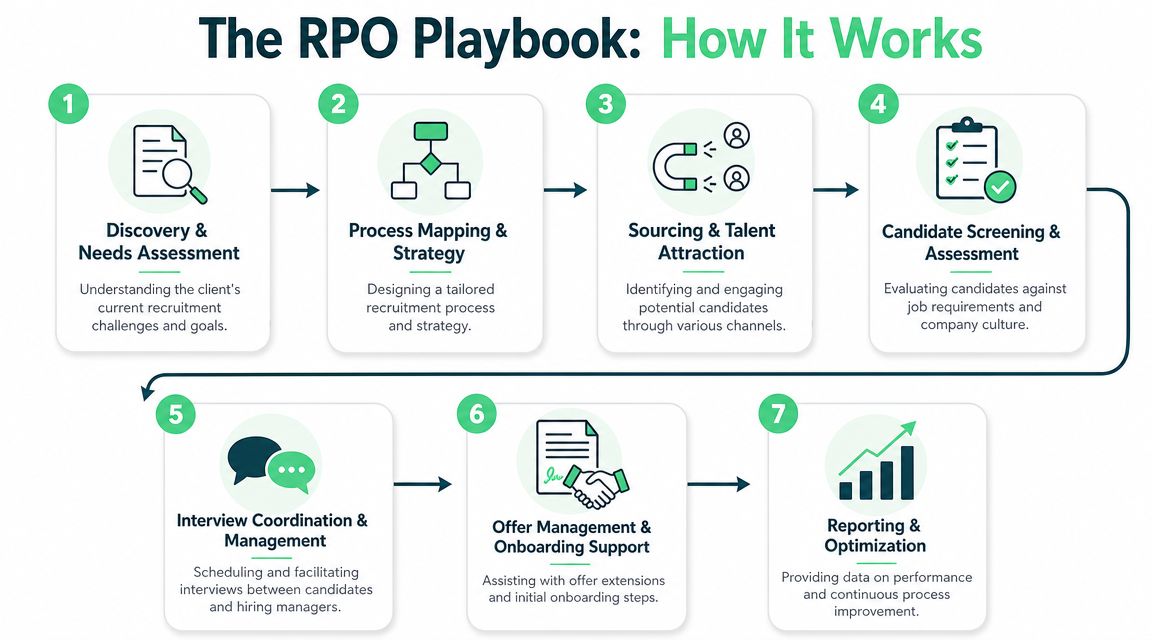
The provider usually starts by pulling apart your current process. If you don't have one, they'll install one.
That includes role intake, sourcing channels, screening criteria, interview stages, scorecards, scheduling rules, and reporting cadence. Many providers also bring recruiting technology into the mix. Oleeo notes that modern RPO commonly uses analytics, automation, ATS workflows, automated screening, scheduling, offer tracking, and onboarding tools to reduce manual work and improve throughput. You can read that in Oleeo's breakdown of RPO technology and automation.
For founders, the practical question isn't “do they use technology?” Of course they do. The question is whether the technology removes friction or just creates another dashboard nobody trusts.
The cleanest way to judge RPO is by funnel conversion, not polished promises.
One published example showed an RPO funnel moving from 10,000 sourced candidates to 2,500 submissions, 1,500 interviews, 450 offers, and 405 hires. That's a useful benchmark because it shows how RPO is supposed to work operationally. It's a throughput model, not a vibes model, as described in Kinetix's example of recruiting funnel metrics in practice.
Here's how to read numbers like that:
You don't need twenty recruiting KPIs. You need a few that affect the business.
Time to fill
How long it takes to move from open req to accepted hire. If the provider can't speed this up, don't pay for a story about “strategic partnership.”
Cost per hire
Not just the invoice. Add internal manager time, tooling overlap, and implementation friction.
Candidate quality
Not resume quality. Actual fit. Can they do the job, ramp, and stick?
Stage-by-stage conversion
This is your diagnosis layer. Without it, you can't tell whether the problem is sourcing, screening, interview quality, or offer handling.
Ask for the funnel by role family, not just one blended dashboard. SDR hiring behaves differently from leadership hiring, and mixed reporting hides weak spots.
If you want to see what transparent hiring outcomes look like in a more specialized model, it's worth reviewing this SDR hiring case study. Not because every business should copy it, but because buyers should expect concrete process visibility.
RPO pricing gets weird fast.
Providers love talking about efficiency. Fine. But the contract structure often matters more than the pitch. A decent model can still become a bad deal if the pricing punishes flexibility, and startups usually need flexibility more than they need a perfectly architected recruiting org chart.
Cost per hire sounds founder-friendly because it feels performance-based. You pay when someone gets hired. Clean, right?
Not always. This model can get painful if you're hiring multiple similar roles quickly, because every hire carries a separate fee. It also encourages narrow optimization. The provider gets paid for filling seats, not necessarily for building a durable hiring system.
Management fee usually means a monthly retainer for an embedded team or defined recruiting service. This can work if you've got steady volume and enough hiring to keep the machine busy.
If hiring slows, that retainer can feel like gym membership economics. Very aspirational. Less delightful on the credit card statement.
Hybrid pricing mixes a lower recurring fee with per-hire charges. In theory, it balances incentives. In practice, you need to read the fine print with the enthusiasm of a tax auditor.
The visible price is rarely the whole price.
Watch for these:
If the provider needs a long contract to make the economics work, that's a signal. It may still be worth it, but don't confuse vendor stability with client value.
I'm skeptical of any hiring solution that requires startup-level faith and enterprise-level commitment.
That's why a lot of younger companies should compare traditional RPO pricing against more flexible recruiting models before signing anything. This breakdown of SDR hiring pricing options is useful for that exercise because it forces the simple question often overlooked by organizations. What are you paying for, and how quickly can you change course if your hiring plan shifts?
If your headcount plan changes every quarter, locking yourself into a rigid recruiting contract is often a self-inflicted wound.
Most companies asking about RPO aren't really asking about RPO.
They're asking, “What's the least painful way to hire good people fast without turning management into a scheduling department?” That's the key question. And for startup founders hiring SDRs, the answer is often different from what works for a large employer building a full recruiting function.
The labor market isn't making this easier. 74% of employers globally report difficulty finding the skills they need, according to Indeed's coverage referencing the 2025 ManpowerGroup Talent Shortage survey. That means your hiring model matters. A lot.
| Model | Best For | Typical Cost | Control Level |
|---|---|---|---|
| In-house recruiting | Companies with steady hiring and strong internal talent leadership | Fixed payroll and tooling overhead | High |
| Staffing agency | Fast, one-off fills when you can tolerate a transactional approach | Usually high per placement | Low to medium |
| RPO | Ongoing or variable hiring where process ownership matters | Retainer, per-hire, or hybrid. Often contract-heavy | Medium |
| MSP | Contingent labor and vendor management, not core direct-hire SDR building | Program-based and operationally structured | Medium |
| RaaS | Growing teams that need recruiting support without full outsourcing baggage | Usually more flexible than classic RPO | Medium to high |
| Talent marketplace | Teams hiring specific roles fast, especially globally distributed SDRs and BDRs | Usually more variable and usage-based | High |
In-house recruiting is great when you've got enough hiring volume to justify a real internal function and enough leadership maturity to run it well. If you don't, you're paying salary for a system that may still be incomplete.
Staffing agencies are the espresso shot of hiring. Fast, energizing, and expensive if you keep ordering doubles. They can work for isolated needs, but they usually don't fix the process.
MSPs are a different beast. Useful in contingent workforce environments. Mostly irrelevant if your core problem is building a direct-hire SDR bench.
Classic RPO wins when the issue is structural. You need recruiting process ownership, consistency, reporting, and the ability to handle more hiring complexity than your team can absorb. For bigger hiring programs, that can be a smart move.
Startup teams hiring SDRs usually don't need an entire outsourced recruiting infrastructure.
They need speed, clear screening, role-specific evaluation, timezone fit, English fluency, and fast adjustments when the hiring brief changes after three customer calls and one rough forecast meeting. That's why RaaS and specialized talent marketplaces are often a better fit for early and growth-stage sales hiring.
These newer models usually give you more agility. Less ceremony. Less contract weight. Better fit when you need a handful of revenue hires, not a full talent acquisition transformation program.
For SDR hiring, specialization usually beats scale theater.
If you're hiring a broad mix of roles across departments, RPO deserves a real look. If you're trying to build an outbound pod quickly, a flexible specialist model often wins on practicality alone.
RPO isn't “good” or “bad.” It's matched or mismatched.
A lot of startups buy it because the hiring pain is real. Fair. But pain doesn't automatically mean full-process outsourcing is the right remedy. Sometimes it means your intake process is sloppy, your role scorecards are weak, or your hiring managers need to stop freelancing the interview loop.
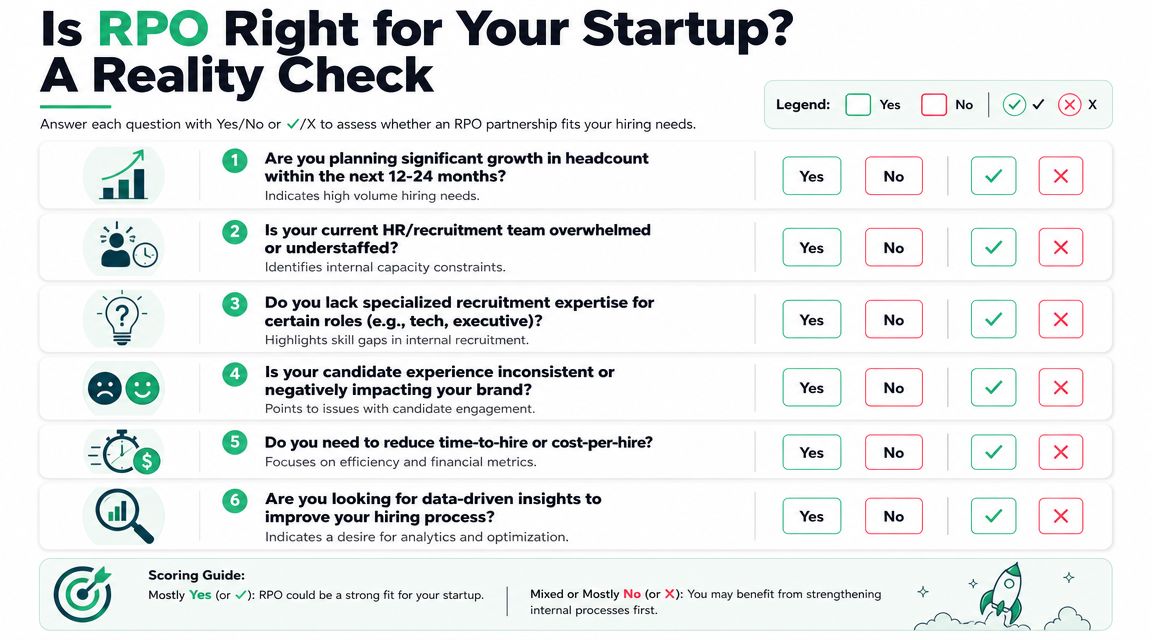
RPO is usually worth serious consideration when most of these are true:
If these sound familiar, slow down:
That last one matters. RPO can reduce workload, but it also introduces vendor management, implementation work, and process decisions that still need leadership attention.
There's another risk buyers keep glossing over. AI in recruiting.
According to Randstad Enterprise's discussion of RPO and AI governance, 32% of firms reported using AI in at least one business function in 2025, and beginner content rarely explains how to govern AI-heavy RPO safely. The same source also notes that the EEOC has warned automated hiring tools can create disparate impact under Title VII.
That means you need to ask ugly but necessary questions:
If a provider says “our AI handles screening” and can't explain governance in plain English, keep your wallet in your pocket.
This is not a legal footnote. It's implementation risk.
Founders usually don't ask broad HR questions. They ask practical ones.
Can this help me hire SDRs fast? Will the provider understand what a good outbound rep looks like? Is this going to become a giant process machine when I just need pipeline next quarter?
Good questions.
Often, yes.
If you're hiring a few SDRs or BDRs and need speed, classic RPO can be more infrastructure than you need. The model shines when you want a repeatable recruiting function across multiple roles or geographies. For a focused sales hiring push, a specialized and flexible model is often cleaner.
That doesn't mean RPO can't work. It means fit matters.
Some do. Many understand recruiting process better than sales motion.
That's a real difference. SDR hiring isn't just “entry-level sales.” You need people who can write clean outreach, handle rejection, speak clearly, research accounts, follow process, and stay productive under repetitive pressure. A provider who mostly hires across generic corporate roles may struggle to screen for that.
Sometimes, but not always in the way founders mean.
RPO can increase speed once the process is live and calibrated. The setup itself can add friction. If you need hires quickly and your spec is narrow, specialized recruiting partners or talent marketplaces often move with less ceremony.
Keep it simple:
And if your actual need is “I need qualified SDR candidates fast, with less internal chaos,” look at a purpose-built option instead of defaulting to enterprise-flavored outsourcing. A focused service to hire SDRs quickly may solve the practical problem with less overhead.
If you came here asking what is RPO recruitment, here's the founder version:
It's outsourcing recruiting as an operating system, not just buying candidates.
That can be smart. It can also be too much. For broad, recurring hiring complexity, RPO is legitimate. For startup SDR hiring, a more flexible model is often the sharper tool.
Buy the solution that matches the problem. Not the one with the nicest slide deck.
If you need SDR hiring speed without a heavy long-term recruiting contract, hireSDR.io is built for that. It helps founders and sales leaders source vetted SDR and BDR talent quickly through a flexible, remote-first model.
You're probably in one of two modes right now. Mode one: you're still taking first calls yourself, hopping from a product standup to a demo,...

Most advice about remote inbound sales jobs is stuck in the same tired loop: post locally, pay through the nose, run endless interviews, then hope...

Your best Account Executive is doing detective work in Apollo, cleaning CSVs, and chasing no-shows instead of closing. Your pipeline has activity, sure, but the...

Tell us who you need. We'll have pre-vetted candidates in your inbox within 72 hours. No commitment until you hire.