
Most advice about remote inbound sales jobs is stuck in the same tired loop: post locally, pay through the nose, run endless interviews, then hope the new rep can handle warm leads without fumbling the handoff. I've done that dance. It burns time, cash, and patience.
The better play is simpler. Stop treating inbound sales like a mystical art practiced only by expensive local hires with polished LinkedIn profiles and suspiciously vague “revenue impact.” Good remote inbound reps are everywhere. The companies winning here know how to define the role, set the right compensation, test for the right behaviors, and hire where the economics make sense.
That matters whether you're trying to get one of these jobs or fill one fast. Applicants need to know what hiring managers care about. Hiring managers need to stop shopping for “sales unicorns” and start building a system.
Founders love to say they want a killer sales rep. What they usually mean is this: “I'd like someone who can qualify leads, run calls, handle objections, update the CRM, close business, work odd hours, write follow-ups, and somehow cost less than my office coffee budget.”
Good luck with that.
The old approach to sales hiring is bloated. You post on the usual job boards, overpay for geographic convenience, sit through interviews with candidates who sound sharp for twenty minutes, then discover they can't manage a live inbound conversation without a script and three Slack lifelines. Hope you enjoy spending your afternoons fact-checking resumes and running mock calls, because that's now your full-time job.
I've made that mistake too. Toot, toot.
A lot of teams still assume the safest hire is someone nearby. That's comforting, not smart. Remote inbound sales isn't about where someone sits. It's about whether they can respond fast, listen well, run a clean process, and move a buyer from interest to decision without chaos.
The market itself tells you these roles are real and competitive. The average annual salary for remote inbound sales representatives in the United States is $58,731, based on 88 active job openings, with base salaries often ranging from $46,000 to $74,000 depending on experience and industry, according to Remote Rocketship's inbound sales representative listings.
That doesn't mean every rep is worth top-of-range pay. It means employers are paying up for people who can convert interest into revenue.
Practical rule: Stop paying for proximity. Pay for judgment, responsiveness, and execution.
Remote inbound sales jobs aren't a compromise anymore. They're a filter. They force both sides to get honest.
For applicants, the role rewards people who can communicate clearly, stay organized, and sell without a manager hovering nearby like an anxious hawk.
For hiring managers, global remote hiring widens the pool and lowers the odds of settling for the “best available” person in one city. That's not a staffing trend. That's basic arithmetic with fewer bad surprises.
Inbound and outbound get mashed together constantly, which is how teams end up hiring the wrong person for the wrong motion.
Here's the clean version. Outbound is hunting. You pick targets, interrupt strangers, and try to create interest. Inbound is guiding. Someone has already raised a hand, clicked a demo request, asked a question, or entered the funnel with intent. You're not chasing game through the woods. You're helping a buyer who already walked into the shop.
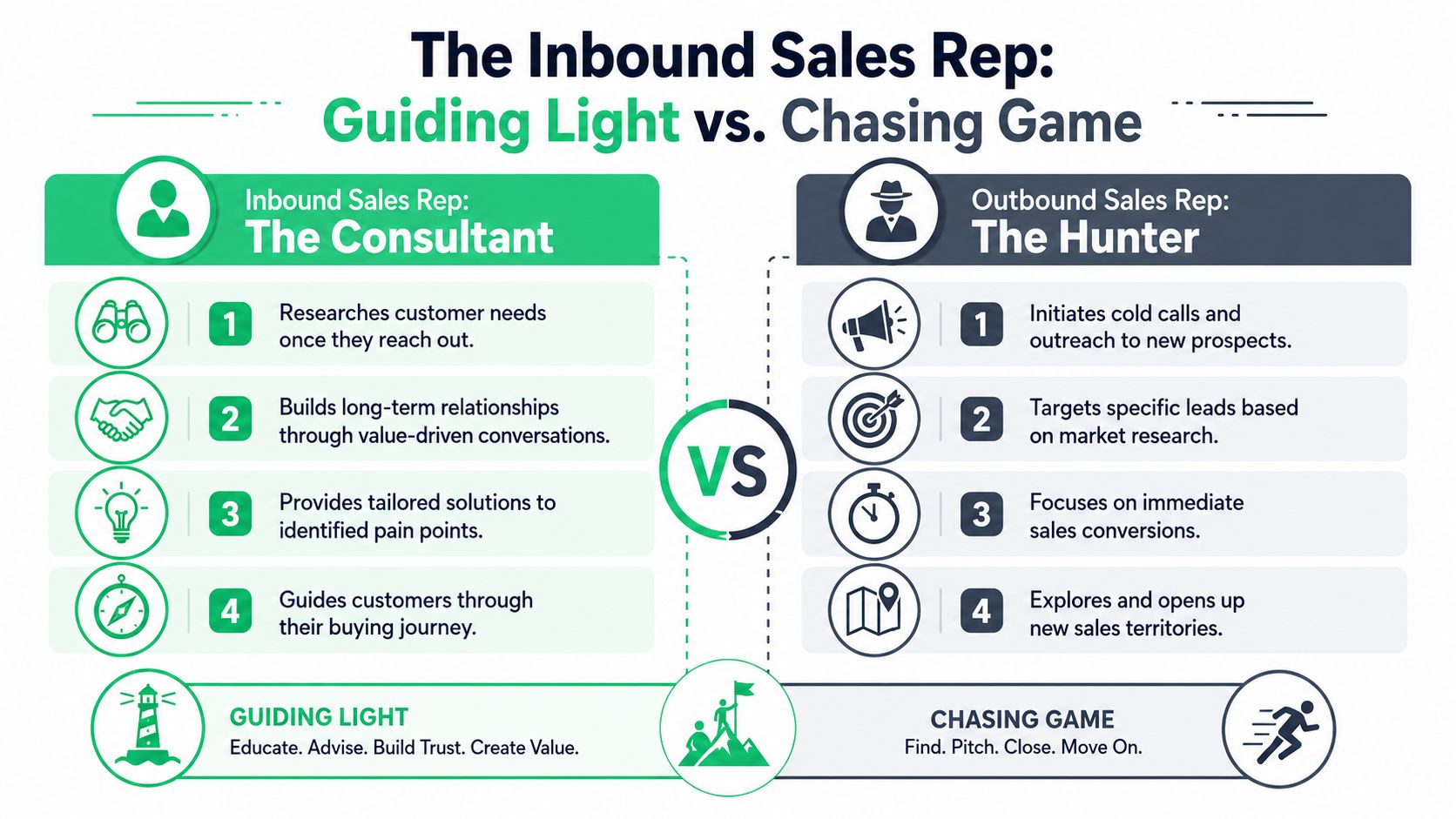
If you want a broader breakdown of where these motions fit inside modern revenue teams, this guide to sales strategies for business growth is useful.
An inbound rep handles leads that already exist. They respond to demo requests, qualify website inquiries, answer product questions, spot buying signals, and keep momentum alive while the lead is still warm.
Think of them as part consultant, part closer, part traffic controller.
They don't just “answer messages.” A good one does the following:
Some teams call the role an Inbound SDR. Others call it a BDR, even when the person isn't doing traditional outbound prospecting. Some fold the whole thing into an inbound-heavy AE role.
Here's the practical difference:
| Role | What they mainly do | Best use case |
|---|---|---|
| Inbound SDR | Qualifies and routes warm leads | High lead volume, shorter qualification step |
| Inbound BDR | Similar front-end work, sometimes with expansion or reactivation | Teams that blend inbound with light outbound follow-up |
| Inbound-focused AE | Runs discovery, demos, and closes warm opportunities | Higher-ticket offers or lean teams |
The best inbound reps don't sound pushy. They sound useful.
Buyers don't need another script reader. They need someone who can make a messy buying decision feel clear.
That means they ask sharper questions than average. They handle objections without sounding defensive. And they know when to push, when to pause, and when to disqualify.
That's the job. Not smiling on Zoom and “building relationships” in the abstract. Moving a live buyer toward a decision with speed and competence.
Most salary talk around remote inbound sales jobs is nonsense. Not malicious nonsense. Just lazy averages mixed together until nobody knows what a realistic offer looks like.
One site says the role pays one thing. Another says something wildly higher. Then a founder builds a budget on bad assumptions, or a candidate walks into an interview expecting enterprise-level money for a generalist inbound seat at a startup. That conversation usually ends badly.
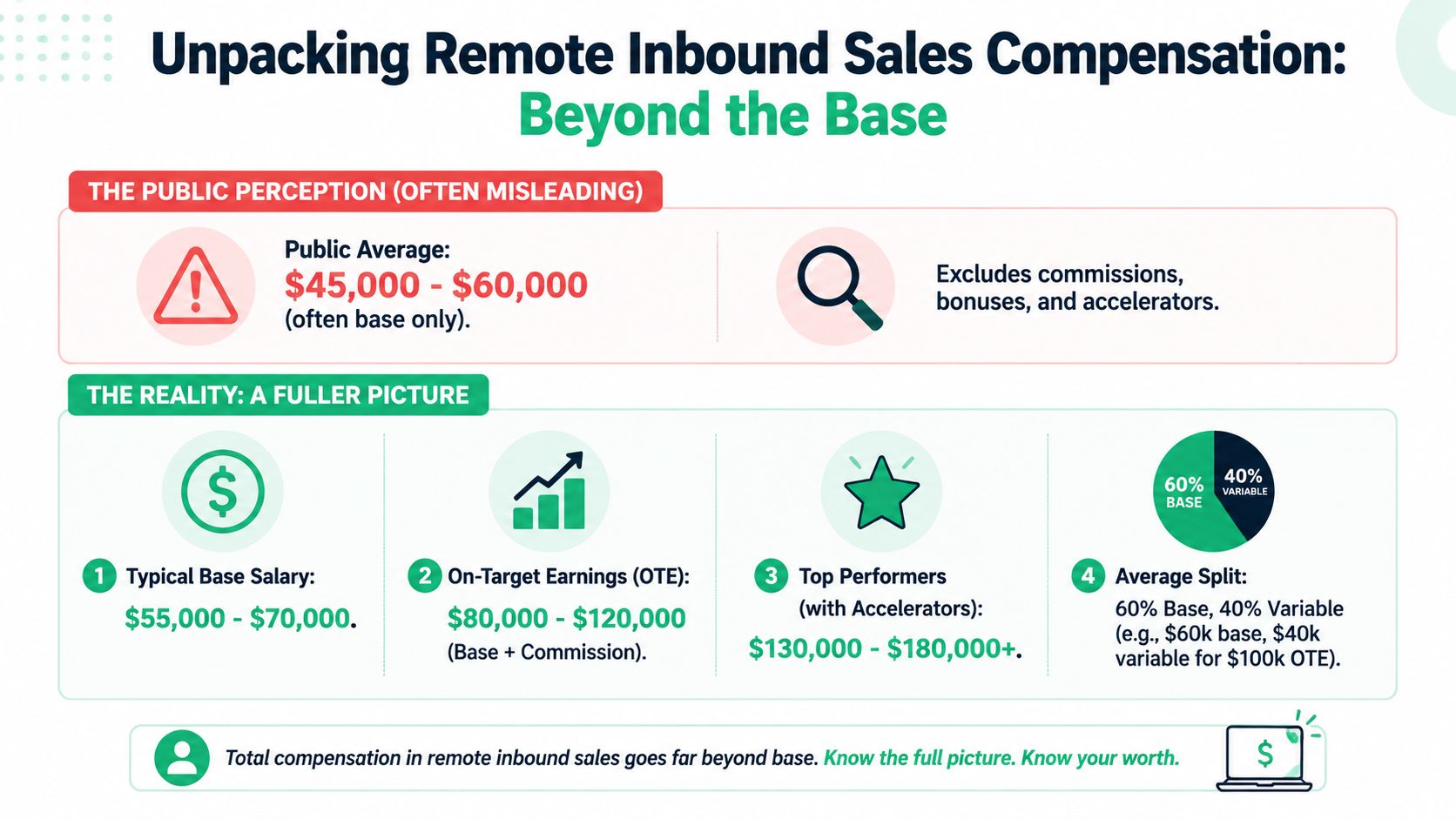
ZipRecruiter puts remote inbound sales roles in the U.S. at an average of $42,488 annually, or $20.43 per hour, with the 25th percentile at $32,000 and the 75th percentile at $50,000, which means most workers land between $15 and $24 per hour according to ZipRecruiter's remote inbound sales salary data.
Then you get another view from Glassdoor, which reports remote Inbound Sales Representatives in the U.S. at an average of $96,806 per year, but that figure is inflated by corporate insurance and enterprise roles, making it a shaky benchmark for startup hiring, as noted in Glassdoor's salary page for remote inbound sales representatives.
Those numbers are not interchangeable. One captures a broader market reality. The other gets pulled upward by a specific slice of higher-paying roles.
If you're hiring or applying, stop asking “what does the role pay?” and ask “what does this version of the role pay at this level?”
DailyRemote shows entry-level remote sales positions with 0 to 1 years of experience starting between $40,000 and $55,000 annually, while senior-level roles with 5 to 9 years jump to $80,000 to $105,000. That's a 2.1x+ pay gap, based on DailyRemote's sales salary breakdown.
That's not a rounding error. That's the difference between “promising junior rep” and “trusted operator who can own deals without supervision.”
Software sales muddies the picture even more. Built In reports remote Software Sales Representatives in the U.S. at an average base salary of $63,275, with total compensation reaching $224,563, including $91,813 in cash bonuses, and 7+ years of experience pushing base pay to $175,500, according to Built In's remote software sales representative salary data.
Useful? Yes. Typical for most inbound roles? Not even close.
If you're a candidate, don't wave SaaS compensation screenshots around like they're universal truth. If you're a hiring manager, don't benchmark your inbound rep role against enterprise software packages and then act shocked when your budget catches fire.
Use salary bands like a grown-up. Match compensation to complexity, deal size, and experience. Don't buy a senior operator when you need a responsive qualifier. Don't hire an entry-level rep and expect seasoned objection handling on day three.
For candidates looking for stable remote sales careers, pay attention to whether a posting clearly separates base salary from variable pay. If it doesn't, ask. Politely, early, and without the weird dance.
Compensation confusion doesn't help anyone. Clarity closes faster than optimism.
Most applicants still treat remote inbound sales jobs like generic customer service roles with commission attached. That's a mistake. Hiring managers can smell that in about ten seconds.
This job is closer to controlled chaos. You're expected to communicate well, think on your feet, manage tools properly, and keep momentum alive without someone tapping your shoulder every hour. If you want the job, show that you can already operate that way.
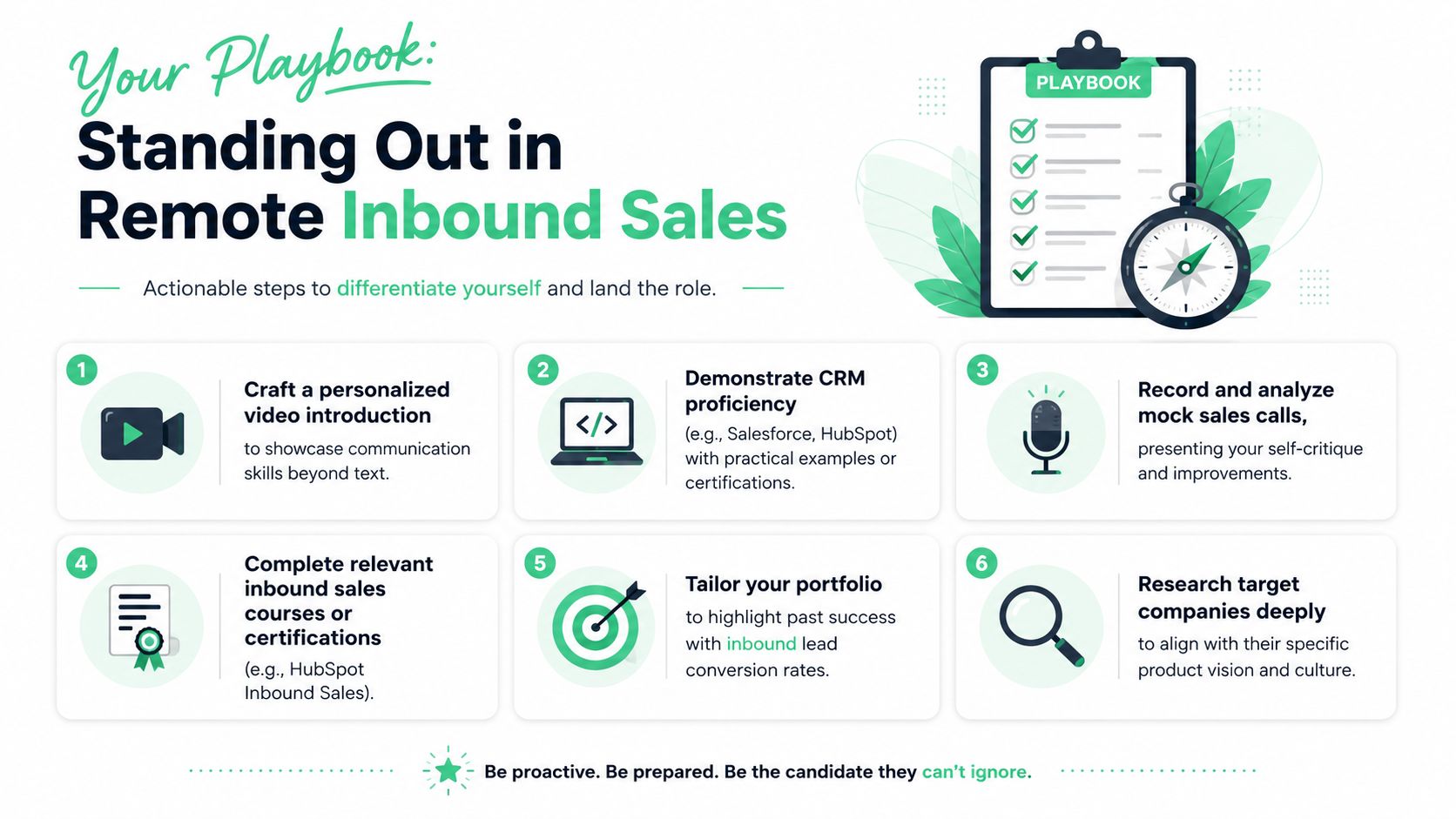
This isn't glamorous, but it matters. Remote inbound sales agents must demonstrate proficiency in specific technical stacks, including low-latency operating systems and USB-based audio hardware, to ensure call clarity and enable 1-call close execution within a 24-hour sales cycle, based on Indeed job requirements for high-paid inbound sales roles.
Translation: if your audio is muddy, your machine lags, or you fumble basic tools, you don't look “remote.” You look expensive to manage.
Put your setup on your resume or application notes when relevant. Mention Windows 11 Home or Pro if that's your environment. Mention your headset. Mention the CRM tools you've used. Yes, really. Specifics beat adjectives.
A lot of applicants have experience from customer support, intake, hospitality, recruiting, or account coordination. That's fine. The problem isn't the background. The problem is the framing.
Don't say:
Say what the work did:
If your resume bullets are still soft and vague, use StoryCV's resume bullet point guide to tighten the language. Many job seekers don't need a prettier resume. They need sharper proof.
Interviewers want evidence that you can operate without babysitting. Give them that.
A strong remote inbound candidate should be ready to discuss:
Response discipline
How do you prioritize fresh leads? What do you do when several hit at once?
Tool fluency
Can you move comfortably inside Salesforce, HubSpot, or another CRM while staying present on a call?
Self-management
How do you structure your day when nobody is looking over your shoulder?
Judgment
Which leads deserve immediate attention, and which ones should be disqualified?
Bring one short story about a messy buyer conversation you turned into a clean next step. That's the stuff people remember.
Record yourself answering common questions. Listen back. Fix the filler words. Tighten your answers. Do mock calls with a friend. Write follow-up emails after the practice call.
None of this is complicated. It just feels like work, which is why many won't do it. Convenient for you.
If your hiring process for inbound reps starts and ends with LinkedIn, you're not running a strategy. You're browsing.
The problem with local job boards and generic inbound resumes is simple: they tell you almost nothing about how a person will perform in a live remote environment. You get polished summaries, vague quota references, and enough buzzwords to wallpaper a conference room.
For U.S. companies, Latin America is the obvious starting point. Companies hiring in the region save between $35,000 and $64,000 per hire annually compared to U.S. equivalents, achieving cost savings of 30% to 70% while maintaining full working-hours overlap with U.S. business hours, according to Hire With Near's guide to hiring remote sales talent.
That's not the whole story, but it's enough to wake up any founder still insisting every rep needs to live within driving distance of headquarters.
The same source notes that Latin America, particularly Colombia, Brazil, and Mexico, stands out for U.S. companies hiring remote sales talent, with Colombia accounting for 23% of all nearshore sales placements in 2025 and BDR and SDR roles topping placement data for two consecutive years. If you want timezone overlap and strong English fluency, that's a practical place to look.
A solid inbound hire isn't just “good with people.” That's how teams talk themselves into weak operators.
Look for these traits instead:
The interview should not feel like a personality contest. It should feel like a work sample with consequences.
Here's the hiring stack I'd use:
| Stage | What to test | Why it matters |
|---|---|---|
| Application review | Writing quality and role relevance | Filters out generic applicants fast |
| Live mock call | Listening, objection handling, clarity | Reveals real selling ability |
| CRM simulation | Notes, follow-up, pipeline hygiene | Shows whether they can work inside a system |
| Scorecard debrief | Coachability and consistency | Prevents “I just liked them” hiring |
If you want more frameworks for screening and structuring remote talent teams, Hire Sense resources are worth browsing.
One practical option in this category is hireSDR.io's remote SDR guide, especially if you need pre-vetted remote sales candidates and don't want your managers buried in first-round screening.
A good hire can still fail with bad onboarding. Remote makes that more obvious, not less.
New inbound reps need rhythm fast. Day one shouldn't feel like being dropped into twelve Slack channels, a dusty Notion wiki, and a half-working CRM login while someone says, “just shadow a few calls.” That's not onboarding. That's abandonment with branding.
Give them three things immediately:
By the middle stretch, reps should be doing more than shadowing.
Use mock calls, recorded call reviews, and written follow-up drills. Have them explain the product in plain English. Make them run through objection scenarios. Review their CRM entries like it matters, because it does.
Remote reps don't need surveillance. They need clean systems, fast feedback, and no mystery about what's expected.
By the end of the first 90 days, the rep should handle inbound conversations with minimal hand-holding, leave usable notes, and know when to advance, nurture, or disqualify.
If that's not happening, don't hide behind “they're still settling in.” Either the hiring call was wrong or the onboarding was lazy. Usually one of those. Sometimes both.
Remote inbound sales jobs are one of those categories where lazy assumptions cost real money. Candidates get misled by inflated salary chatter. Founders hire for charisma instead of process. Managers confuse warm-lead handling with generic inside sales. Then everyone wonders why conversion quality feels mushy.
It doesn't have to be that messy.
The practical version is straightforward. Define the role clearly. Pay according to actual scope and experience. Screen for judgment, communication, and system use. Hire from markets that give you real talent and sensible economics. Then onboard like performance matters from week one. Radical concept, I know.
We built remote hiring workflows because the old version was too slow, too expensive, and too dependent on luck. You don't need more resumes. You need fewer, better ones, screened against real work.
If that's what you're after, start with Hire SDRs.
If you want a faster way to find remote inbound sales talent without spending your week buried in screening calls, take a look at hireSDR.io. You can review pre-vetted candidates, see who fits your sales motion, and move from sourcing to interviews without doing the hard way all over again.

Your VP of Sales wants more pipeline. Your CFO wants lower burn. You want both, and you're tired of pretending another overpriced SDR hire in...

You probably know this scene a little too well. Your CRM says the quarter looks alive. Your SDRs are booking meetings. Your AE says there's...

You're probably here because you need to hire revenue talent, you searched sales executive salaries, and Google handed you a neat little number that looked...

Tell us who you need. We'll have pre-vetted candidates in your inbox within 72 hours. No commitment until you hire.