
You probably know this scene a little too well.
Your CRM says the quarter looks alive. Your SDRs are booking meetings. Your AE says there's “good momentum.” Then you look closer and realize half the pipeline is built on polite interest, fake urgency, and one enthusiastic manager who can't buy anything without six other people.
We've been there. More than once.
At one point, we had remote SDRs hustling across time zones, founders jumping into “promising” calls, and a forecast that looked healthy right up until it smashed into reality. The problem wasn't effort. It wasn't even messaging. The problem was that we were letting unqualified deals eat qualified time.
That's what a sales qualification framework is for. Not to make your reps sound like robots. Not to impress RevOps with a shiny acronym. It's there to act like a bouncer for your pipeline. If a lead can't answer the right questions, it doesn't get to consume your team's calendar, attention, demos, proposals, and emotional stability.
And yes, emotional stability matters. Founders do enough unpaid therapy already.
A leaky pipeline rarely looks leaky at first.
It looks busy. Calendars are full. Slack is noisy. Somebody says, “We've got a lot of top-of-funnel activity.” Toot, toot. Then the meetings start slipping. Follow-ups get vague. Procurement appears out of nowhere. The person who “loved the demo” suddenly needs to “circle back next quarter.”
That's not bad luck. That's weak qualification.
We made this mistake the hard way. We treated interest like intent. If someone took a call, asked smart questions, and nodded at the right moments, we let them into pipeline. Big error.
A real pipeline has friction by design. A decent sales qualification framework forces your team to test whether the account fits, whether the problem is painful enough to matter, and whether there's a real path to a decision. Without that, your CRM becomes a storage unit for wishful thinking.
Practical rule: If your reps can't explain why a deal should close beyond “they seemed interested,” the deal is not qualified.
This gets worse in fast-growing startups because everyone is tempted to keep deals alive. Founders want optionality. SDRs want meetings. AEs want pipeline coverage. Nobody wants to be the person who disqualifies what might become revenue.
So garbage stays in the system.
A lot of teams try to fix this by pushing productivity harder. More calls. More follow-ups. More sequences. That helps only if the underlying filter works. If it doesn't, you're just scaling waste.
If you're trying to tighten rep output, this guide on how to improve sales productivity is useful, but productivity only pays off when qualified work sits underneath it.
Here's what weak qualification usually creates:
Qualification is not a discovery script. It's a control system.
That's the shift most startups miss. A rep asking a few budget questions is not a system. A repeatable standard for deciding what enters pipeline is a system. One protects your time. The other creates busywork and false confidence.
If your pipeline feels heavier every month but revenue doesn't, stop adding leads. Fix the gate.
A sales qualification framework is your team's shared decision model for saying, “Yes, this deal is real enough to pursue.”
That's the practical version. No buzzwords. No laminated enablement nonsense.
It gives SDRs, AEs, founders, and RevOps one common language for judging deal quality. Without it, every handoff turns into an argument. SDR says the lead was good. AE says the lead was junk. Founder gets dragged into the replay like a tired school principal.
Here's the better way to think about it.

A good framework doesn't tell reps to ask the exact same sentence every time. It tells them what coordinates they must collect before they move a deal forward.
That matters because selling isn't linear. Calls go sideways. Prospects ramble. Stakeholders appear late. Your reps need flexibility in conversation, but not flexibility in standards.
A proper sales qualification framework answers questions like these:
If those answers are fuzzy, your rep doesn't need better persuasion. Your rep needs to qualify harder.
One reason qualification frameworks still matter is that the core buying questions haven't changed much.
A foundational historical fact is that BANT emerged from IBM in the 1950s, and it remains one of the most widely recognized models because it checks budget, authority, need, and timeline, as explained in this overview of sales qualification frameworks.
That's old. Very old. Yet it stuck because the underlying logic is durable. Does the prospect have money? Does a decision-maker exist? Is there a real problem? Is there a meaningful timeline?
Those are still the bones of almost every modern framework.
Most startups think qualification is for reps. It's not. It's for the whole revenue team.
When everyone uses the same standard, a few good things happen fast:
| Team | What the framework fixes |
|---|---|
| SDRs | They know what counts as a legit meeting |
| AEs | They inherit cleaner opportunities |
| Managers | They can coach to specific gaps instead of vague “better discovery” advice |
| Founders | They stop getting surprised by fake pipeline |
A framework should make deal quality visible before the quarter ends, not after.
And that's why we like frameworks that are structured but not theatrical. If your process takes ten minutes to explain and nobody follows it on live calls, you don't have a framework. You have a slide deck.
There are dozens of frameworks. Typically, only a handful require understanding.
Here's the honest version. Some are useful. Some are useful only in specific conditions. Some become CRM wallpaper the second you hire your third rep.
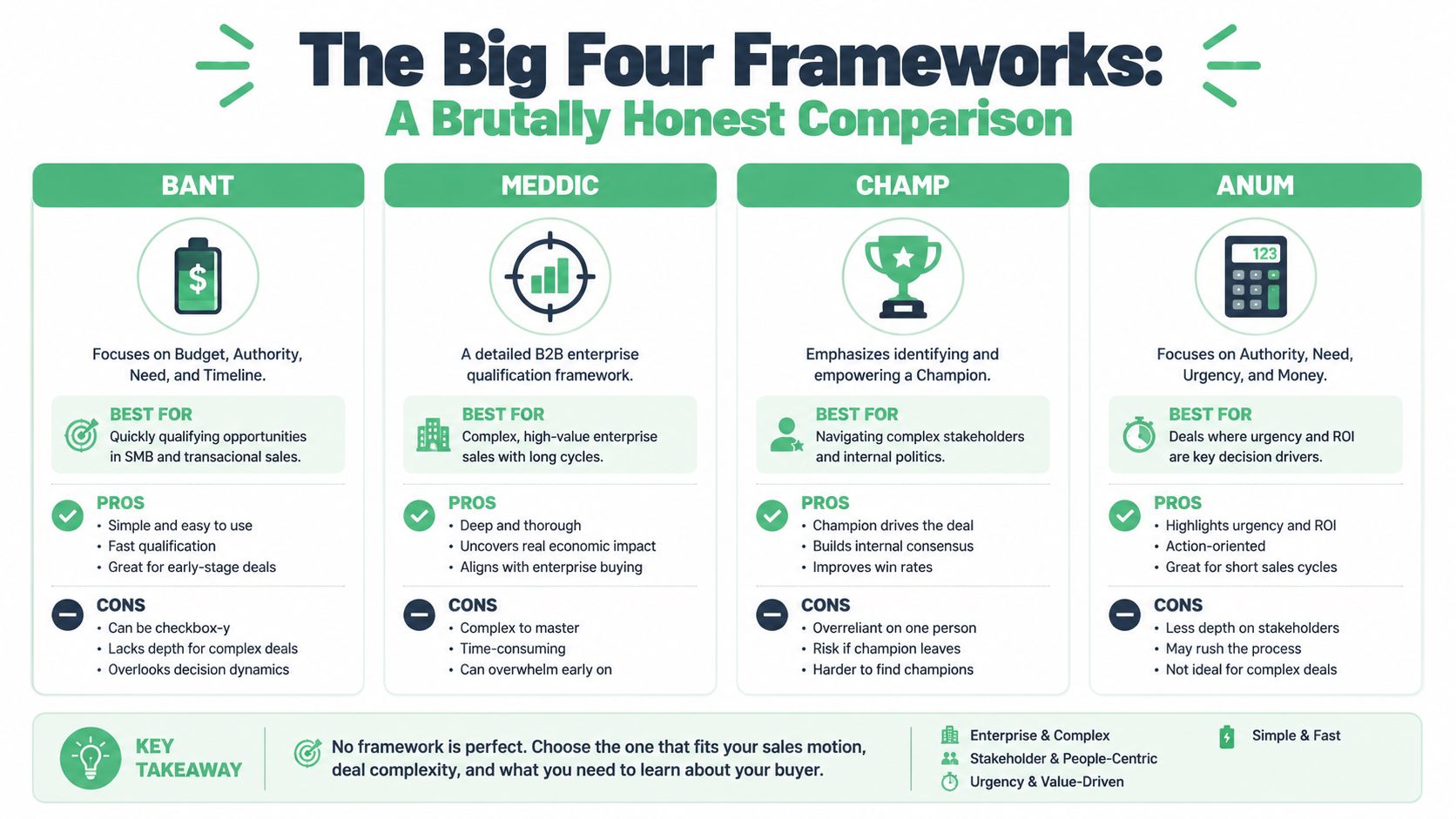
BANT is the classic. It checks budget, authority, need, and timeline.
That sounds basic because it is basic. Which is not the same as useless.
For early teams, BANT works well as a forcing function. It keeps reps from calling every curious person a pipeline opportunity. If your team is young, your ACV is modest, and you need a common qualification language fast, BANT is a solid place to start.
But let's not romanticize it. BANT can be clumsy in modern B2B sales, especially when buyers don't reveal budget early or when authority is spread across multiple stakeholders. Reps can also use it lazily and turn discovery into an interrogation.
Our take: good starter framework, weak finishing framework.
MEDDIC is where things get serious. For higher-complexity deals, it operationalizes qualification around Metrics, Economic Buyer, Decision Criteria, Decision Process, Identify Pain, and Champion, as outlined in Outreach's guide to sales opportunity qualification.
This is useful because each part maps to a different way a deal can die. Missing metrics weakens the ROI case. Missing the economic buyer blocks budget access. Missing the decision process creates those maddening late-stage stalls where everyone “likes the solution” and nothing happens.
MEDDIC is powerful. It is also very easy to abuse.
If you sell into larger accounts, have multiple stakeholders, or keep losing deals in procurement or approval stages, MEDDIC can save you from expensive stupidity. It forces discipline where startups usually wing it.
If you're selling a relatively simple product with short cycles, MEDDIC can become theater. Your reps will fill in fields they don't understand, managers will pretend the data is clean, and everyone will privately resent the CRM.
If your deal size and sales motion don't justify MEDDIC, don't cosplay enterprise sales.
CHAMP usually resonates better with startup teams because it starts with the customer's challenge, not your internal checklist. That makes it feel more natural in discovery.
The appeal is obvious. If there's no meaningful challenge, who cares about budget or authority? You shouldn't advance a deal just because someone can pay. They also need a problem worth solving.
For startup sales, this is often the most practical mindset. Reps can focus on whether the pain is real, whether someone inside cares enough to move it, and whether the issue has enough priority to beat all the other internal distractions.
Its weakness is also obvious. Teams can fall in love with “pain” and ignore funding reality or decision structure until too late.
Our take: best default for many fast-growing startups, especially with lighter customization.
ANUM is basically BANT with authority moved to the front.
That's not a bad tweak. In many startups, reps waste absurd amounts of time with people who are smart, engaged, and completely unable to buy. Pushing authority earlier can clean that up.
Still, ANUM doesn't feel radically different in practice. It's more like a sharper version of BANT than a new worldview. If your team already likes BANT but keeps getting trapped with non-decision-makers, ANUM is a reasonable upgrade.
If we had to summarize it in one sentence, it's this: choose the framework your team will use under pressure, not the one that looks smartest in onboarding docs.
Most advice on qualification says “it depends,” then disappears into a fog of diagrams. We hate that. Founders need a decision, not a philosophy seminar.
So here's the blunt version.
If your team is tiny, your motion is fast, and your buyers can make decisions without a committee, don't overengineer this. A lightweight framework wins because your reps can remember it, use it, and coach against it.
If your deals involve multiple approvals, technical review, procurement friction, or a genuine business case, your qualification needs more structure. Otherwise you'll keep confusing friendly conversations with real progress.
For a lot of early-stage teams, this works well:
And if your team still argues about whether inbound and outbound leads should be qualified the same way, fix that too. This breakdown of the difference between inbound and outbound sales is worth reviewing because the qualification bar and context often differ.
For most fast-growing startups with remote SDRs, we'd choose a customized CHAMP-style framework.
Why? Because it starts where good startup selling should start: with a problem that matters. Budget matters too, obviously. We enjoy getting paid. But asking budget-first questions too early can make junior reps sound like they're guarding the minibar.
A practical startup version usually centers on:
| Priority | What you need to know |
|---|---|
| Challenge | Is the problem painful enough to justify change? |
| Authority | Can this person drive the process or bring in the buyer? |
| Money | Is there a believable path to funding? |
| Priority | Will this get worked on now, not “sometime this year”? |
That's enough structure to keep standards high, without turning every discovery call into a corporate hostage note.
Picking a framework is the easy part. Getting people to use it correctly is where most startups faceplant.
The fix is not more training slides. The fix is operational simplicity.
A robust framework should verify six variables before a lead enters pipeline: ICP fit, problem severity, authority, funding path, purchase date, and product match. When teams enforce shared criteria, RevOps gets a consistent MQL-to-SQL standard and forecasting becomes more reliable, as noted in Highspot's framework guidance.
That's the standard. Here's how to install it without hiring a consultant who bills like a boutique law firm.
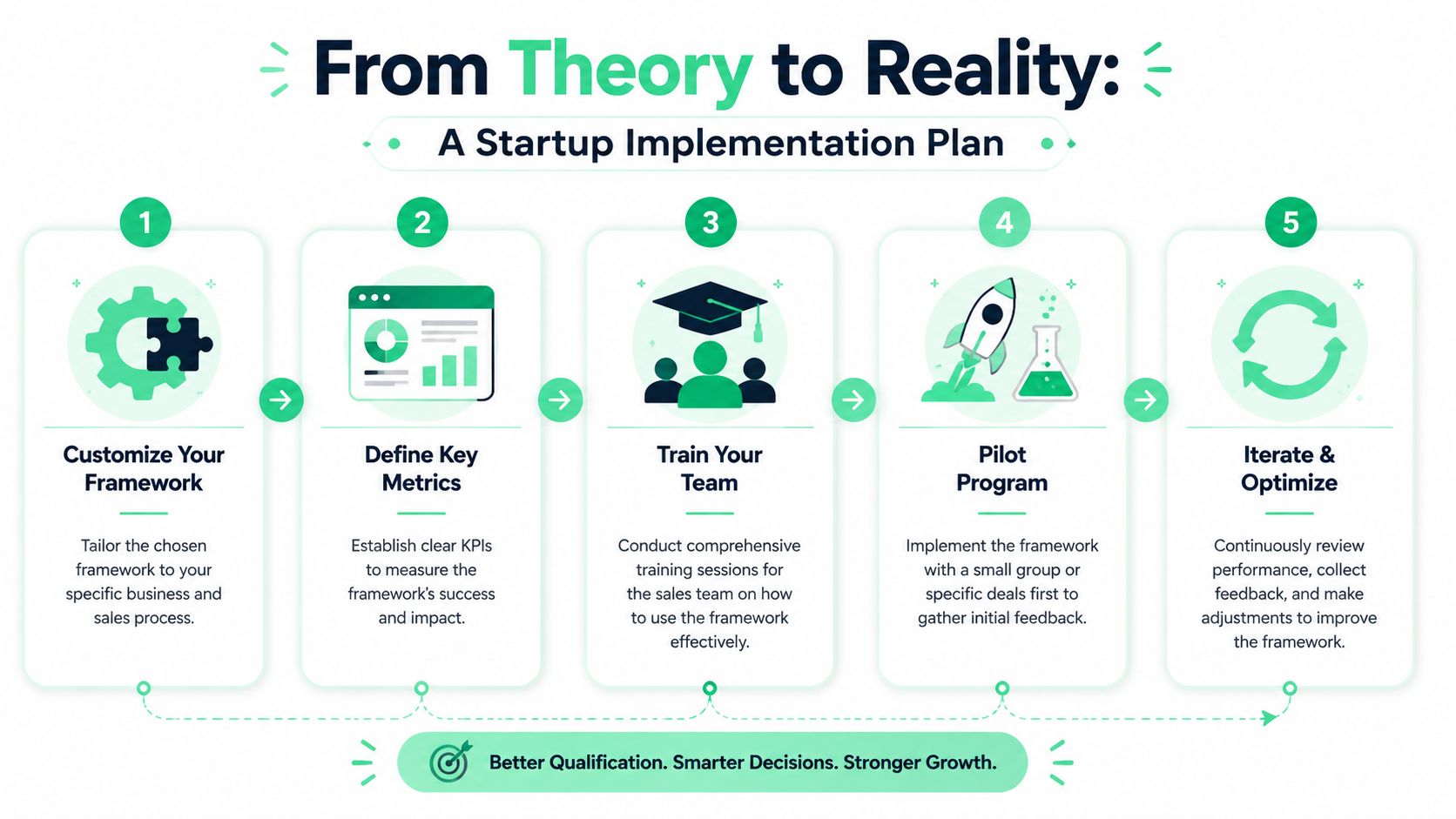
Don't deploy any framework out of the box.
Take the model you chose and rewrite it in your team's language. If your SDRs need a glossary to understand the fields, you already lost. “Economic buyer” might stay. “Compelling event” might become “why now.” “Product match” might become “can we solve this without custom nonsense?”
Start with fewer required fields than you think you need. Teams adopt simple systems. They ignore ornate ones.
At this point, good intentions usually die.
Create a small set of mandatory fields tied to stage progression. If a rep moves a lead into pipeline, they should have to document the basics. Keep the fields tight, clear, and inspectable.
A simple startup setup might include:
You can also use a lightweight internal score. Not because the score itself is magical, but because it forces reps to summarize deal quality with discipline.
This part matters more than the acronym.
Bad qualification sounds like this:
Good qualification sounds like this:
Same goal. Better conversation.
The best reps don't dodge qualification. They ask smarter questions.
You do not need a two-day enablement retreat. You need examples.
Use recorded calls. Tag moments where reps uncovered real pain, missed authority, skipped next-step validation, or accepted vague urgency. Then coach in public patterns and private specifics.
A simple weekly routine works:
The handoff between SDR and AE tells you whether your framework is real or decorative.
If AEs keep saying, “This wasn't qualified,” don't settle it with opinions. Check the fields. Check the call. Check whether the SDR collected the agreed evidence. If not, the framework wasn't followed. If yes, then your criteria need updating.
That's the point. A sales qualification framework should evolve with your motion.
Not weekly. Don't turn this into interpretive dance. But if the same deals keep dying for the same reason, update the process and retrain the team.
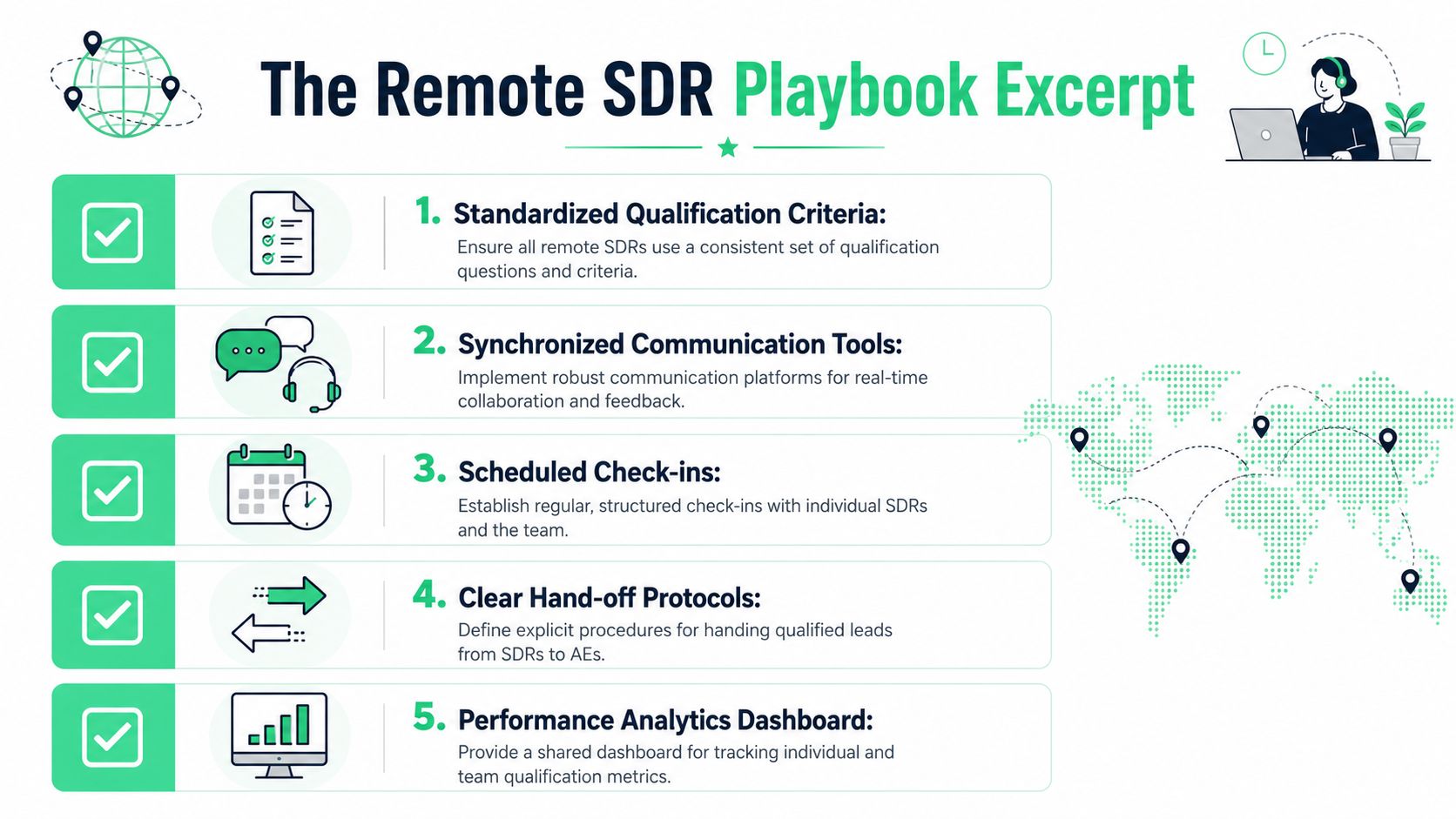
Qualification gets harder when your SDR team is remote. Not because remote reps are worse. Because inconsistency spreads faster when managers can't overhear live calls and fix things in the moment.
If you're hiring across time zones, you need more than “good English” and a pulse. You need structured thinkers who can follow a qualification system without sounding scripted.
A lot of founders overvalue confidence in SDR interviews. Big mistake.
An SDR can be charming and still hand you unusable meetings all week. What you want is someone who can listen, organize information, and decide whether a lead deserves scarce sales time.
One of the best interview tests is simple: ask the candidate to qualify you.
Tell them you run a startup and are considering hiring SDR support. Then ask them to lead the qualification conversation. Strong candidates won't just pitch themselves. They'll ask about your sales motion, ICP, handoff process, urgency, and decision criteria.
If you're building a distributed team, this guide to the remote sales development representative role is a solid reference point for what to expect operationally.
Most SDR onboarding is backwards. Teams start with product features, pricing, and tools. Qualification comes later.
For remote teams, qualification should come first because it shapes every conversation from day one.
Your onboarding checklist should include:
Remote SDR leaders get trapped by activity dashboards. Calls made. Emails sent. Tasks completed. Fine. Useful, but incomplete.
If your qualification is weak, those metrics just tell you people were busy.
Watch outcomes that reveal quality instead:
| What to inspect | Why it matters |
|---|---|
| Qualification completeness | Shows whether reps are capturing what the framework requires |
| Meeting acceptance by AEs | Exposes weak handoffs fast |
| Progression from first meeting to next stage | Tests whether SDRs are teeing up real opportunities |
| Call review trends | Reveals repeated misses in authority, urgency, or pain |
Remote teams don't need more supervision. They need clearer standards and faster feedback loops.
Call recording tools help here because managers can coach asynchronously. That matters when one SDR is in Manila, another is in Bogotá, and your AE is somewhere between Slack notifications and despair.
Consistency is the whole game.
| Question | The Short, Honest Answer |
|---|---|
| Do we really need a formal sales qualification framework this early? | Yes, if more than one person is touching leads. The earlier you define standards, the less junk enters pipeline. |
| Should SDRs and AEs use the exact same framework? | They should use the same core criteria, but at different depth. SDRs screen. AEs validate and expand. |
| Is BANT outdated? | Not outdated. Incomplete for many modern deals. Good starting point, not always enough by itself. |
| When should we move to MEDDIC? | When deals involve multiple stakeholders, internal approvals, or repeated late-stage stalls. |
| Can we combine frameworks? | Yes. In fact, most good teams do. Just don't create a Frankenstein process nobody remembers. |
| What's the biggest qualification mistake? | Treating interest like intent. A prospect liking the demo doesn't mean they can buy. |
| How many fields should we track in the CRM? | Fewer than your RevOps instincts want. Enough to inspect deal quality. Not so many that reps fake the data. |
If you need SDRs who can follow a qualification framework instead of spraying meetings into your calendar and calling it pipeline, hireSDR.io is worth a look. They help founders and revenue leaders build remote SDR and BDR teams fast, with pre-vetted talent and cross-border hiring support, so you can spend less time screening candidates and more time fixing the part that matters: pipeline quality.

You're probably here because local hiring feels like a bad joke. You post for an SDR, get a pile of mediocre applicants, spend weeks interviewing,...

You're probably doing the math right now. You want an SDR. You've got a salary number in your head. Maybe you've even built a neat...

Your best Account Executive is doing detective work in Apollo, cleaning CSVs, and chasing no-shows instead of closing. Your pipeline has activity, sure, but the...

Tell us who you need. We'll have pre-vetted candidates in your inbox within 72 hours. No commitment until you hire.