
Most advice on hiring a remote sales development representative is nonsense.
It treats the role like a bargain-bin staffing exercise. Find someone cheap, hand them a script, plug in Salesforce, and wait for meetings to appear. That advice sounds efficient right up until you're paying for bad outreach, chasing missed follow-ups, and discovering that "low cost" talent somehow became your most expensive sales experiment.
I've done the old way. Expensive local hires. Random freelancers. Agencies with shiny decks and suspiciously vague vetting. The result was the same more often than I'd like to admit: a lot of activity, not much pipeline, and a management burden nobody mentioned on the sales call.
A remote sales development representative can absolutely be a force multiplier. But only if you stop hiring for cheap labor and start hiring for operational fit.
The worst remote SDR advice starts with price.
Not role design. Not process. Not target market. Just price. Founders get sold the fantasy that a remote sales development representative is basically a low-cost human autoresponder who can smile on Zoom, say "just following up," and somehow manufacture pipeline from thin air.
That's how you burn cash with a lower hourly rate.
The remote SDR role isn't some sketchy gig-economy side category anymore. It's a real, standardized hiring lane with defined compensation bands. One industry article notes that remote work had already become common enough that about 63% of SDRs were allowed to work remotely, and the same piece cites ZipRecruiter data showing average yearly pay for remote SDRs in California at $54,297, with most workers earning between $41,400 and $60,200 and a median wage of $49.8K. It also points to a Remote job listing with a compensation range of $31,500 to $88,100 USD for a full-time SDR, which tells you the market is broad but very much real, not improvised (remote SDR compensation bands and historical adoption).
That matters for one reason. Mature roles punish lazy hiring.
If the market already knows what this job looks like, then your edge doesn't come from underpaying. It comes from building a sharper system for selecting, onboarding, and managing the right person.
Practical rule: If your entire hiring thesis is "we found someone cheap," you don't have a hiring thesis. You have a future cleanup project.
A bad SDR doesn't just cost salary. They waste leads, muddy your CRM, annoy the market, and force your closer to sit through junk meetings. Then you replace them and pay the same onboarding tax all over again.
The old office-bound model had its own mythology too. Hire nearby, overpay for "culture fit," and hope proximity fixes weak execution. It doesn't. A mediocre rep in your office is still a mediocre rep. They just get free snacks.
Here's the blunt version:
A remote sales development representative should be hired like an operational role tied to pipeline creation. Because that's what it is.
A good remote sales development representative doesn't spend the day mindlessly hammering out cold calls.
They manage a territory, a queue, a message map, and a follow-up rhythm. They're at the top of the funnel, doing the part most founders pretend is "simple" right up until nobody books meetings.
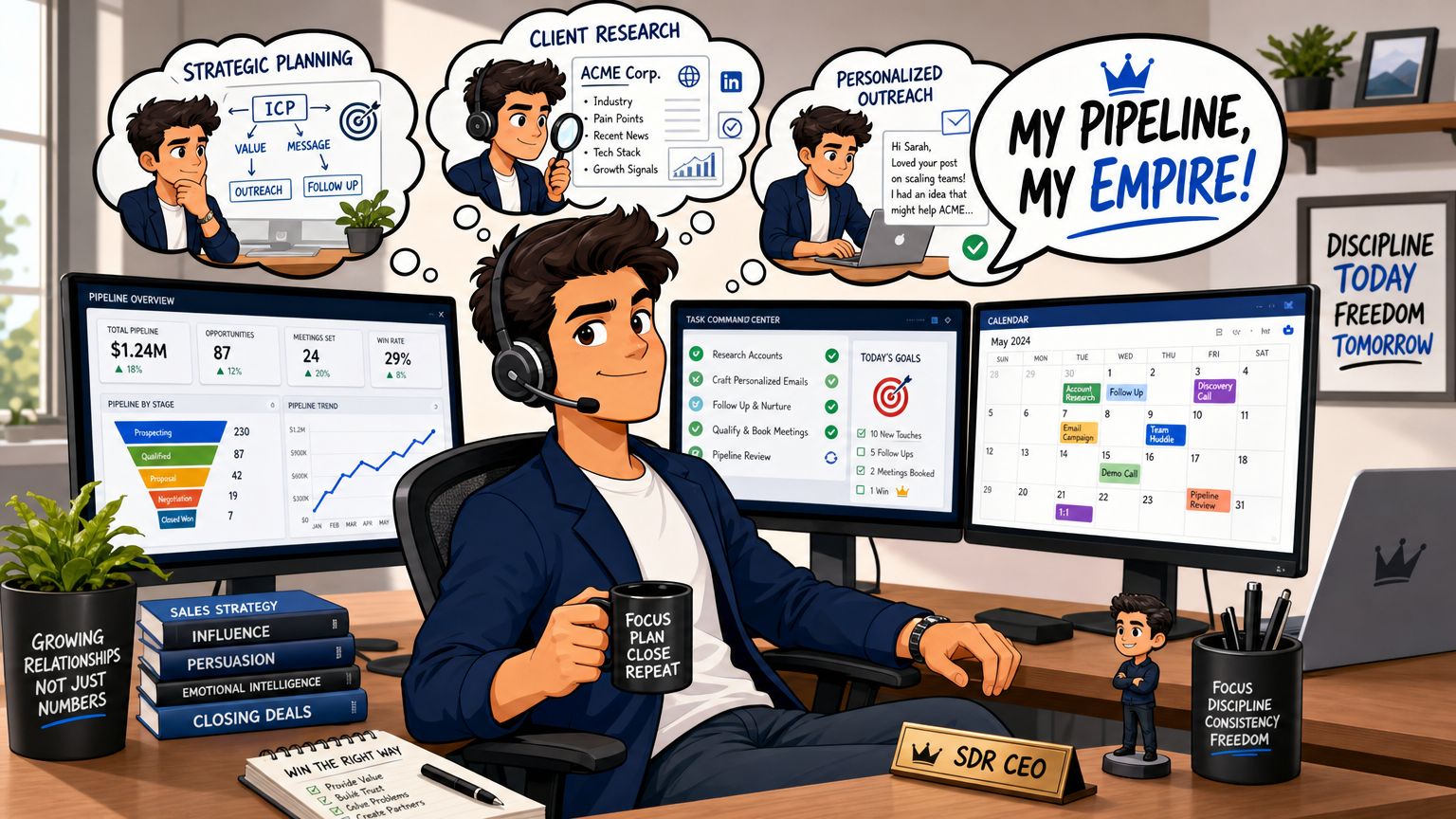
Coursera's overview of the role describes the SDR as responsible for outbound sales and marketing activities at the start of the funnel, including finding prospects, initiating contact, and generating qualified leads for closers. It also notes an average U.S. base salary of $62,000, with experienced SDRs with 15 or more years reaching an average base pay of $72,000. That's a useful reminder that this is a structured revenue role with clear responsibilities, not an improvised assistant position (SDR role responsibilities and salary benchmarks).
The day-to-day work usually falls into a handful of buckets, but the order matters as much as the tasks.
A competent rep usually works in loops, not random bursts.
That last one is where most weak hires fall apart. They like the idea of outreach more than the repetition of it.
Remote work adds a layer of operational discipline that office managers used to fake with proximity.
Everwall's remote SDR role is refreshingly honest about it. The job requires a rep who can convert time zones correctly because customers are globally distributed, and it includes outreach through email, phone, LinkedIn, plus CRM updates in Pipedrive and Trello (remote SDR territory and time-zone execution).
That sounds small until you watch a rep call Europe at the wrong hour, miss U.S. windows later in the day, and then wonder why connect rates are lousy.
A remote SDR isn't just doing outreach. They're deciding when outreach has the best chance to land.
A strong remote sales development representative usually treats the calendar like part of the playbook. They know when buyers are available, when follow-ups go stale, and when a "quick call" is a terrible idea because the prospect is clearly offline.
If you're hiring this role, expect consistency more than theatrics.
The right rep should be able to:
| Daily area | What good looks like |
|---|---|
| Prospecting | Clear account fit, relevant contacts, no list junk |
| Messaging | Concise, personalized, and tied to buyer pain |
| Calls | Confident openers, decent objection handling, clean handoff |
| CRM updates | Accurate notes, next steps, and zero mystery fields |
| Follow-up | Persistent without becoming annoying |
The reps who win remotely aren't always the loudest. They're the ones who can run a repeatable cadence without someone hovering behind them pretending to "coach."
Resumes lie. Not always maliciously. Sometimes they just exaggerate in an optimistic, career-enhancing sort of way.
Every SDR resume says some version of the same thing. Prospecting, CRM, cold outreach, hunter mentality, self-starter, team player. Wonderful. Very moving. Completely useless if you're trying to predict who can build pipeline from a laptop without needing daily rescue.
I don't care if a candidate can recite a sales acronym. I care whether they know how to think.
Good remote SDRs get curious in practical ways. They look at the account, spot what changed, infer what might matter to the buyer, and adjust the message. They don't blindly shove the same script into every inbox and call it "scale."
A rep with real curiosity asks better questions on calls too. They don't interrogate prospects like a budget chatbot. They listen, probe, and adapt.
Remote SDR work rewards boring excellence.
Remote job postings now spell this out more clearly than founders do. Remote's SDR opening requires applications and CVs in English, names tools like Salesforce, LinkedIn Sales Navigator, and Nooks, and uses a structured hiring funnel that includes recruiter screening, a mock call, and a bar-raiser interview. That's a strong signal that the market wants tool fluency, communication quality, and proof that the candidate can operate inside a CRM-driven workflow from day one (Remote SDR tool stack and interview standards).
That should change how you screen people.
Look for signs like these:
My rule of thumb: If a candidate resists structure, they'll resist accountability five minutes after you hire them.
This one sounds soft. It isn't.
A remote sales development representative gets feedback constantly if the team is managed properly. Messaging gets revised. Targeting changes. Talk tracks tighten. If a rep hears feedback as an attack, you've hired a future excuse machine.
Coachability shows up in small moments:
The best hires aren't blank slates. They're fast editors of their own behavior.
A few things impress inexperienced founders and shouldn't.
| Overrated signal | Better signal |
|---|---|
| Fancy logo on the resume | Can they explain what they specifically did |
| High activity claims | Can they show judgment and follow-through |
| Generic "great communicator" line | Strong English under pressure in live role-play |
| Years of experience alone | Ability to learn your market and process quickly |
A remote SDR who prints money isn't magic. They're curious enough to find relevance, disciplined enough to execute the playbook, and humble enough to improve fast.
Let's talk about the lie everybody likes because it fits nicely in a spreadsheet.
You see a low hourly rate for an offshore SDR and think you've hacked labor economics. Great job. Silicon Valley should probably call. Then reality arrives with payroll obligations, management overhead, slower ramp, replacement costs, and compliance headaches nobody mentioned in the ad copy.
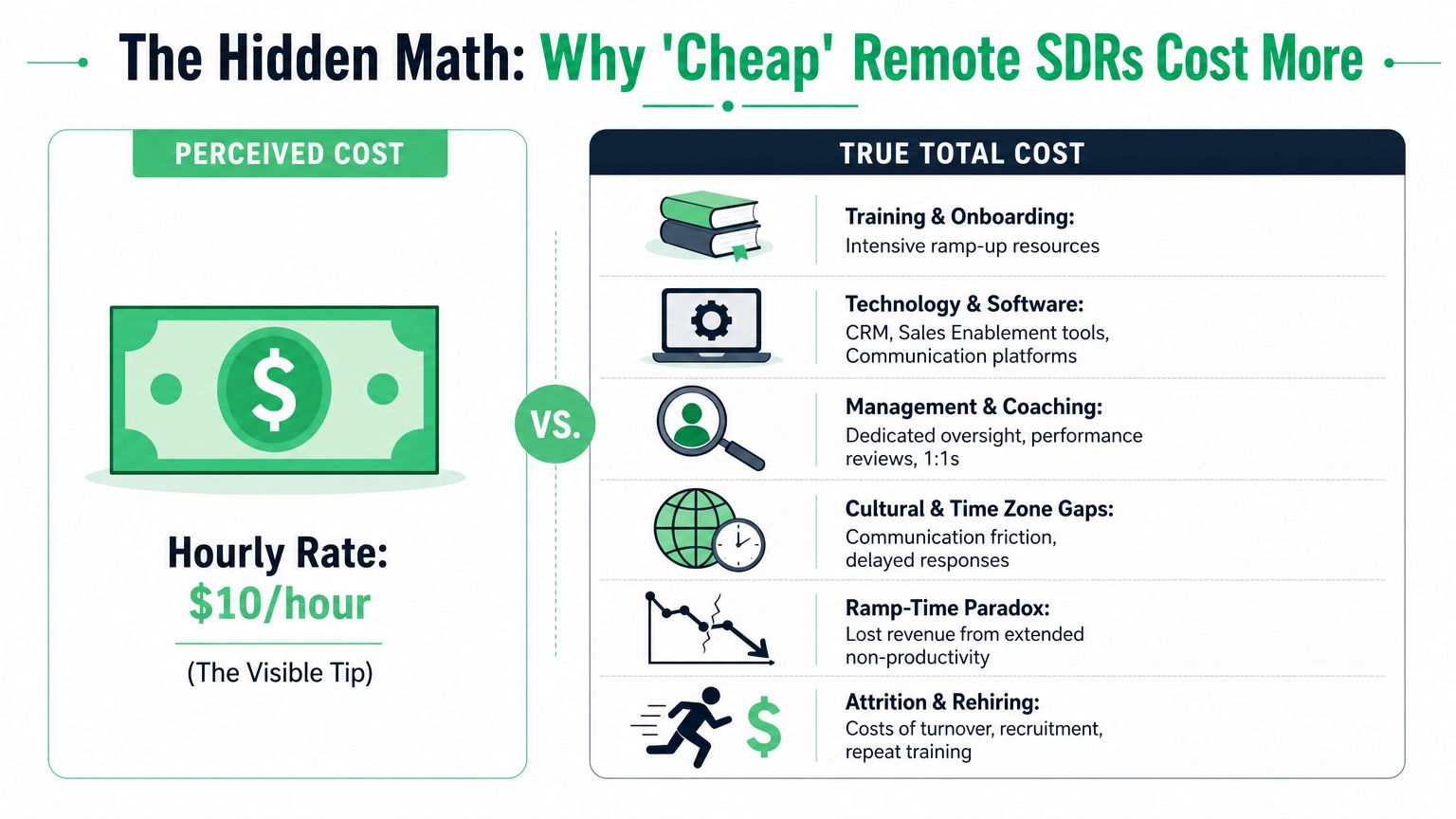
The most useful overlooked concept in remote hiring is the fully loaded labor rate. If you're only comparing wages, you're doing toddler finance. You need to account for payroll, tools, management time, onboarding, and compliance exposure. This breakdown of fully loaded labor rate mechanics is the kind of math founders should do before they congratulate themselves on "saving money."
The hidden compliance tax is real. The verified data here makes that painfully clear: hidden costs from local payroll mandates, benefits, and statutory contributions can inflate a $6/hour rep to $12/hour, and 40% of U.S. firms with remote international teams face unexpected compliance penalties or double-taxation issues in the first year.
If you're hiring across borders, "cheap" can disappear fast.
Founders usually underestimate four things.
Cheap talent with expensive supervision is not cheap talent.
Here's the table most sales teams should build before they hire.
| Cost Factor | US In-House SDR | DIY Global Remote SDR | Managed Remote SDR (e.g., hireSDR.io) |
|---|---|---|---|
| Base compensation | Higher cash outlay | Lower visible rate | Lower visible rate than most U.S. in-house hiring |
| Compliance admin | Usually simpler if domestic | Often complex across jurisdictions | Typically handled by provider or embedded in model |
| Payroll and benefits | Employer-managed | Country-specific and variable | Centralized support is often included |
| Sourcing burden | Internal recruiting load | Internal recruiting load | Provider handles shortlist creation |
| Vetting burden | Internal team runs process | Internal team runs process | Screening is usually pre-done |
| Ramp risk | Still significant | Significant, plus cross-border friction | Still present, but process can reduce chaos |
| Management load | High if rep is weak | High if rep is weak or misaligned | Lower sourcing burden, but rep still needs management |
| True cost predictability | Moderate | Often poor | Usually better than DIY if terms are clear |
That doesn't mean managed talent partners are automatically the right answer. It means founders should compare all-in cost, not fantasy cost.
A low rate is seductive because it's visible. The ugly stuff isn't.
You don't see the time your sales leader spends rewriting bad emails. You don't see the calendar damage from unqualified meetings. You don't see the opportunity cost when a rep spends weeks sounding busy without creating useful pipeline.
And then there's compliance. If your team gets hit with penalties, or if tax and payroll obligations were misunderstood at the start, congratulations. Your bargain hire just became a finance problem.
A remote sales development representative can absolutely reduce labor costs. But the right comparison is not "U.S. salary versus offshore salary." It's reliable pipeline creation at a predictable all-in cost.
That's the math that matters.
If your interview process is one pleasant Zoom chat and a vague discussion about "grit," don't act surprised when the hire turns out to be all charm and no pipeline.
Remote SDR hiring needs friction by design. Not bureaucratic nonsense. Useful friction. You want enough structure that weak candidates get exposed before they're in your CRM talking to your market.
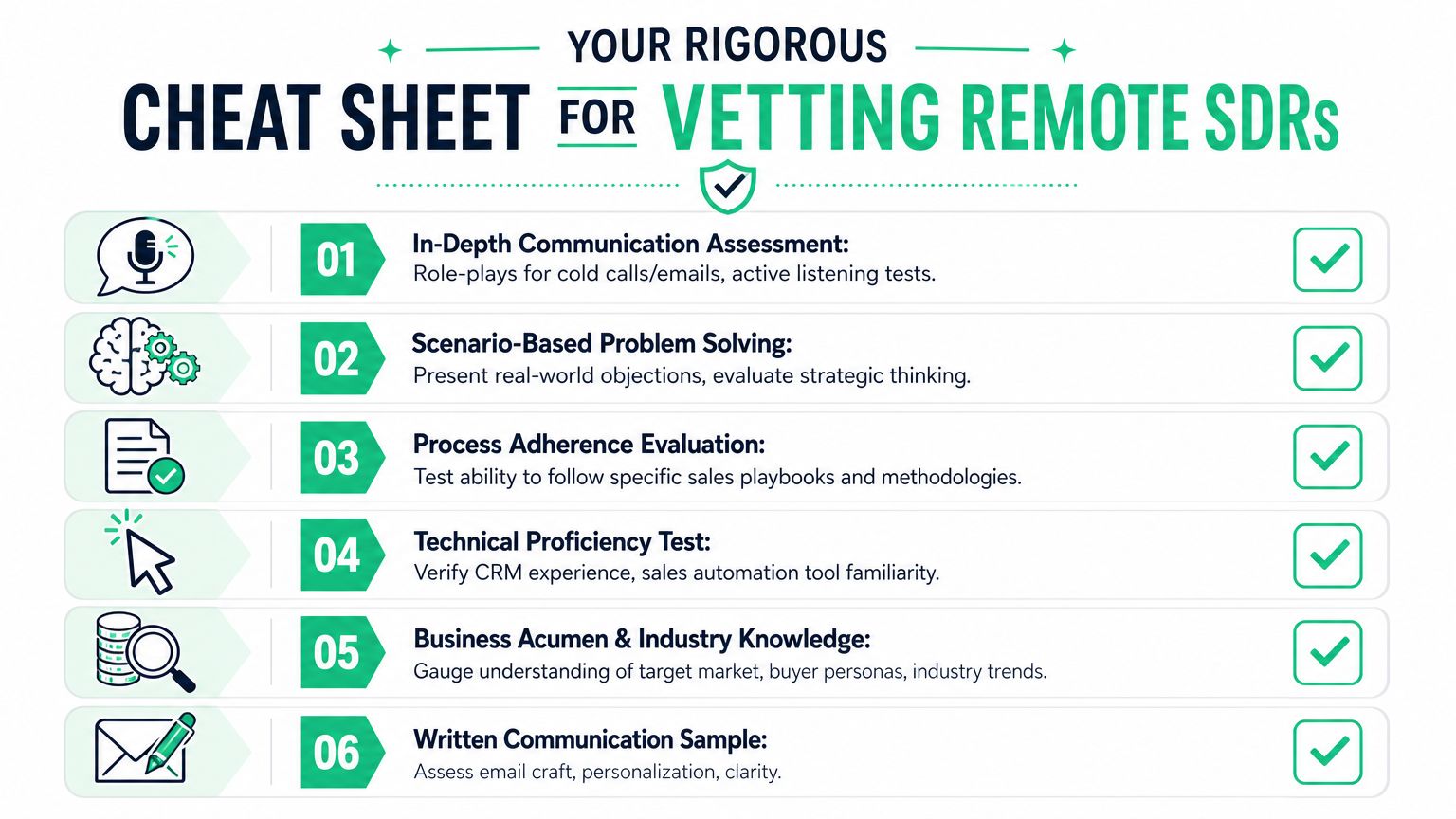
I strongly prefer a skills-first approach over resume worship. That's one reason skills-based hiring is more useful than pedigree-based hiring for SDR roles. The work is observable. So observe it.
A remote sales development representative should prove they can write, speak, think, and follow process. If they can't do those four things in your interview flow, no brand-name employer on the resume will save them.
Use a sequence that tests live performance, not storytelling.
Run a communication screen
Have them answer simple situational questions in English. You're listening for clarity, brevity, and whether they ramble when pressure shows up.
Use a mock cold call
Give them a basic prospect scenario. See how they open, how they respond to brush-offs, and whether they can keep the conversation structured.
Ask for a written sample
Give them a target account and ask for a prospecting email. You want relevance, not fake cleverness.
Test tool literacy
Ask how they use Salesforce, LinkedIn Sales Navigator, sequencing tools, and note-taking practices in real workflows.
Probe for reflection
Ask about a deal or sequence that underperformed. Strong candidates own the miss and explain the adjustment.
If a candidate looks polished only when talking about the past, but shaky when asked to do the work live, you've learned something valuable.
Most founders ask lazy questions and get polished nonsense back. Ask questions that force the candidate to reveal how they think.
Notice what's missing. No "Where do you see yourself in five years?" nonsense. You're not hiring a prom date.
A useful reference call is short and direct.
| What to verify | Why it matters |
|---|---|
| Follow-through | SDR work dies without consistency |
| Coachability | Messaging and targeting always change |
| Communication quality | Remote reps live in calls, emails, and notes |
| Reliability | Missed tasks become missed pipeline |
| Process adherence | Freelance energy doesn't scale in a team |
Ask former managers whether the rep needed heavy supervision, whether they took feedback well, and whether they'd hire them again for the same role. Then stop talking and listen.
Hiring the rep is the easy part. The hard part starts the moment they join and realize your product, market, message, and sales process are all messier than your interview deck suggested.
Founders often get burned by the "plug-and-play" fantasy. A candidate can have SDR experience and still fail badly in your environment.
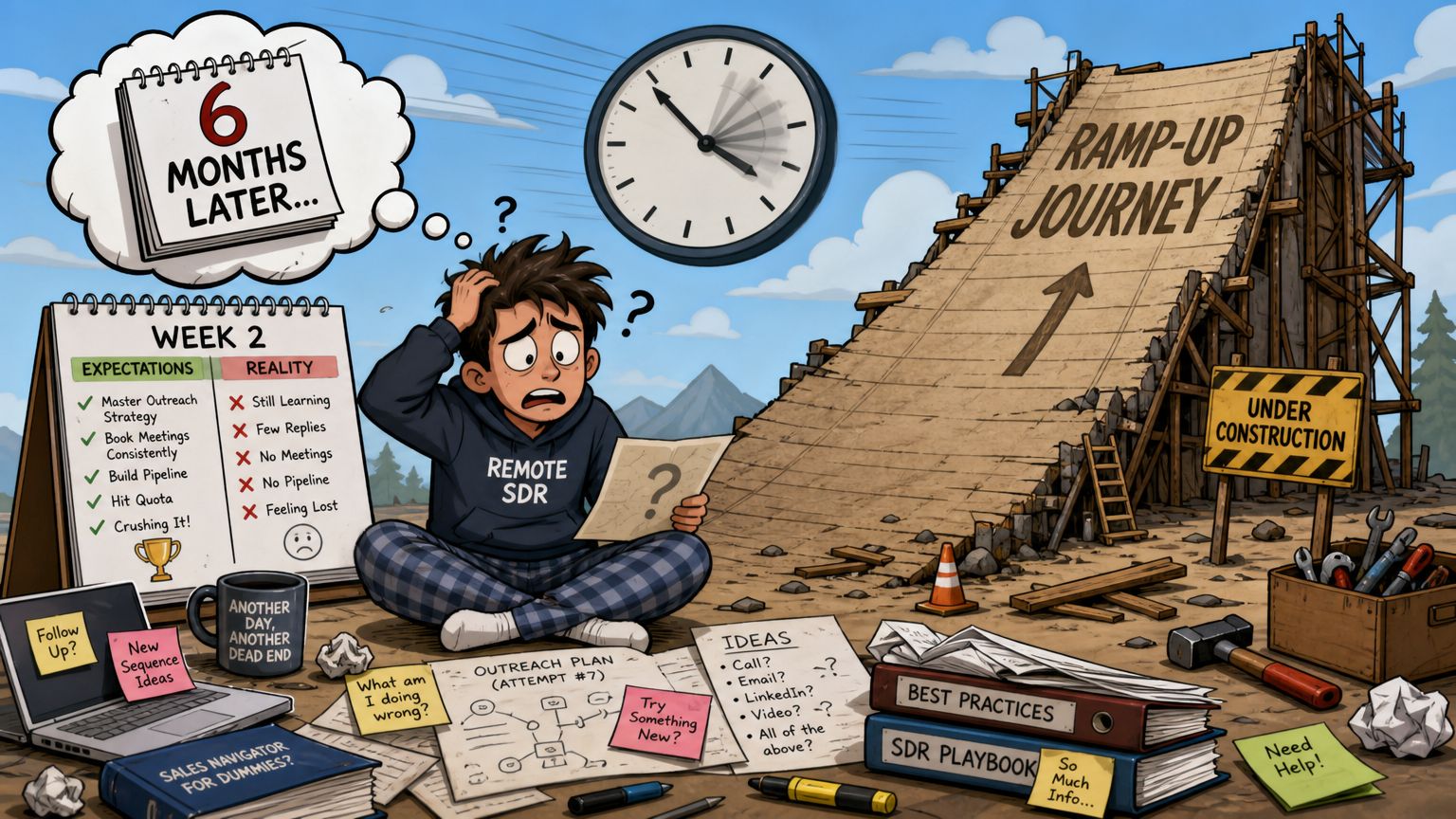
The verified data is blunt here. A 2025 Salesforce report found 68% of new remote SDRs need 3 to 5 months of training to reach 80% of quota. That's the ramp-time paradox in one sentence. Fast hiring doesn't equal fast revenue.
This gap often comes from missing industry context and weak cultural fit, not raw sales incompetence. In other words, your hire may know how to prospect in general but still not know how to prospect for you.
That's why onboarding has to be operational, not ceremonial.
A useful first month is built around progressive exposure.
Week one should narrow the world.
Teach the product, the ICP, common objections, the CRM rules, and what a qualified meeting means. New reps don't need every slide your company has ever produced. They need signal.
Week two should add controlled reps.
Use role-play, call shadowing, objection handling, and message practice. Review real accounts. Rewrite bad emails together. Make quality visible.
Week three should introduce supervised execution.
Let them start outreach with guardrails. Review notes, check follow-ups, and audit whether they understand account fit.
Week four should shift toward measured independence.
Now you're looking for consistency. Can they manage their book of business without losing the plot?
Train the rep on your judgment, not just your product. Product facts don't book meetings by themselves.
If you only evaluate booked meetings, you'll miss the reasons performance is breaking down.
I prefer a simple scorecard built around daily and weekly behaviors:
This is also where management cadence matters. Daily standups don't need to be theatrical. Weekly 1:1s don't need to be therapy. They need to surface blockers fast and tighten execution. If you're trying to improve remote output, practical systems like these sales productivity improvements matter more than motivational speeches.
A remote sales development representative should be self-directed. That does not mean invisible.
Founders love to say they want "hunters who can work independently." Fine. But independence without clear standards becomes drift. Drift becomes weak messaging, poor follow-up, and a mystery pipeline.
I like a lightweight structure:
| Management rhythm | Purpose |
|---|---|
| Daily standup | Priorities, blockers, focus |
| Weekly 1:1 | Coaching, message review, deal quality |
| Call review | Improve talk tracks and qualification |
| CRM audit | Catch sloppiness before it spreads |
None of this is glamorous. That's why teams often skip it and then blame the rep.
A fast-ramping SDR team comes from repeated feedback, clear definitions, and manager attention applied early. Not from wishful thinking and a login to your sales stack.
Most founders think they're hiring people. They're not. They're building a machine, whether they admit it or not.
A remote sales development representative performs well when the machine works. Clear sourcing criteria. Structured vetting. Tight onboarding. Defined quality standards. Reasonable management cadence. Compliance handled before it becomes a surprise guest in your finance meeting.
Miss any part of that system and you'll blame the wrong thing. You'll blame geography. You'll blame "remote culture." You'll blame the market. Usually the problem is that you hired one-off, managed loosely, and hoped for magic.
That old way is expensive. Not just in payroll. In attention.
The better approach is boring in the best way. Standardize what good looks like. Test for it. Train for it. Manage to it. If you don't want to build that infrastructure yourself, use a provider that already has pieces of it in place. Just don't outsource your judgment along with the paperwork.
A remote SDR strategy works when it stops being a scramble and starts being a system.
If you want a faster way to operationalize remote SDR hiring, hireSDR.io is one option to look at. It focuses on pre-vetted, English-fluent remote SDR and BDR talent, with screening and cross-border hiring support built into the process, which is useful if you want to avoid doing sourcing, vetting, and compliance from scratch.

You need more pipeline. Your calendar says “growth.” Your bank account says “please relax.” So you do what every founder does at some point: open...

Stop hiring “sales ninjas” and start building a real team. You need to hire a salesperson. Sounds simple until the applicants start calling themselves Growth...

Your global talent search is broken. Let's fix it. A founder posts an overseas role on Monday, gets 86 applications by Friday, and still has...
Tell us who you need. We'll have pre-vetted candidates in your inbox within 72 hours. No commitment until you hire.