
You're probably doing sales right now. Between product reviews, investor updates, and the Slack fire drill of the day, you're also writing cold emails, chasing no-shows, and telling yourself that once you hire “a salesperson,” your calendar will magically stop bleeding.
It won't.
I've seen this movie too many times. Founder gets stretched thin, panics, hires a charming generalist with a polished LinkedIn profile, and then acts surprised when nothing changes except payroll. Hope you enjoy spending your afternoons fact-checking resumes and running interviews, because that can become your new hobby fast.
The problem usually isn't effort. It's that teams often misunderstand roles in sales from day one. They hire a person when they need a sequence, a handoff, and a scoreboard. Sales is not one seat. It's a system. Break the system, and even talented reps look mediocre. Build it properly, and average-looking hiring decisions suddenly perform a lot better. Toot, toot.
Most early founders start as the accidental VP of Sales. You take the first calls because nobody knows the product better. You handle objections because the roadmap is still changing. You close early customers because they're buying your conviction almost as much as the product.
That part is normal.
The trap starts when you assume the fix is “hire someone to own sales.” That sentence has wrecked more startup budgets than bad office leases and founder-branded hoodies combined. One person rarely fixes a messy process. More often, they inherit your chaos and add their own flavor to it.
Founder-led selling matters because it reveals what buyers respond to. You hear the same objections. You notice which demos land. You learn whether people buy because of urgency, economics, compliance pain, or plain old status anxiety.
But then the wheels wobble.
You start missing follow-ups. Marketing sends leads and nobody responds fast enough. Cold outreach becomes “I'll do it tomorrow.” Product calls eat your mornings, fundraising eats your afternoons, and pipeline gets whatever sad leftovers are still standing by 6 p.m.
Practical rule: If your pipeline depends on founder mood, you do not have a sales motion. You have a sales episode.
That's the moment to stop thinking in job titles and start thinking in workflow.
Early teams love the fantasy of the all-in-one “sales ninja.” Prospect in the morning, run demos at lunch, negotiate at dinner, retain customers before bed. Sounds efficient. It usually produces one exhausted rep, inconsistent messaging, and a CRM that reads like a crime scene.
What you need is separation of duties.
Those aren't identical skills. They're adjacent skills. Big difference.
Founders often ask, “Which sales role should I hire?” Wrong question.
Ask these instead:
If you're still the bottleneck for meetings, qualification, demos, and follow-ups, don't hire randomly. Fix the chain in the order it breaks. In most startups, that means the top of funnel comes first. Not because prospecting is glamorous. It isn't. It's repetitive, emotionally bruising, and wildly important.
Sales teams don't fail because nobody wanted revenue. They fail because founders hired for the wrong stage.
Sales teams work better when you stop thinking of them as a collection of titles and start seeing them as a production line. Lead comes in rough. Different people refine it. By the end, someone owns a customer, not just a conversation.
That's the clean version, anyway.
Too many founders still chase a mythical rep who can do outbound, inbound, discovery, demos, negotiation, expansion, and maybe fix HubSpot on weekends. That person exists in the same place as unicorn interns and bug-free releases.
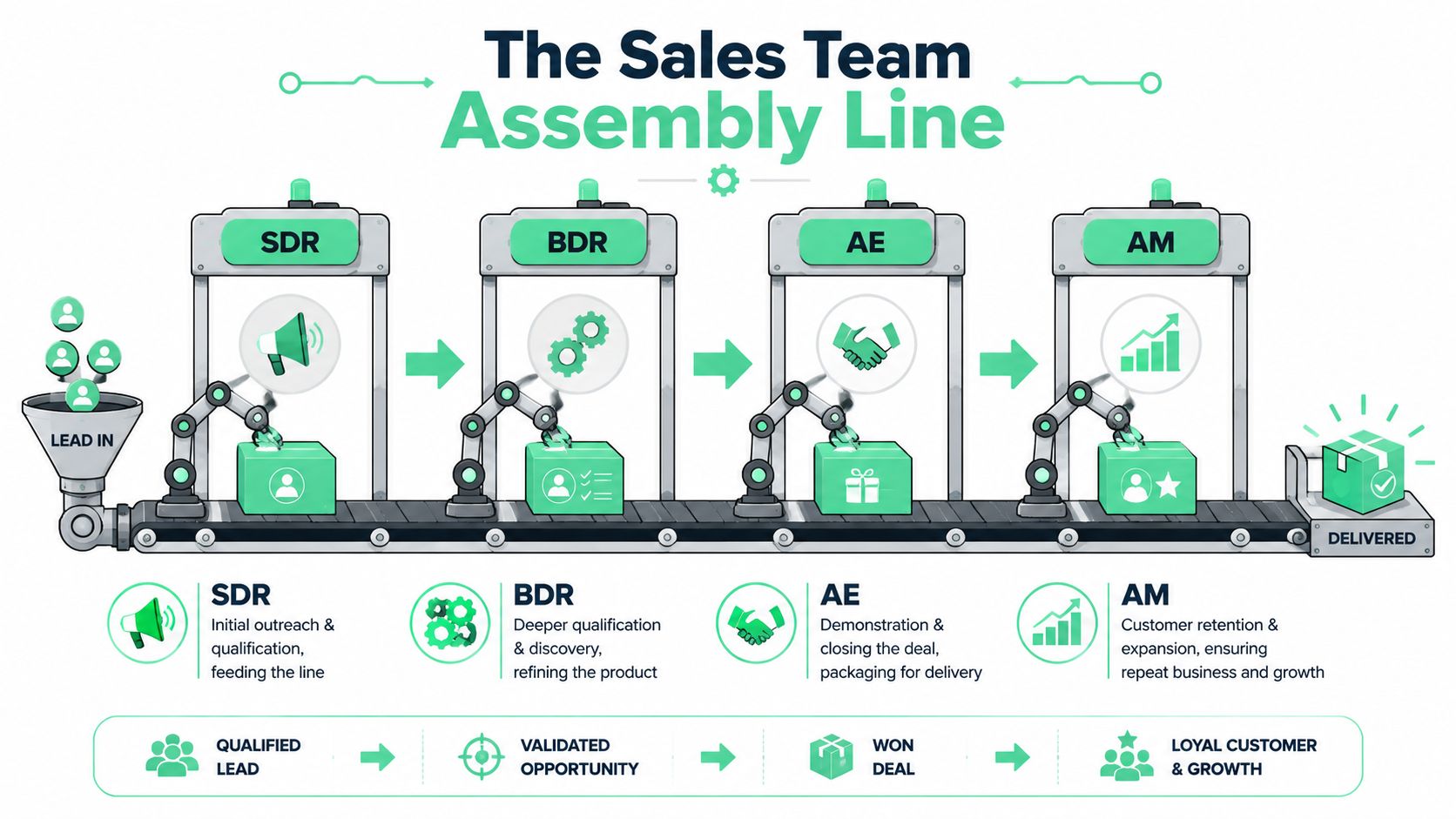
Here's the version I wish more founders learned earlier.
| Role | What they actually do | What goes wrong when you mix it up |
|---|---|---|
| SDR | Starts conversations and qualifies early interest | Closer spends half the week chasing ghosts |
| BDR | Builds pipeline through targeted outreach and early discovery | Marketing leads get ignored while outbound sputters |
| AE | Runs the sales process, demo to signature | Expensive closer becomes a calendar filler |
| AM | Retains, grows, and protects customer revenue | Closed deals churn because nobody owns the relationship |
That's the food chain. Find. refine. close. expand.
A lot of guides flatten sales into “sales rep” and move on. That's lazy, and it creates bad hiring decisions. As noted by Third Coast Events on types of sales jobs, successful salespeople need problem-solving and adaptability, but founders often still struggle to separate a generic rep from a specialized SDR built for pipeline generation.
That confusion gets expensive fast.
An SDR's job isn't the same as an AE's job just because both talk to prospects. One is optimized for volume, qualification, and pattern recognition. The other is optimized for diagnosis, persuasion, and deal control. Similar ingredients. Different kitchen.
If your hiring brief says “must own the full sales cycle” before you've even built repeatable lead flow, you're not writing a job spec. You're writing fan fiction.
I'd rather take a decent SDR, a competent AE, and a clean handoff over one “killer” rep trying to juggle the whole funnel. Specialization wins because each role can be measured correctly.
A founder should know who is responsible for each stage:
Once you understand the chain, hiring gets less mystical. You stop shopping for charisma and start shopping for fit. That alone saves a lot of pain.
This is the part founders botch most often. Not because they're careless. Because the acronyms are annoying, the job descriptions all blur together, and every candidate says they can “do both.”
Sure. And every spreadsheet is “simple” until month-end.
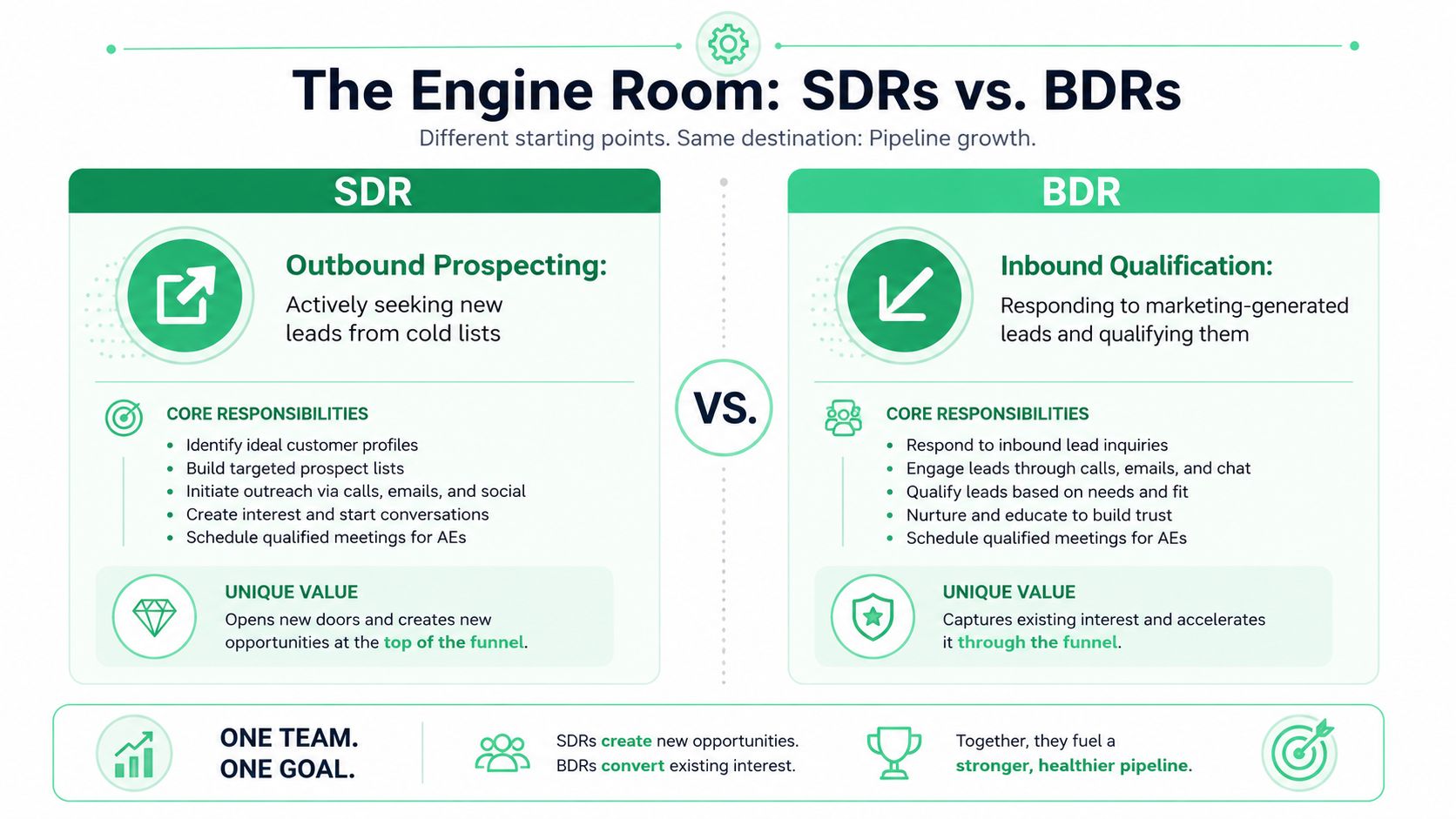
For modern B2B teams, the cleanest distinction is this: SDRs qualify inbound demand, BDRs create outbound demand. Sales Focus Inc. explains the SDR vs. BDR split plainly. SDRs are primarily responsible for qualifying inbound leads from marketing and are measured on response time and meetings booked, while BDRs focus on outbound prospecting through cold emails and calls. Ignore that distinction and you get missed opportunities.
That's not semantics. That's operating design.
An inbound-heavy company needs speed, triage, and lead handling discipline. An outbound-led company needs list quality, targeting, persistence, and message testing. The motions look similar on the surface. Under the hood, they're different jobs.
An SDR's day is reactive in a good way. Marketing drives interest. The SDR responds quickly, qualifies fit, books the next conversation, and keeps the lead from going cold. They're playing traffic controller.
A BDR's day is proactive and a little more bruising. They build lists, personalize outreach, call cold accounts, send follow-ups, and keep pushing until someone either engages or clearly doesn't belong in the pipeline. They're hunting.
If you're trying to decide who to hire: SDR or BDR, start with one question. Is your problem poor lead response or lack of new pipeline? The answer usually picks the role for you.
At this stage, founders get distracted by activity theater. Lots of dials. Lots of emails. Lots of CRM confetti. Very little pipeline.
Better benchmarks are tied to conversations and meetings that sales can use. According to Factor 8's SDR metric benchmarks, SDRs should aim for 3 to 5 conversations per day as a baseline, and cold calls convert at only 2% to 5% on average, though elite reps can reach up to 33% in optimal situations. That gap tells you something useful. Raw effort matters, but quality of execution matters more.
A rep can look busy all day and still produce nothing but voicemail archaeology.
Founders hire one “hybrid” rep, then dump inbound follow-up, cold outreach, qualification, CRM cleanup, and meeting coordination on them. Predictable result. Hot leads wait too long, outbound sequences get inconsistent, and everyone blames the rep.
The rep usually isn't the issue. The role design is.
If your funnel is thin, hire for top-of-funnel focus. If your inbound demand is slipping through the cracks, hire for speed and qualification. Just stop pretending one vague title covers both motions equally well.
Founders love hiring Account Executives too early. I get it. Closers are easier to picture. They demo. They negotiate. They say confident things on Zoom. It feels like progress.
Sometimes it's just expensive cosplay.
An AE without enough qualified meetings is a very polished person waiting around for work. In technical and scientific sales categories such as SaaS, the median annual salary was $99,710 in 2023, with top earners above $193,470, according to the Florida Tech career guide for sales representatives. That's real money. Don't spend it to solve a pipeline problem with a closing hire.
The trigger is simple. Bring in an AE when qualified meetings are becoming too frequent for the founder to handle well, and when those meetings are consistent enough to support a dedicated closer.
If the founder is still squeezing demos between fundraising calls and product reviews, yes, that hurts. It does not automatically mean you need an AE. It might mean you need better qualification upstream so the founder only speaks to the right accounts.
AEs don't just “take calls.” They control the middle and late stages of the deal.
That's different from the SDR or BDR muscle set. More patience. More commercial judgment. Less raw activity.
Hiring an AE before you've solved lead flow is like buying a race car when you haven't paved the road.
A lot of strong AEs come from early pipeline roles. That path exists for a reason. The iPlum overview of sales job types notes that employment of sales managers is projected to grow 5% from 2024 to 2034, with about 49,000 openings each year, which signals real upward mobility from SDR work into leadership and AE tracks.
That's another reason not to over-romanticize the closer hire. Sometimes your future AE is already in your funnel-facing team. They just need reps, coaching, and a process worth inheriting.
Most sales comp plans are either too clever or too lazy. Too clever means the spreadsheet needs a priest and a forensic accountant. Too lazy means “just pay commission and see what happens.” Both are bad.
Roles in sales need different scorecards because they produce different outcomes. If you pay everyone as if they own final revenue, you distort behavior. Prospectors cherry-pick easy meetings. Closers take junk meetings because calendar volume looks good. Nobody wins except maybe your CRM admin, who gets to document the collapse.
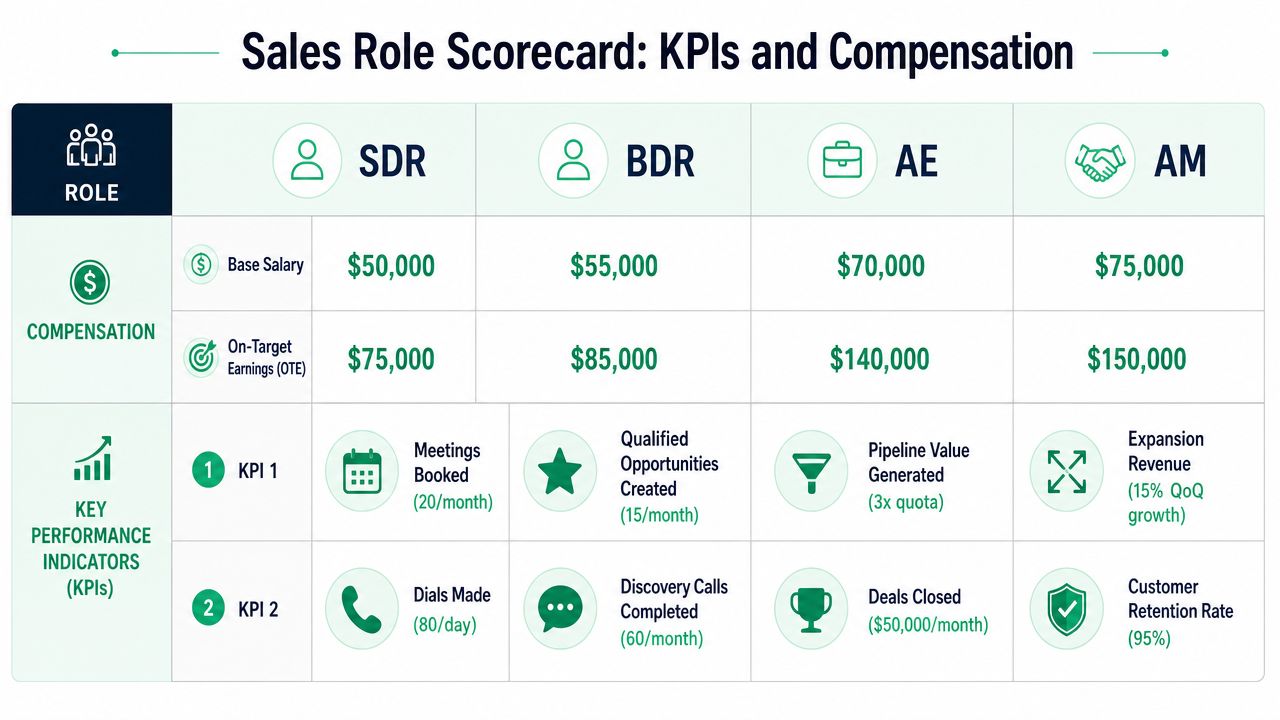
For SDRs and BDRs, measure pipeline creation. According to Superhuman Prospecting's SDR and BDR benchmarks, a key benchmark is 20 qualified meetings per week, and median OTE is approximately $85,000 with a 70/30 base-to-variable mix.
That structure makes sense. These reps should be rewarded for activity that becomes real pipeline, not for revenue they don't control.
For AEs, the usual logic shifts. Their comp generally leans toward a 50/50 split, because they own the commercial outcome more directly, as noted in that same benchmark source earlier in this section. I like that because it keeps the accountability where it belongs.
| Role | Primary KPI | Secondary KPI | Comp logic |
|---|---|---|---|
| SDR | Qualified meetings created | Speed and quality of lead handling | Base-heavy with upside |
| BDR | New qualified pipeline created | Consistency of outreach and discovery | Base-heavy with upside |
| AE | Closed revenue against quota | Deal progression and forecast quality | Balanced base and variable |
| AM | Retention and expansion | Account health and follow-through | Retention plus growth incentives |
The point is alignment. Don't pay for noise. Pay for the behavior each role controls.
A lot of founders set quotas the way toddlers stack blocks. With confidence and no physics.
If your SDRs are supposed to produce qualified meetings, define what “qualified” means before comp kicks in. If your AEs inherit those meetings, agree on acceptance criteria. If you need a practical framework for setting targets without turning your team mutinous, DialNexa's sales quota strategy is worth reading because it treats quota design like an operating decision, not a pep talk.
You'll also want market context before you write offers. A useful benchmark reference is this founder's guide on sales executive salaries, especially if you're comparing what level of rep you can realistically afford.
Watch for this: when fewer than 60% of reps hit target, the benchmark source above warns that quotas are likely unrealistic. That's usually a management problem wearing a performance costume.
Early-stage sales org charts don't need to be fancy. They need to be clear. Clarity beats ambition every time.
The usual breakdown is simple. Top-of-funnel roles generate or qualify opportunities. AEs run the deal. Account Managers protect and grow the customer relationship. Leadership keeps the machine honest and fixes bottlenecks before they become folklore.
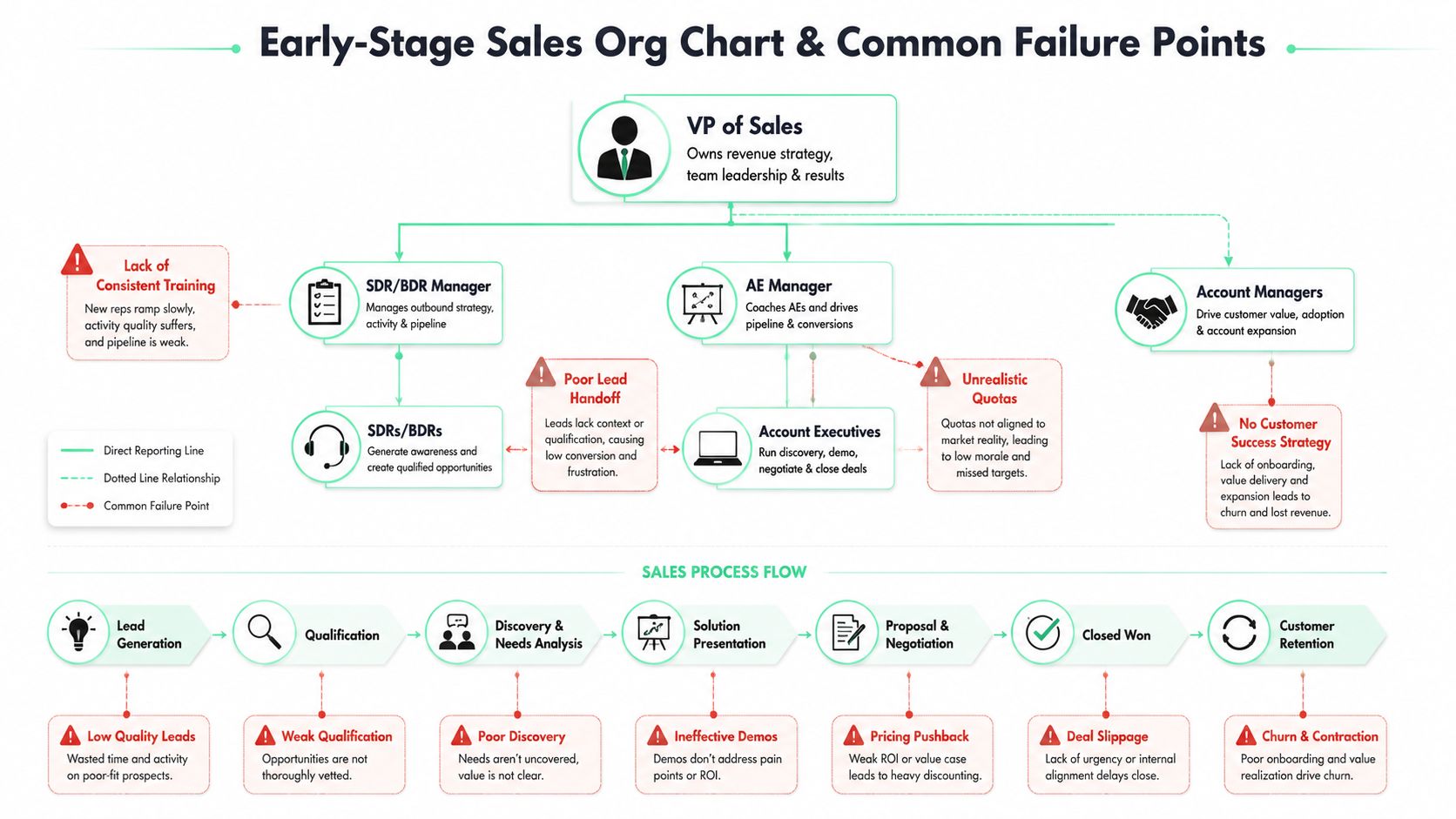
The ugliest failure point is the handoff from pipeline generation to closing. One side says the lead was good. The other says it was junk. Both might be right, which is even worse.
Fix that with a clear Sales Accepted Lead standard. An AE should know, before taking the meeting, why this account matters, what pain triggered interest, who is showing up, and what next step would count as progress.
Use a quick checklist:
Assessments are helpful. The Criteria Corp guidance on pre-employment testing for technical sales roles recommends the CCAT for cognitive aptitude and the EPP for personality traits. Their point is blunt. Miss those benchmarks and outbound performance often suffers.
I agree with the spirit of that advice. Not because tests are magical. They aren't. But founders consistently overvalue confidence and undervalue processing speed, coachability, and communication discipline.
A missed callback, a sloppy note, a weak handoff, an AE who freelances discovery, no owner for existing accounts. None of these look dramatic alone. Together, they rot the funnel.
That's also why simple response infrastructure matters. If your team is still losing interested prospects because nobody caught the call or returned it cleanly, tools like SnapDial missed call features can help tighten the gap between intent and follow-up without adding process theater.
Sales teams rarely die from one catastrophic mistake. They bleed out through dozens of tiny ones nobody owned.
Founders love to say they'll hire the first reps themselves because “nobody knows the business like I do.” True. Also irrelevant after the tenth resume and the fifth interview with a candidate who says they're “passionate about building relationships” and then can't write a decent outbound opener.
DIY hiring feels responsible. Sometimes it's just slow and expensive.
Technical sales talent isn't cheap. The earlier Florida Tech source noted that in 2023, sales representatives in technical sectors like SaaS earned a median annual salary of $99,710. That number alone should sober up any founder who thinks hiring mistakes in sales are minor oopsies. A bad product hire hurts velocity. A bad sales hire hurts velocity and cash flow at the same time. Fun combo.
The first mistake is writing a mushy job description. “Self-starter.” “Rockstar.” “Full-cycle.” “Thrives in fast-paced environments.” That language attracts people who are good at interviewing and vague about execution.
If you need help tightening the spec before you go to market, RedactAI's job description templates are useful because they force more precision around responsibilities, outcomes, and candidate fit.
The second mistake is underestimating screening time. You aren't just checking if someone can talk. You're checking if they can prospect, qualify, write, listen, follow process, and survive rejection without turning weird.
For SDRs and BDRs especially, specialized recruiting or marketplace models usually beat founder-led fishing expeditions. Not because outsourcing is trendy. Because these are high-volume, pattern-based roles where vetting quality matters more than storytelling.
A strong specialist sourcing partner can screen for:
That cuts down a lot of nonsense.
If you still want to build the whole hiring function yourself, go for it. Hope you enjoy spending your week buried in scorecards, interview scheduling, and resume archaeology. Most founders should keep ownership of the profile and final interview, then let a specialist compress the messy middle.
For fast-moving teams, that's usually the smarter bet. If you're exploring a more efficient route, HireSDR is one example of a specialist marketplace approach built around pre-vetted SDR and BDR hiring.
If you need SDRs or BDRs without turning your calendar into a recruiting landfill, hireSDR.io is the practical next step. They help founders and revenue leaders hire pre-vetted, English-fluent sales talent quickly, with timezone alignment and cross-border support already handled. That means less time screening and more time building pipeline.
Your reps are busy all day, your CRM is full of “activity,” and somehow pipeline still feels anemic. Founders see that and reach for the...

Your VP of Sales wants more pipeline. Your CFO wants lower burn. You want both, and you're tired of pretending another overpriced SDR hire in...
You're probably in the same place a lot of founders hit sooner than they'd like. Pipeline is thin. Your account execs are grumbling. You need...

Tell us who you need. We'll have pre-vetted candidates in your inbox within 72 hours. No commitment until you hire.