
The median U.S. SDR package is $85,000 OTE with a $60,000 base salary. That sounds crisp and useful. It's also the vanity metric that hides the only question founders should care about. What should you pay to get reliable pipeline without lighting cash on fire?
Most salary advice on SDRs is built for optics. It helps recruiters post shiny job ads and helps founders tell themselves they're “market competitive.” Cute. Then the first missed quarter arrives, half the team is sulking about commission, and your CAC model starts wheezing.
I've made that mistake. More than once. I've hired the expensive “safe” rep, the scrappy bargain rep, the startup cowboy who wanted upside, and the polished enterprise transplant who wanted a logo on the resume more than a quota. The painful lesson is simple: sales development representative salary is not one number. It's a structure. If you treat it like a headline figure, you'll overpay for the wrong behavior.
Here's the contrarian take. The salary number is usually the least useful part of the offer.
Founders get handed a clean benchmark, plug it into a hiring plan, and feel responsible. Then reality shows up. One SDR ramps slowly, another never gets enough qualified accounts, a third books junk meetings to chase variable, and suddenly that “market rate” hire is an expensive lesson in fake precision.
The problem is not the benchmark itself. The problem is treating a single SDR salary figure like it has universal meaning. It doesn't. A U.S. in-office outbound rep, a remote inbound qualifier, and a globally distributed team member supporting founder-led sales should not be priced the same way. Yet plenty of salary guides flatten all of that into one neat number and call it helpful.
OTE looks clean in a spreadsheet. In practice, it's conditional pay wrapped in optimism.
It assumes your list quality is good, your messaging converts, your routing is fast, your manager can coach, your CRM is usable, and your qualification rules are not a mess. If even two of those break, your comp plan stops being a performance system and turns into a morale problem.
That's why I tell founders to budget from fixed cash first, then build variable around behavior the rep controls. Anything else is how you end up paying for fantasy. If your qualification process is fuzzy, fix that before you start dangling upside. Orbit AI lead qualification best practices is a useful gut check on that point.
Practical rule: Price the job you actually need done. Do not buy a shiny OTE story and pretend it is a staffing strategy.
A lazy salary target creates a lazy team design.
You overpay for candidates who interview well but need perfect conditions to produce. Or you squeeze base pay, puff up commission, and attract reps who care more about the headline than the work. Both mistakes are common. Both are expensive.
The bigger blind spot is geographic. A lot of U.S.-centric salary advice implicitly assumes your only option is hiring in expensive domestic markets. That is how companies spend premium dollars on average pipeline coverage while ignoring strong remote talent in lower-cost regions. Same role outcome. Better capital efficiency. Lower fixed burn. More room to invest in tools, data, and management instead of dumping everything into salary.
The benchmark is not useless. It is just incomplete. If you start with “What does an SDR cost?” you get a generic answer. If you start with “What pipeline motion are we building, what behavior are we paying for, and where should this talent sit?” you make smarter hires and keep more cash.
SDR compensation is not complicated. Companies make it complicated so they can hide a bad plan behind a shiny OTE number.
The plan has three parts: base salary, variable pay, and OTE. Get the mix wrong and you create churn, sandbagging, and endless quota arguments. Get it right and you buy focused activity, cleaner pipeline, and fewer management headaches.
A car analogy helps explain this: Base salary is the chassis. Variable pay is the engine. OTE is the top speed printed in the brochure by a very optimistic marketing team.
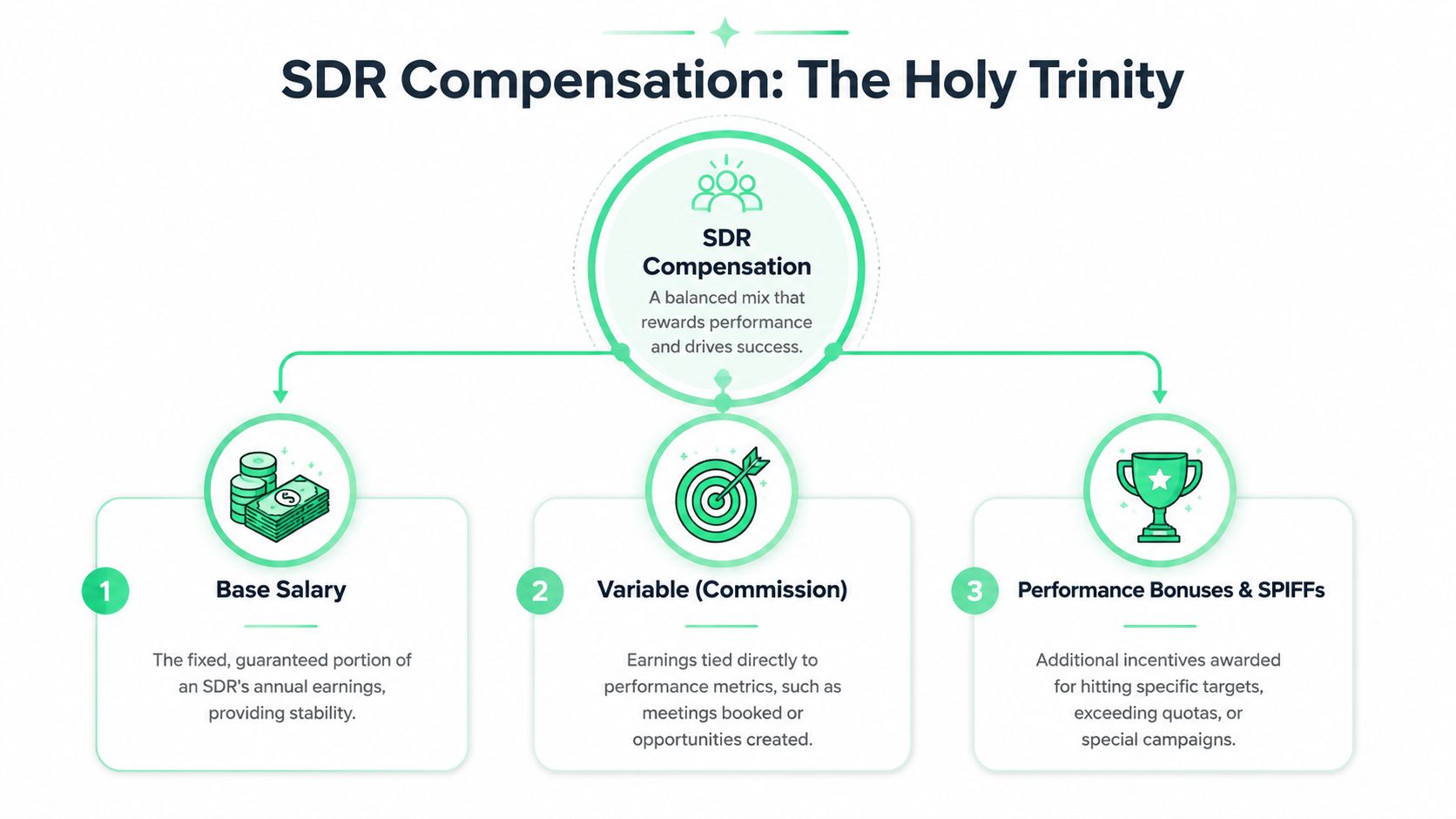
Base salary is the fixed cash the rep can count on. It covers rent, lowers stress, and gives you a better shot at consistent execution.
For SDRs, a heavier base usually makes sense. They influence pipeline, but they do not control every input that affects results. List quality, territory design, routing speed, messaging, manager quality, and calendar availability all shape outcomes before the rep ever gets credit. If you force too much risk into variable comp, you are asking junior sellers to absorb problems created by your system.
That is dumb and expensive.
A solid base also protects your hiring funnel. Thin bases attract desperate candidates, not always disciplined ones. Then founders act surprised when the team chases junk meetings just to survive the month.
This is the part companies love to overengineer.
Variable comp should reward booked meetings, qualified meetings, accepted opportunities, or another pipeline milestone the SDR directly influences. Paying on closed revenue sounds tough and performance-driven. It is usually lazy plan design. The SDR should not carry compensation risk for pricing, demos, proposals, and late-stage AE execution.
If you want better handoffs, pay on qualified opportunities. If you need more top-of-funnel activity, put more weight on held meetings. If your lead stages are still a mess, fix that first. Orbit AI lead qualification best practices is a useful gut check before anyone starts assigning quotas and arguing about what counts.
Bad variable design creates bad behavior fast. Reps stuff calendars with weak meetings. Managers fight over attribution. AEs reject garbage. Finance wonders why pipeline volume is up while revenue quality is down.
OTE matters, but founders give it way too much power.
A big OTE can signal upside. It can also hide a compensation plan held together with optimism and PowerPoint. If half the earnings depend on perfect execution across marketing, ops, data, management, and AE follow-up, the headline number is doing a lot of dishonest work.
Read OTE like an investor reads a pitch deck. The promise is less important than the assumptions underneath it.
Use a simple filter:
Good comp plans are boring. That is a compliment. Reps understand them in one read. Managers can defend them without theater. Finance can forecast them without crossing its fingers.
And one more thing. Founders who copy expensive U.S. SDR pay structures without questioning geography are solving the wrong problem. A flawed comp plan is bad enough. A flawed comp plan attached to a high-cost domestic salary is how you burn cash and call it go-to-market strategy.
The benchmark most founders quote is the one that helps them rationalize a bad hiring plan.
A U.S. SDR salary average looks neat in a spreadsheet. It falls apart the second you compare a New York hire, a remote rep in a lower-cost market, and an offshore SDR team built for the same pipeline target at a fraction of the burn. Salary benchmarks matter. Blindly copying expensive local benchmarks is how early-stage companies torch cash and call it go-to-market maturity.
Earlier benchmarks in this article already showed the U.S. median sitting far below what many founders assume they need to pay in major metro markets. That spread is the point.
San Francisco and New York can support very high SDR pay. So can brand-name software companies with polished enablement, strong inbound demand, and managers who know how to coach. Your startup probably has none of those advantages on day one. Paying top-market comp without top-market infrastructure is one of the dumbest ways to buy underperformance.
Use the U.S. benchmark as a ceiling check, not a default offer template.
| Profile | Base Salary Range | OTE Range |
|---|---|---|
| U.S. median SDR | National benchmark, as noted earlier | National benchmark, as noted earlier |
| Major metro SDR | Often materially above national median | Usually above national median |
| Early-career SDR | Lower base, narrower upside during ramp | Depends heavily on enablement and quota design |
| Proven SDR in a strong U.S. org | Premium base with meaningful variable upside | Can reach top-tier earnings if the territory and plan are real |
| United Kingdom SDR | £15,000 to £53,000 | Around £28,000 average annual earnings |
| Global remote SDR | Typically far below U.S. metro cost | Can still be highly attractive relative to local markets |
That table does one job well. It kills the fantasy that there is one clean market rate.
The smarter question is simpler: what level of spend produces qualified pipeline without bloating fixed payroll?
Founders love to pay for years. They should pay for evidence.
A rep with clean habits, decent writing, coachability, and the discipline to work a process will beat a “seasoned” SDR who has spent three jobs hiding behind a famous logo. Tenure can help. It does not rescue weak execution.
Coursera's roundup of SDR pay data shows a modest lift from entry-level to long-tenured reps, which is exactly why overpaying for experience is usually a bad deal. The gap in compensation is often smaller than the gap in expected performance during interviews. That should make you suspicious, not generous.
Use three filters instead:
If you need help estimating the full loaded cost behind that salary line, read hireSDR.io's employee expense guide. Salary is only the visible part of the bill.
Outside the U.S., salary compression is real, and many U.S.-centric guides barely mention it because the comparison is uncomfortable.
Klenty's global sales salary breakdown puts U.K. SDR earnings well below typical U.S. metro packages. That gap is not trivia. It is a budgeting decision. If your SDR motion is process-driven, scriptable, and tightly managed, insisting on a U.S.-only team is often more about habit than economics.
That does not mean every company should rush offshore and hope for the best. It means founders should stop pretending geography is a side note. Geography is often the biggest driver of cost efficiency in the entire outbound engine.
Training quality matters here. A lower-cost team without real coaching will still fail. If you are building enablement for distributed reps, this objection handling guide for L&D teams is a useful reference.
Set your compensation around the job you need done, not the zip code that produced the loudest salary blog.
If the role requires heavy discovery, nuanced product fluency, and close AE collaboration in a complex U.S. enterprise motion, pay up. If the role is disciplined top-of-funnel execution with strong systems and clear management, global remote talent is often the sharper move. Same pipeline goal. Better capital efficiency. Far less payroll drag.
That is the benchmark that matters.
The expensive mistake is treating SDR pay like a clean market rate. It is not. It is a bundle of risk premiums, ramp costs, management burden, and role complexity hiding behind one job title.
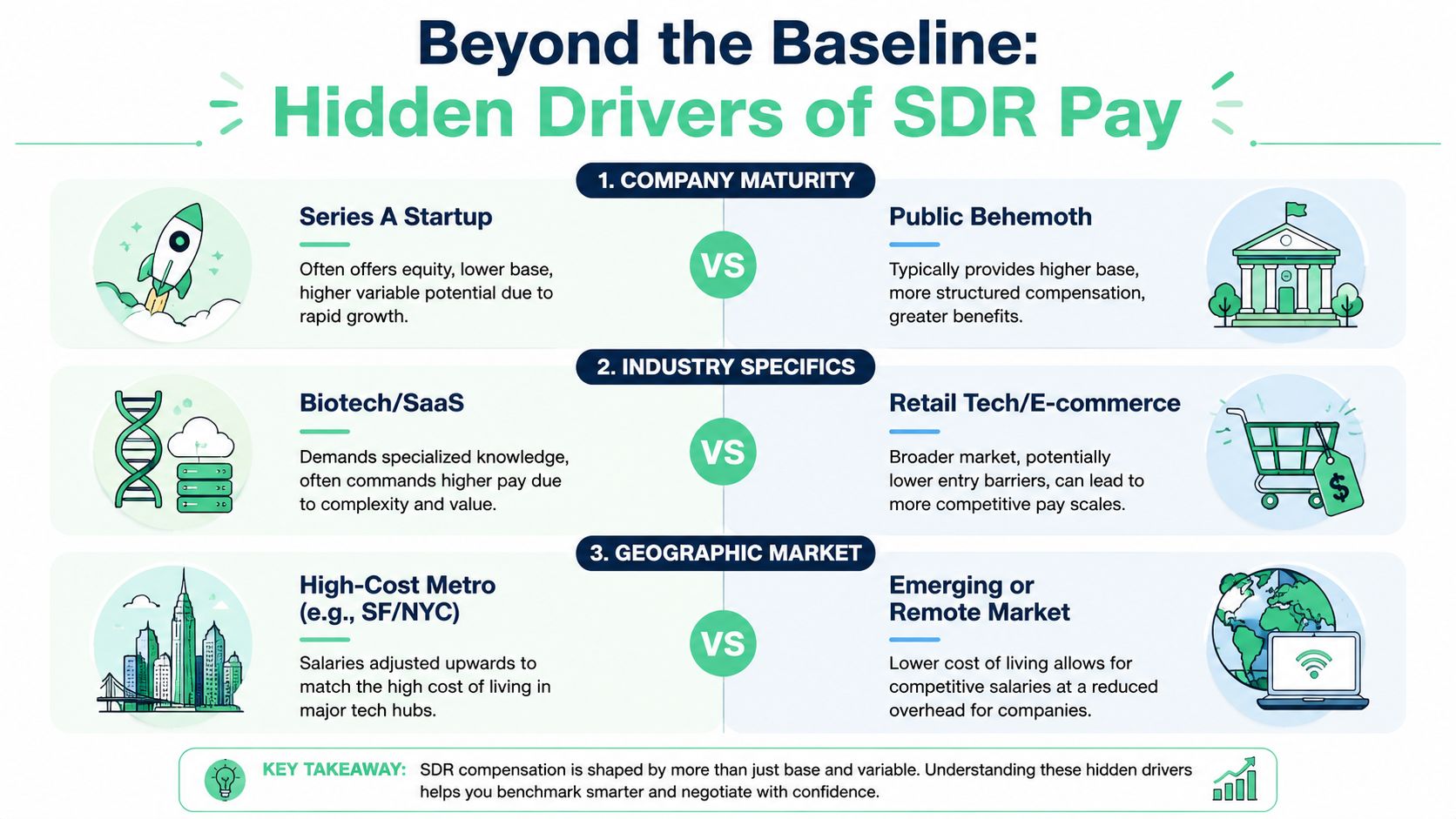
Company maturity changes what you are really asking the rep to do.
Early-stage teams rarely hire an SDR to run a polished playbook. They hire someone to prospect through messy positioning, patchy systems, weak data, and founder-grade improvisation. That job deserves a different comp logic than an SDR seat inside a mature org with established messaging, real enablement, and a manager who has seen the movie before.
Cash pay usually rises with company maturity because the risk falls, the process gets clearer, and the business can afford more salary. Simple.
Founders still get this wrong. They post one SDR title, then expect one candidate to do outbound execution, messaging feedback, CRM cleanup, and market discovery for a mid-range salary. That is not one job. That is two jobs wearing the same hoodie.
Annualized OTE makes the spreadsheet look great. The first six months decide whether the hire pays off.
Ramp cuts output before it cuts cost. You are paying salary, manager time, tooling, list support, training time, and opportunity cost before the rep reaches steady production. If the onboarding is weak, the bill gets ugly fast.
Put the ramp plan in writing. Include quota relief, milestone dates, and what “fully ramped” means. If you leave this fuzzy, reps assume the plan is political, managers improvise, and finance gets dragged into a trust problem you created for free.
Training matters more here than founders like to admit. If your managers need a cleaner coaching framework, use this objection handling guide for L&D teams.
An SDR booking meetings for a straightforward transactional offer is not doing the same work as an SDR prospecting into technical buyers, regulated markets, or long buying committees.
Harder markets require better judgment. Better judgment costs more.
That does not mean you should throw cash at every difficult motion. It means you should stop under-scoping the role. If your SDR has to understand compliance risk, map multi-threaded accounts, or hold a credible first conversation with senior operators, you are hiring for more than activity volume.
This is also where salary-only budgeting falls apart. The actual cost includes onboarding time, replacement risk, management drag, benefits, payroll burden, and the systems wrapped around the rep. hireSDR.io's employee expense guide is useful for modeling the full bill instead of just the base salary.
Companies do not pay SDRs for motion. They pay for useful output inside a specific sales system.
That is why global remote talent belongs in this conversation, even when U.S.-centric salary guides pretend it does not. If the role is process-heavy and coachable, overpaying for a local badge is usually a vanity decision, not a revenue decision.
A comp plan should make the right behavior obvious.
That's the whole job.
If reps need a decoder ring to understand how they get paid, the plan is broken. If managers have to keep “clarifying” edge cases in Slack, the plan is broken. If finance keeps explaining why nobody got what they expected, congratulations, you built a trust-eroding machine.
I call this one The Accelerator. Use it when you need aggressive outbound activity, fast list coverage, and lots of first conversations.
Best fit:
How to structure it:
This model works when your bottleneck is conversation volume. It fails when AEs complain the meetings are garbage and everyone starts blaming each other in forecast calls.
This one is The Foundation. It's better for longer sales cycles, enterprise motions, and teams that need fewer but stronger handoffs.
Use it when:
How to structure it:
A bad comp plan pays people for what's easy to count. A good comp plan pays people for what the business actually needs.
For founders, the recommendation is blunt. Don't copy a giant company's comp plan into a startup. Their process tolerates waste. Yours probably can't.
For SDRs, negotiate more than base. Ask how leads are qualified, what counts for payout, how ramp works, and what happens when ops changes the rules mid-quarter. A bad answer now becomes a pay dispute later.
This is the part most U.S.-centric salary guides tiptoe around because it makes the old playbook look expensive.
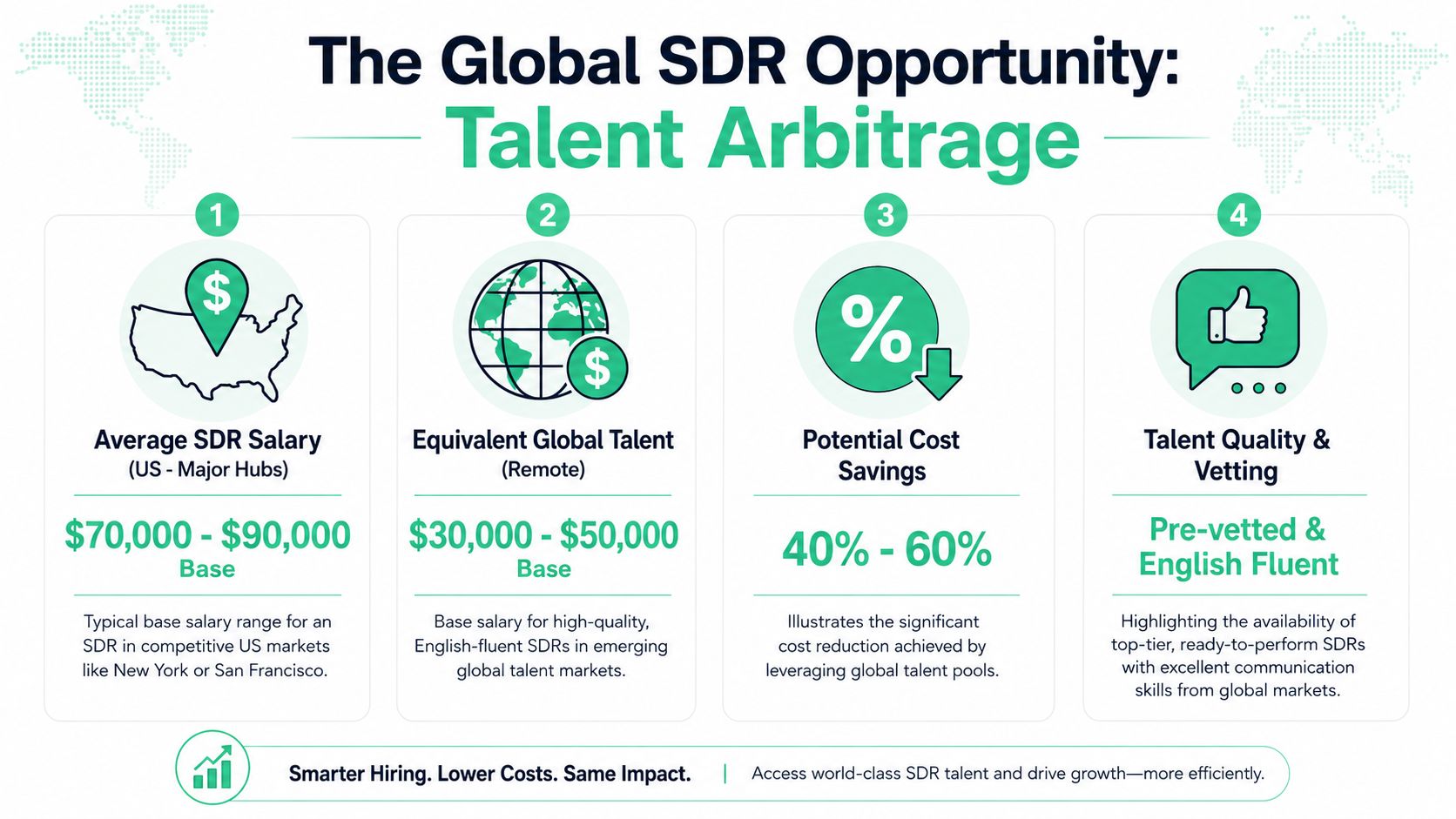
If an SDR in New York averages a $56,000 base, and pay in San Francisco can reach $145,000, you need a very good reason to pretend local-only hiring is the smart default, according to Built In's New York SDR salary data. Especially when companies can hire English-fluent, timezone-aligned SDRs from global markets like LATAM for under $3,000 per month, cutting total costs by 80% to 90% without sacrificing output.
That's not a minor optimization. That's a budget strategy.
Founders hear “global remote SDR” and immediately split into two camps.
Camp one says it's obvious. Lower cost, broader talent pool, faster scaling. Camp two starts muttering about quality, communication, and time zones like it's still 2017.
Let's be adults. The question is not whether a global hire is automatically better. The question is whether your company can get equal or better pipeline output per dollar by hiring globally. In many cases, yes.
That means you can:
“Will they be fluent enough?”
If you hire well, yes.
“Will they understand U.S. buyers?”
If you train properly, yes.
“Will time zones be messy?”
Timezone-aligned hiring exists for a reason. Use it.
The biggest failures in remote SDR teams usually come from lazy onboarding, fuzzy messaging, and bad management hygiene. Not geography. A local rep with weak coaching is still a weak setup. A global rep with clean enablement can outperform quickly.
If you're evaluating the mechanics, hireSDR.io's global hiring playbook is a useful reference for how teams handle cross-border hiring, compliance, and onboarding without turning it into an HR side quest.
If you're still insisting every SDR must sit in a U.S. zip code, you're choosing a cost structure, not quality.
Use U.S.-based hiring selectively. Keep it for roles where local market nuance, on-site overlap, or highly specialized product context really matters. For broad outbound, inbound qualification, or team expansion, go global first and prove you need the premium before you pay it.
That's the part founders get backward. They start with the expensive option and ask whether they can justify it. Start with the capital-efficient option and ask whether the role requires more.
The right sales development representative salary is not “whatever the market says.”
It's the amount and structure that gets you predictable pipeline, sane retention, and room to scale. Sometimes that means paying up for a very specific U.S. hire. Often it means refusing to confuse expensive with effective.
The median U.S. numbers are useful. Fine. Use them as a reference point, not a religion. Location shifts the range. Company stage warps the risk. Ramp changes first-year reality. Comp design determines whether your reps chase quality or chaos. And global hiring can completely rewrite the economics if you're willing to stop worshipping local benchmarks.
My blunt advice is this. Build the role around output, not ego. Keep the plan simple. Pay for behavior you can defend. Don't buy a vanity OTE and call it strategy.
If you need SDRs, Hire SDRs with the same discipline you'd use to build any other revenue system. The salary number matters. The engine matters more.
If you want to build pipeline without paying San Francisco prices for every seat, hireSDR.io is worth a look. It helps teams find vetted, English-fluent SDRs and BDRs fast, with global hiring and compliance handled for you, so you can scale outbound without turning recruiting into your new full-time job.

Your CRM is open. The dashboard looks busy enough to fool you for a minute, but the pipeline tells the truth. A few stale opportunities....

Your best Account Executive is doing detective work in Apollo, cleaning CSVs, and chasing no-shows instead of closing. Your pipeline has activity, sure, but the...

You're probably staring at a pipeline that looks busy on paper and dead in real life. Plenty of open opportunities. Lots of “good conversations.” A...

Tell us who you need. We'll have pre-vetted candidates in your inbox within 72 hours. No commitment until you hire.