
You're probably staring at a pipeline that looks busy on paper and dead in real life.
Plenty of open opportunities. Lots of “good conversations.” A few deals that were supposed to close last month and are now floating in that weird CRM purgatory between “verbal yes” and “who signs this?” Meanwhile, your reps keep saying deals are progressing, and your forecast keeps behaving like fan fiction.
I've seen this movie. Too many founders treat slow deals like a motivation problem, a rep problem, or a market problem. Sometimes it is. Most of the time, it's a velocity problem. Your system has friction baked into it, and your pipeline is paying the price.
The annoying part is that a lot of teams still use one blended number and call it insight. It isn't. It's comfort food for dashboards. If you want to close faster, forecast better, and stop babysitting every deal like it's a fragile houseplant, you need to understand deal velocity properly and segment it aggressively.
A founder I know had the classic “looks fine from a distance” pipeline.
There were enough opportunities to keep everyone calm in Monday meetings. The CRM had color. The reps had activity. But every meaningful deal had started to stretch. A prospect who wanted pricing now needed security review. Another one wanted “just one more stakeholder call.” One hot account turned into three demos, two legal loops, and then complete silence. Not dead. Just slowly decomposing.
That feeling is real. You're not imagining it. And it's not rare.
According to a RevOps survey, 49% of SaaS companies experienced an increase in their sales cycle length, with 52% of those seeing increases exceeding 10 days (GetAccept). If your deals feel slower this year than they used to, welcome to the club nobody wanted to join.
When deals drag, you don't just lose speed. You lose options.
And late revenue is still pain. Payroll doesn't care that procurement needs another week.
Slow deals rarely mean your team needs more hustle. They usually mean your process is making buyers do too much work.
Most pipelines don't stall for one dramatic reason. They stall because of small, stupid frictions stacked on top of each other. Bad qualification. Weak next steps. Missing stakeholders. Generic follow-up. Late security docs. Reps chasing “interested” instead of “committed.”
That's why I don't treat deal velocity like a vanity metric. I treat it like a pulse check. If deals are moving in slow motion, your revenue engine is trying to tell you something. The mistake is ignoring the signal and adding more top-of-funnel like that'll magically fix the middle.
It won't.
Let's clear up the mess first. Half the internet talks about deal velocity like it's just sales cycle length wearing a nicer shirt. That's wrong.
Cycle length matters. A lot. But if you only track days-to-close, you're missing the core question: how much revenue throughput is your pipeline producing?
The formula that matters is this:
(Number of Opportunities × Average Deal Size × Win Rate) ÷ Sales Cycle Length
That gives you a revenue-per-day throughput number. Not a vague feeling. Not “we had some good meetings.” Actual output.
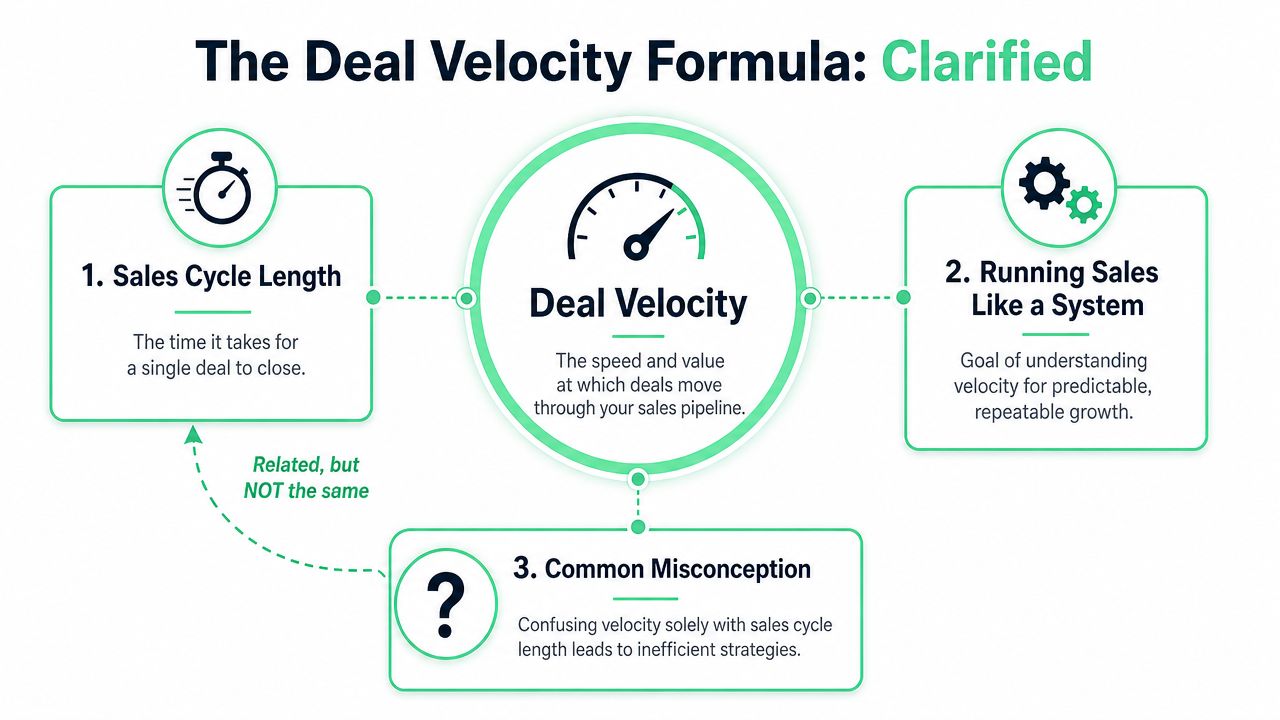
People confuse deal velocity with cycle length because cycle length is easy to understand. It's one number. It feels operational. It sounds smart in a board deck.
But cycle length alone can lie to you. A team can shorten cycle time while deal size drops. Or they can close tiny deals quickly while bigger, more strategic opportunities rot in late-stage limbo. Fast isn't always efficient.
If you want a sharper mental model, this overview of understanding pipeline speed is a useful companion. The key point is simple: speed without throughput is just motion.
Think of the formula like a revenue engine with four moving parts:
| Variable | What it tells you | What goes wrong when it slips |
|---|---|---|
| Opportunities | How much qualified pipeline exists | Reps stay busy but not productive |
| Average deal size | How valuable each win is | You hit activity goals and miss revenue |
| Win rate | How often pipeline converts | Pipeline inflates while confidence drops |
| Sales cycle length | How long revenue takes to land | Cash gets delayed and forecasts wobble |
This is why I like the formula. It forces honesty. If one variable is weak, the whole machine feels it.
Practical rule: Don't ask “Are we selling faster?” Ask “Are we generating more revenue per day from the pipeline we already have?”
There's also a founder-friendly gut check here. Halving your sales cycle from 90 days to 45 days, without changing anything else, instantly doubles your revenue output (Teamgate). That's the math. Brutal, simple, and yes, a little “toot, toot!” if you manage to pull it off.
The point isn't to rush buyers. The point is to remove the nonsense that buyers shouldn't have to fight through in the first place.
Good news. You don't need a finance degree, a RevOps team of twelve, or a six-tab spreadsheet shrine.
You need four inputs from your CRM. That's it. If you use HubSpot, Salesforce, Pipedrive, or anything remotely competent, the data is already there. The hard part is not lying to yourself when you pull it.
Start with these:
Qualified opportunities
Count the opportunities that meet your team's threshold for entering pipeline. Not leads. Not booked meetings. Not “someone replied.” Use the stage where a rep would be embarrassed to say, “This was never real.”
Average deal size
Pull this from recent closed-won deals. Use actual contract value, not the number your team likes to repeat on investor calls after one unusually large quarter.
Win rate
This should reflect the percentage of qualified opportunities that become closed-won. If your denominator includes junk pipeline, your win rate is fiction.
Sales cycle length
Measure the average time from qualified opportunity to closed-won. Be consistent. If one rep starts the clock at first email and another starts at discovery, your number is garbage.
The math looks like this:
(100 opportunities × $5,000 average deal size × 25% win rate) ÷ 60-day sales cycle = $2,083 per day (Count)
That's your throughput. Not your ambition. Not your pipeline story. Your throughput.
Here's the no-drama version:
A lot of teams get more mileage from fixing rep workflow than from adding more reporting layers. If you're already wrestling with handoffs, follow-up discipline, and activity quality, this guide on optimizing sales team productivity is worth your time.
First, teams use dirty pipeline data. Dead deals stay open forever because nobody wants to close-lost them. That bloats opportunity count and stretches cycle time.
Second, teams choose convenient definitions instead of useful ones.
If your reps can't explain exactly when a deal enters the velocity calculation, your metric is theater.
Keep it simple. Define the entry stage. Define the close stage. Pull the numbers. Calculate it weekly or monthly, depending on how fast your pipeline moves. Done.
Not glamorous. Very useful.
Once you've got the number, stop admiring it.
Deal velocity isn't a grade. It's a diagnostic. The formula gives you four levers, and each one can improve revenue throughput if you stop treating sales like a sequence of heroic individual efforts and start running it like a system.
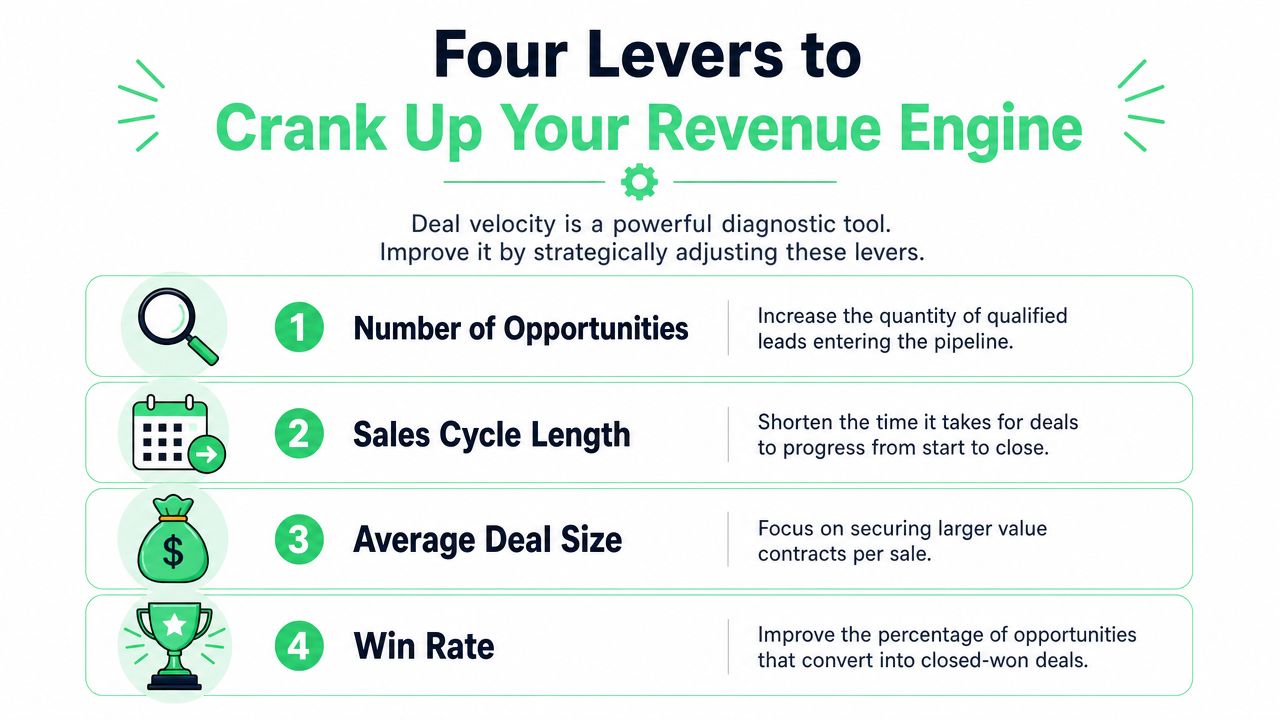
The first two levers look straightforward, which is exactly why teams misuse them.
More opportunities sounds like “book more meetings.” Usually a mistake. More junk at the top creates drag all the way down. I'd rather have fewer qualified opportunities with clear pain, urgency, and decision access than a bloated pipeline full of polite tourists.
Bigger deals is not code for “raise prices and hope.” It means packaging your offer better, selling a sharper business case, and bundling the right scope without stuffing the proposal like a Thanksgiving turkey. If you can't explain why the expanded package matters to the buyer's problem, don't force it.
Here's the compact version:
Most velocity gains occur here.
Win rate improves when qualification gets stricter and follow-up gets better. “No decision” kills more deals than competitors in a lot of SaaS motions. Reps lose momentum because they leave discovery with vague next steps, no mutual action plan, and half the buying committee still in the dark.
Sales cycle length improves when you remove friction. Not when you pressure buyers. Pressure creates fake urgency and real distrust. Friction removal is different. It means getting security docs ready early, identifying approvers before proposal stage, clarifying commercial terms sooner, and sending follow-up that moves decisions forward.
If your team wants a useful operating lens for this, this guide to optimize your B2B sales does a good job connecting process design to day-to-day execution.
Better velocity comes from fewer stalls, not louder follow-ups.
Not all levers are equal in every business. Some are easier to move, and some have outsized impact.
According to benchmark data, a 10% reduction in sales cycle length or a 5% increase in win rate can increase daily revenue velocity by 12–18%, and high-velocity teams with cycles of 45 days or less achieve 2.5x higher CAC payback efficiency (DealHub).
That's why I usually start with these questions:
| Lever | First question to ask | Common bad habit |
|---|---|---|
| Opportunities | Are these actually qualified? | Counting meetings as pipeline |
| Deal size | Are we packaging outcomes well? | Discounting too early |
| Win rate | Why are buyers choosing no decision? | Weak qualification |
| Cycle length | Where do deals pause most often? | Discovering stakeholders too late |
The fastest path isn't always adding more pipeline. Sometimes the smart move is fixing the middle, where deals slow down, confidence drops, and reps start “checking in” like they've run out of ideas.
That's not a sales strategy. That's calendar maintenance.
Here's the mistake I see constantly. A team calculates one nice-looking velocity number, puts it on a dashboard, nods at it in a meeting, and thinks they're data-driven.
They're not. They're blind with spreadsheets.
A single blended velocity metric hides the truth. It mixes fast small deals with slow big ones, good channels with bad channels, strong reps with weak ones, and simple products with messy implementations. Then leadership stares at the average and wonders why nothing they change seems to work.
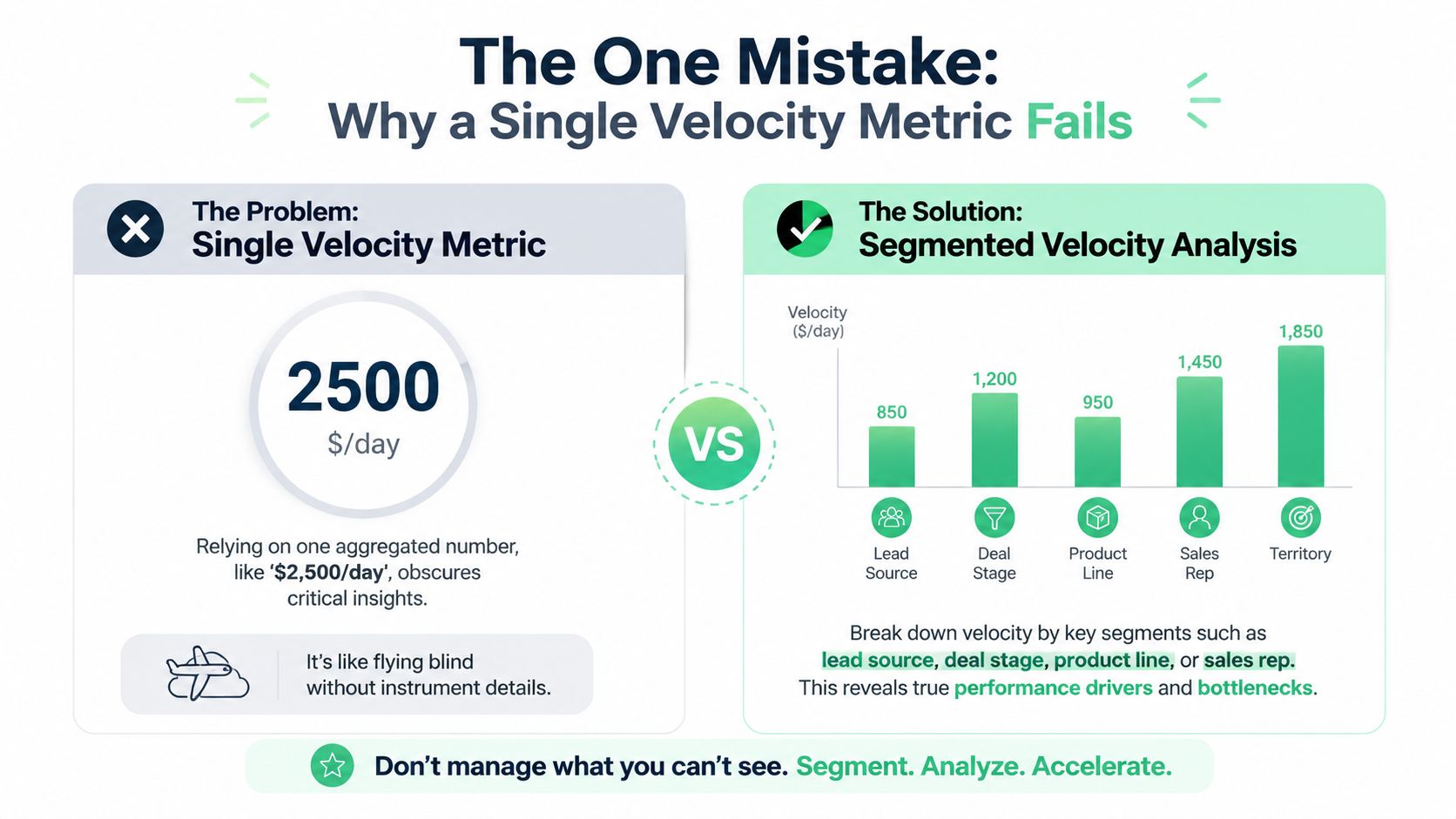
Let's say your SMB motion closes quickly but with lower values, while your enterprise motion has longer procurement cycles and more stakeholders. Blend those together and you get one average that explains nothing.
Now add geography. Add product line. Add inbound versus outbound. That one number gets even worse.
Highspot explicitly advises segmenting velocity by segment, product, or geography because a single number masks where bottlenecks exist, especially for SaaS companies with mixed deal sizes where enterprise deals skew the entire average (Highspot).
That's the whole game. Segmentation is not a reporting luxury. It's the only way to find the actual problem.
Don't segment everything at once. You'll build a dashboard monster and nobody will use it.
Start with the cuts that most affect buying behavior:
One pipeline. Multiple motions. One blended metric cannot do justice to all of them.
The situation becomes intriguing.
Segmented velocity can show that your inbound deals move fast but stall at proposal because pricing is vague. It can show that enterprise outbound has healthy deal size but miserable time-to-close because legal gets pulled in too late. It can show one rep closes slower because they keep multi-threading too late, not because they're “bad at closing.”
That's operational insight. Finally.
Blended metrics give you anxiety. Segmented metrics give you a to-do list.
Let's bring this out of the dashboard and back to the front lines.
Two of the strongest velocity levers sit close to the top of the funnel: opportunity quality and early deal momentum. Both live or die with SDR execution. If the wrong meetings get booked, your pipeline slows down later. If the right meetings get booked but context is weak, your AEs spend the first call rebuilding the sale from scratch.
That's expensive. And boring.
A strong SDR team does more than calendar Tetris.
They open accounts with relevance. They qualify with discipline. They make sure the first conversation includes enough context that the buyer doesn't feel like they're starting over every time a new person joins the thread. That alone can cut a lot of pointless drag from the early stages of a deal.
Founders often underestimate how much damage mediocre SDR work does downstream.
A weak SDR creates fake pipeline. An average SDR books meetings that look promising and die off. A strong SDR creates clean handoffs, better-fit opportunities, and earlier urgency. That changes the entire shape of the sales cycle.
If you want your team to sharpen discovery and follow-up quality in live conversations, a practical guide on sales call software features can help you evaluate tools that surface what's happening on calls instead of relying on rep memory and vibes.
Here's what I'd expect from SDR coverage if velocity matters:
A lot of leaders struggle here because hiring and ramping SDRs is painfully slow. You spend weeks sourcing, another stretch screening, then more time training, and by the time someone is fully productive your quarter is already wobbling. If you need to build top-performing sales teams, the standard should be simple: find people who can create qualified pipeline fast, operate in your timezone, and hand off opportunities cleanly.
The fastest way to improve deal velocity often starts before the AE ever sends a proposal.
That's the part founders miss. They obsess over closing tactics while the main leak sits in the first conversation.
Deal velocity is only useful if it changes how you operate.
Not how you present. Not how you narrate the quarter. How you operate.
Track it. Segment it. Review it with your team on a real cadence. When the number drops, ask where deals are stalling and who owns that friction. When a segment improves, don't celebrate too early. Figure out what changed and make it repeatable.
This doesn't need to be complicated:
The teams that improve velocity don't worship dashboards. They use dashboards to force better decisions.
If you want a practical place to start, put your segmented velocity review on the same weekly agenda as pipeline review. Same meeting. Same people. Same accountability. If you need extra firepower to build pipeline without waiting months for hiring to catch up, take a look at HireSDR.
If your deals are slow because your top-of-funnel is inconsistent, your handoffs are messy, or your reps are stretched too thin, hireSDR.io is a smart shortcut. You get pre-vetted SDR and BDR talent fast, without dragging your team through a long recruiting cycle. That means more qualified opportunities, cleaner early-stage execution, and fewer quarters spent admiring pipeline problems instead of closing revenue.

Most advice about remote inbound sales jobs is stuck in the same tired loop: post locally, pay through the nose, run endless interviews, then hope...

Your CRM is open. The dashboard looks busy enough to fool you for a minute, but the pipeline tells the truth. A few stale opportunities....

You probably know this scene a little too well. Your CRM says the quarter looks alive. Your SDRs are booking meetings. Your AE says there's...

Tell us who you need. We'll have pre-vetted candidates in your inbox within 72 hours. No commitment until you hire.