
You're probably here because you've lived this already.
You hired an SDR in the U.S. The resume looked sharp. The interviews felt good. They said “pipeline” a lot, nodded at your ICP, and had a polished LinkedIn profile that screamed “I crush quota.” Then the ramp dragged, activity got weird, meetings stayed soft, and suddenly you were paying premium money for premium excuses.
That's the part founders don't say out loud enough. Bad sales hires don't just burn cash. They burn time, momentum, manager attention, and your patience. In an early-stage company, that's not a small leak. That's a hole in the boat.
Nearshore outsourcing is one of the few hiring moves that can lower the financial risk without turning your sales org into a coordination circus. For SDR and BDR teams especially, the advantages of nearshore outsourcing aren't abstract “global talent” talking points. They're practical. More reps. Better overlap. Faster coaching. Less nonsense.
I've seen this movie too many times.
A founder finally decides to invest in outbound. They open a U.S.-based SDR role, spend weeks sorting resumes, run intro calls, run mock cold calls, debate culture fit, and convince themselves the right hire is “worth paying up for.” Then thirty, sixty, ninety days roll by and the rep still isn't turning activity into real pipeline.
Now you're stuck doing the founder shuffle. You're rewriting sequences at night, listening to Gong calls with a growing headache, and pretending this is all part of a thoughtful ramp plan. It isn't. It's hiring regret with a calendar invite.
Hope you enjoy spending your afternoons fact-checking resumes and running technical interviews. Because that's now your full-time job.
The sting isn't only salary. It's the hidden mess around it. Lost meetings. Delayed experiments. Sales managers babysitting instead of coaching the whole team. If you want a useful gut-check on how ugly this gets, read how teams quantify recruitment waste. It's a good reminder that one weak hire can undermine a quarter.
A bad SDR hire creates second-order problems:
You don't need more “talent acquisition strategy.” You need fewer expensive misses.
That's why I'm bullish on nearshore for sales roles. Not because it sounds trendy. Because SDR is a high-turnover, high-repetition job where speed, coachability, and consistency matter more than paying top-dollar for a domestic logo collector.
If your current hiring model feels slow, expensive, and oddly fragile, that's because it is.
Most outsourcing jargon is needlessly annoying, so let's strip it down.
Consider coffee temperature.
Onshore is the cup that costs too much. Offshore is the one you forgot on the counter and now it's cold. Nearshore is the one you can drink.
Onshore means hiring in your home market. For a U.S. company, that usually means U.S.-based talent.
The upside is obvious. Same market, same context, same working hours. The downside is also obvious. You're paying domestic rates for roles with brutal turnover and repetitive workflows. For SDR teams, that's often bad math dressed up as “control.”
You're basically paying San Francisco pricing for someone to work from their apartment and ask for better sequences after week two.
Offshore means hiring in a distant region with major time zone separation. It can reduce labor costs, sure. It can also make basic management feel like a hostage negotiation with the clock.
Your 9 a.m. pipeline review becomes their late-night slog. Coaching gets delayed. Feedback lands a day late. The little stuff piles up, and in sales, little stuff becomes missed meetings fast.
Nearshore sits in the middle. Nearby geography. Similar work hours. Easier communication. Lower cost than domestic hiring. Less friction than far-off offshore setups.
That's why it works so well for SDRs and BDRs. These roles need live coaching, fast feedback, and constant alignment with messaging. You can't run that well if your team is asleep when your prospects reply.
Here's the simple visual.
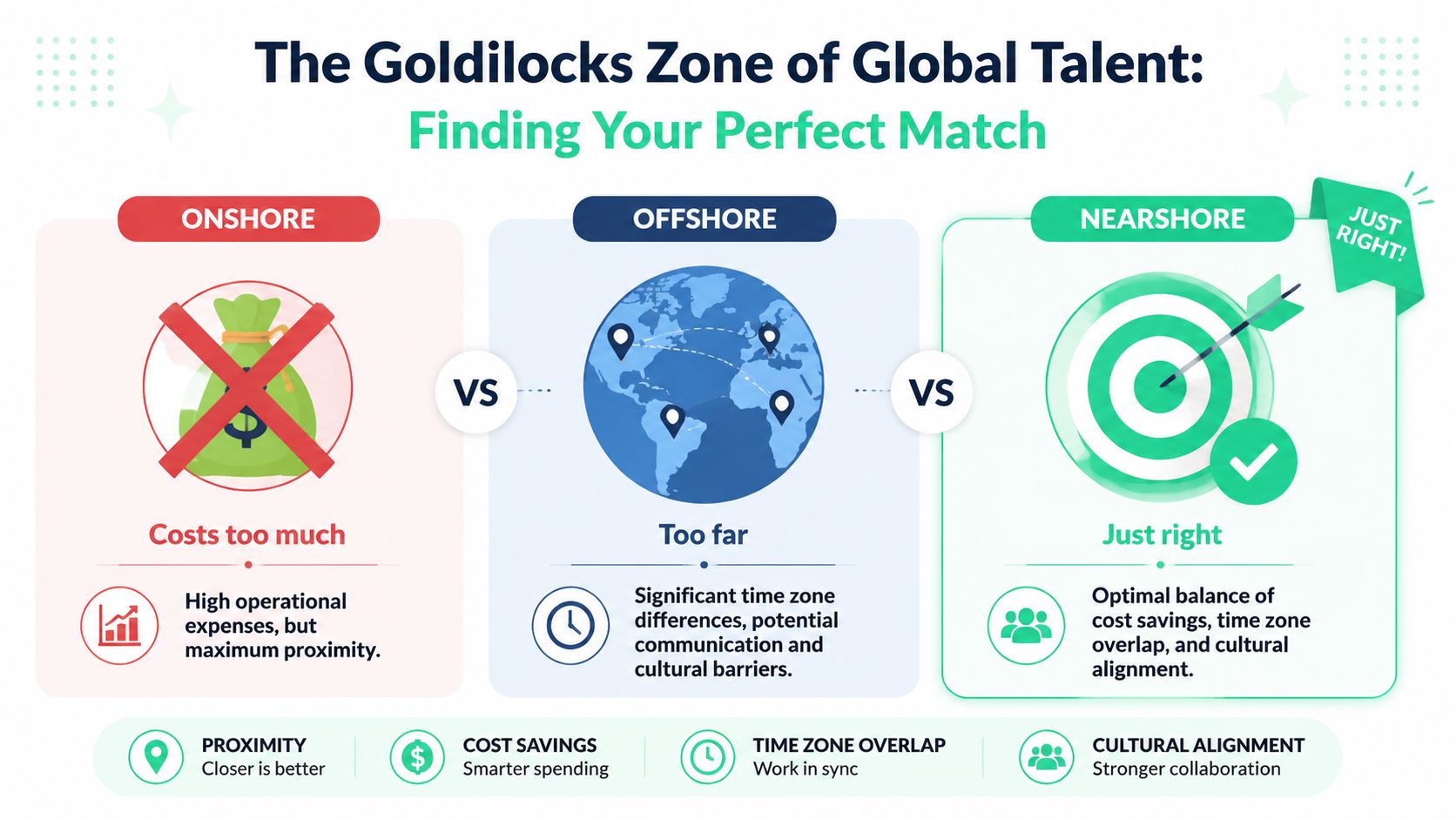
| Model | What you gain | What it usually costs you |
|---|---|---|
| Onshore | Maximum proximity and easy oversight | High payroll and overhead |
| Offshore | Lower sticker price | Delays, communication friction, less live collaboration |
| Nearshore | Better balance of cost, overlap, and alignment | Slightly more than offshore, usually worth it |
If you want a plain-English breakdown beyond the usual outsourcing buzzwords, this piece from hireSDR.io on outsourcing SDRs is worth a read.
The punchline is simple. Onshore is comfortable. Offshore is tempting. Nearshore is usually the grown-up choice.
Nearshore works because SDR teams live or die on speed. A bad engineer can hide for a sprint. A bad SDR setup burns pipeline this week.
The founders who win with nearshoring do not treat it as a staffing trick. They use it to tighten coaching loops, reduce sloppy execution, and get more outbound coverage without bloating payroll.

SDRs need live correction. Not next week. Not after the quarter slips.
If your reps work close to your hours, managers can review calls the same day, fix bad targeting before a sequence scales, and catch weak messaging while prospects are still replying. That alone makes nearshore far more useful than a cheap offshore team that only surfaces problems after a full day is lost.
For SDRs and BDRs, time overlap is not a scheduling perk. It is a revenue control system.
Sales work is full of tiny judgment calls. Tone. Follow-up timing. Personalization. Knowing when a message sounds confident versus awkward.
That is why language fluency and cultural familiarity matter so much in outbound. Reps ramp faster when they understand how your buyers speak, how your team gives feedback, and what your market considers credible. The result is simpler. Less rewriting from managers. Fewer broken handoffs. Better conversations with prospects.
If a rep cannot hear the difference between stiff and natural, they will struggle to book meetings.
Strong communication also helps on channels beyond email. Teams that want to improve SDR team's LinkedIn presence need reps who can write like humans, not like translation software.
Founders get distracted by salary comparisons. That is rookie thinking.
The smarter question is what nearshore lets you buy with the same budget. More call blocks. More account coverage. More coaching time per manager. More shots on goal before you need to hire an expensive domestic layer around the team.
That is why nearshore beats the usual cost-cutting story. You are not just spending less. You are buying a sales machine with more capacity and less drag. If you want a clearer framework for that tradeoff, these insights on reducing employee spend are worth reviewing before you approve another full-cost domestic SDR hire.
This is the part founders usually miss.
A nearshore SDR team is easier to inspect. Easier to coach. Easier to keep aligned on ICP, messaging, and follow-up standards. That matters in high-turnover sales orgs, where one weak manager or two rushed hires can turn outbound into expensive noise.
When nearshore is set up well, you get:
That is the operating edge. Nearshoring gives early-stage and growth-stage founders a practical way to build pipeline without paying premium onshore prices for every seat.
For SDR hiring, that is not a compromise. It is the grown-up move.
Founders love saying “we need more pipeline” right before approving the most expensive possible way to get it.
That's backwards.
For SDR teams, the best nearshore setups aren't just cheaper. They let you create more top-of-funnel coverage without ballooning payroll. If you're serious about revenue, that matters more than prestige hiring.
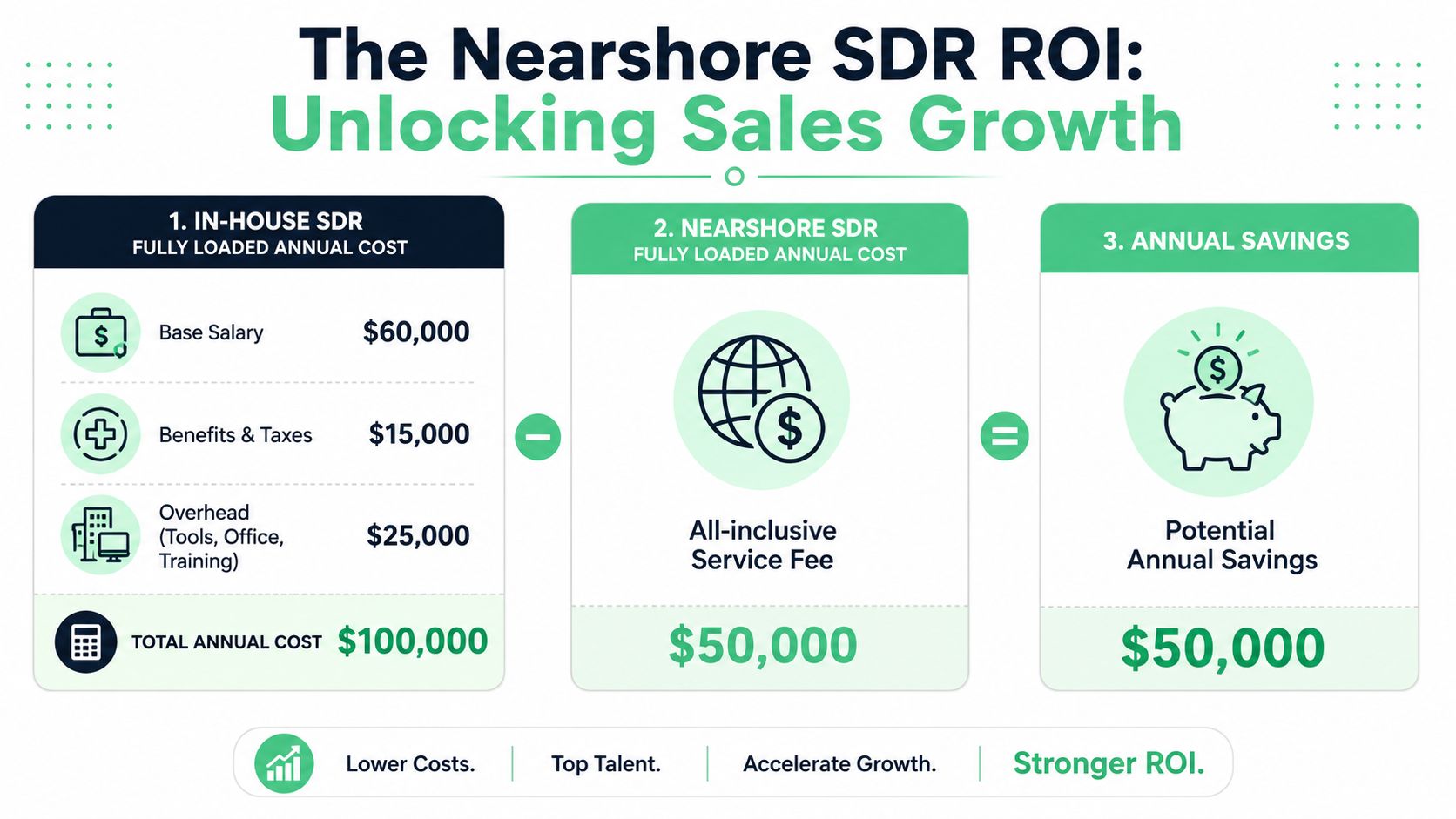
Ask one question. For the same budget, how many quality selling hours can you buy?
Nearshore outsourcing delivers operational cost reductions of 40–60% compared to U.S. onshore hiring while preserving real-time management capability through time zone alignment, according to SkyCom's overview of nearshore outsourcing benefits. That matters a lot for SDR teams because outbound improves through quick feedback loops, not through annual performance reviews and motivational Slack emojis.
So don't frame nearshoring as “cheaper labor.” Frame it as more reps, more activity, and more coaching bandwidth per dollar.
If your budget currently supports one domestic SDR, a nearshore model often gives you room to do one of these instead:
That changes the shape of your pipeline engine. More call blocks. More LinkedIn touches. More follow-up consistency. More experiments running at the same time.
And yes, your team should care about channel quality too. If you're building outbound seriously, this guide on how to improve SDR team's LinkedIn presence is useful. Most SDR teams underuse LinkedIn badly, then wonder why email alone feels tapped out.
A domestic SDR isn't just salary. It's recruiting time, management attention, tool access, onboarding drag, and all the little operating costs nobody remembers until finance starts squinting.
If you want a practical angle on that, these insights on reducing employee spend make the point well.
A founder who hires one expensive rep is making a bet. A founder who builds a nearshore SDR pod is building a system.
That's why I like nearshore for BDR and SDR teams specifically. These are process-heavy roles. Repetition matters. Coaching matters. Cost discipline matters. When you can lower spend and still manage in real time, you're not cutting corners. You're finally playing offense with your budget.
Your VP of Sales is frustrated, pipeline is light, and the new SDR quit in week six. Then the founder decides nearshore “didn't work.”
Wrong diagnosis.
Nearshoring fails for SDR and BDR teams for the same reason onshore hiring fails. Sloppy role design, weak management, and panic-buying cheap talent. The difference is that revenue teams feel the pain faster. A bad engineer can hide for months. A bad outbound rep shows up in your calendar, your reply rates, and your pipeline coverage almost immediately.
The first mistake is hiring for cost instead of output. If your only filter is price, you will get reps who sound fine in interviews and fall apart under real prospecting pressure. SDR work is repetitive, high-churn, and easy to underestimate. That makes screening and coaching more important, not less.
The second mistake is dumping a rep into chaos. No clear ICP. No call review rhythm. No documented objections. No definition of a qualified meeting. Then leadership blames geography.
That pattern creates the same predictable problems:
One more problem matters a lot in SDR hiring. Founders often assume any fluent English speaker can prospect well. That is expensive nonsense. Good SDRs need sharp writing, call discipline, coachability, and the stamina to hear “no” all day without getting sloppy.
Run your nearshore reps inside the same operating system as your domestic team. Same CRM. Same call recordings. Same dashboards. Same QA standards.
Keep the stack simple. Slack for daily communication. Zoom for coaching. HubSpot or Salesforce for workflow. Gong if you use it. One source of truth for scripts, targeting notes, and objection handling. If a rep has to hunt across five tools to do basic outbound work, management caused that problem.
Review calls every week. Read outbound copy. Audit sequences. Check whether meetings are qualified, not just booked.
If your nearshore SDR team needs heroic management to stay on track, your sales process is too loose.
For hiring, skip the random freelancer route unless you enjoy rebuilding the role every quarter. SDR and BDR seats turn over. You need a repeatable way to vet candidates, replace misses, and keep payroll and compliance off your plate. That is why many founders use a specialist partner like HireSDR.
Ask direct questions before you sign anything:
If the answers sound vague, leave.
My recommendation is simple. Treat nearshore SDR hiring like revenue infrastructure, not bargain staffing. The founders who win with nearshoring build process first, hire against a scorecard, and manage quality every week. The ones who lose usually wanted cheap meetings fast. That bill always comes due.
Your pipeline is light, two reps have already washed out, and your VP of Sales wants meetings next month, not next quarter. That is usually when founders make the worst SDR hire of the year. They post a vague role, skim LinkedIn, get fooled by polished English, and end up paying for activity that never turns into revenue.
Do this with a scorecard first.
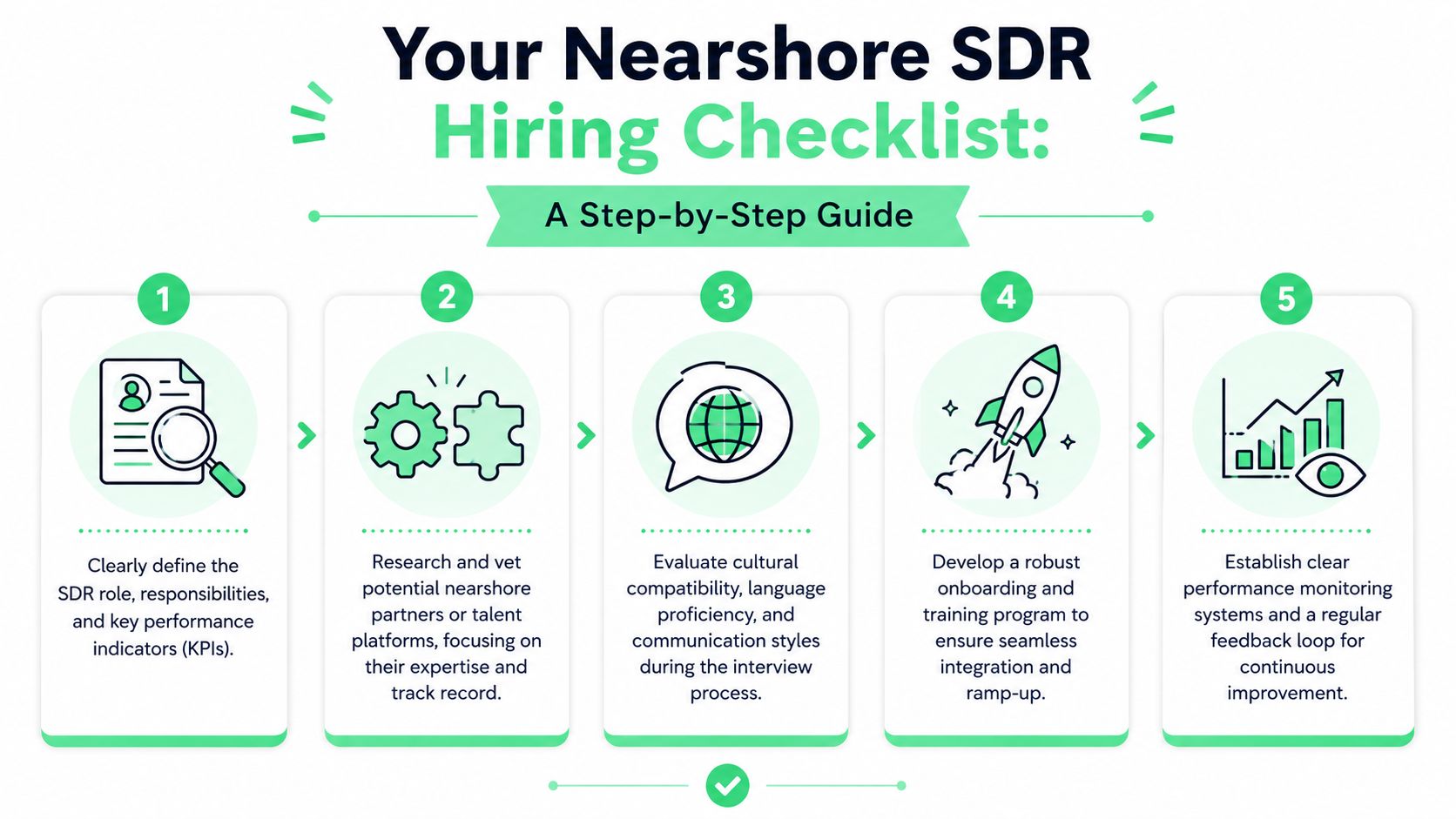
Your first nearshore SDR is not a generic sales hire. In a high-churn SDR or BDR seat, the wrong person burns leads, wastes coaching time, and gives you fake confidence because the activity numbers look fine.
Write the job the way you plan to inspect it. Define the market, the accounts, the channels, the daily output, the reply handling, and the handoff standard for qualified meetings. If you cannot explain what a good first 30 days looks like, you are not ready to hire.
Pressure-test three points before you interview anyone:
Founders get burned here because they buy convenience instead of rigor.
Ask blunt questions:
Nearshore helps because coaching, call reviews, and live feedback can happen in the same working day. For SDR teams, that matters more than founders admit. Speed to correction is often the difference between a rep who ramps in six weeks and one who underperforms for three months.
Selection matters. Ramp matters more.
In week one, get the rep into real sales material immediately. Good call recordings. Good emails. Real objections. Real account notes. Do not make them learn your motion from a half-finished Notion page and a wish.
Then keep the cadence tight:
Hire for coachability, then train hard and inspect every week.
If you want a faster path, HireSDR is worth evaluating because it gives you a structured way to source, vet, and replace reps in a role that naturally turns over.
The best nearshore SDR hires do not need magic. They need a tight process, fast coaching, and a founder who treats the seat like revenue infrastructure instead of cheap labor.
Let's call it straight.
The old playbook says serious companies hire SDRs locally, pay a premium, and hope the rep figures it out before finance notices the burn. That playbook is expensive, slow, and weirdly fragile. It survives mostly because people confuse familiar with effective.
Nearshore is different. It gives you cost control without the usual offshore headaches. It gives you working-hour overlap that sales teams require. It gives you access to strong, coachable talent without turning every hire into a five-week recruiting mini-series.
That's why I see nearshoring as a strategic move, not a budget hack. In the world of SDRs and BDRs, where turnover is high and speed matters, the advantages of nearshore outsourcing are brutally practical. More coverage. Faster coaching. Cleaner execution. Better use of cash.
Toot, toot. That's the sound of a founder who finally stopped paying top dollar for avoidable hiring mistakes.
You can keep wrestling with the expensive, slow, unpredictable domestic talent market. Or you can build a nearshore sales bench that's easier to scale and easier to manage. One of those options gives you more chances to win this quarter.
Choose the one that doesn't require mortgaging your office ping-pong table.
If you want to build an SDR or BDR team without wasting weeks on sourcing, screening, and cross-border admin, hireSDR.io is a practical place to start. It helps founders and sales leaders hire vetted, English-fluent reps fast, with built-in payroll and compliance support, so you can focus on pipeline instead of paperwork.

Most advice on the candidate screening process is backwards. It tells you to polish the job post, skim resumes faster, and trust your gut in...

Stop hiring “sales ninjas” and start building a real team. You need to hire a salesperson. Sounds simple until the applicants start calling themselves Growth...

You know this movie. A candidate walks in with the polished resume, the familiar logos, the neat little ladder of “progression,” and everyone in the...

Tell us who you need. We'll have pre-vetted candidates in your inbox within 72 hours. No commitment until you hire.