
Your pipeline is thin. Your founders' calendar has awkward white space. Your reps are “working the list,” which usually means clicking around the CRM and calling it strategy.
So you start thinking: maybe I should hire a telemarketer.
Reasonable thought. Dangerous execution.
I've seen this go two ways. Either you get someone who can create real conversations out of thin air, or you pay for a headset, a script, and a daily recital of failure. Most founders make the same mistake. They hire for a role. They should hire for a result.
That changes everything.
If you treat telemarketing like a quick, measurable sales experiment, you can de-risk the whole thing. If you treat it like a traditional headcount decision, you'll waste weeks on interviews, onboarding, and “let's give them a little more time” conversations that should've ended much earlier.
Usually this starts with a familiar lie: “We just need more activity.”
Maybe. But often you need better outbound. Not more random dials. Not another script that sounds like it was approved by a committee. Not a cheerful amateur who folds the second a prospect says, “Not interested.”
A telemarketer can absolutely help if your problem is top-of-funnel creation. Phone outreach is still relevant. One industry source reports that 27% of sellers say telemarketing is extremely effective for reaching new contacts, and 41.2% of salespeople believe the phone remains the best-selling tool. It also notes that telemarketers can work from anywhere and that the role often doesn't require more than a high school education, though customer service experience helps (industry hiring notes on telemarketing effectiveness and remote flexibility).
That matters because a lot of startups confuse outbound motions. If you're still fuzzy on whether you need someone generating demand or handling existing interest, get clear on the difference between inbound and outbound sales. A telemarketer belongs on the outbound side. They create conversations that wouldn't exist otherwise.
Don't hire a telemarketer because your team is busy. Hire one because you can define the exact commercial outcome you want from phone outreach.
The fundamental risk is drift.
You hire someone. You let them “get familiar with the product.” They spend a week reading docs, another week tweaking a script, and by the time you look up, you've funded a tiny theater production called Outbound Sales.
Skip that.
A good telemarketing hire should be judged like a campaign. Tight timeline. Clear audience. Specific offer. Fast feedback. If you can't say what success looks like before day one, don't hire yet.
My advice is blunt. Start with a short runway and a measurable business case. Assume nothing. Test everything.
That means:
Founders get into trouble when they romanticize grit. “They're working hard” is not a sales metric. Revenue teams don't run on effort alone.
There are three ways to hire a telemarketer. All of them work. All of them can also waste your money in slightly different outfits.
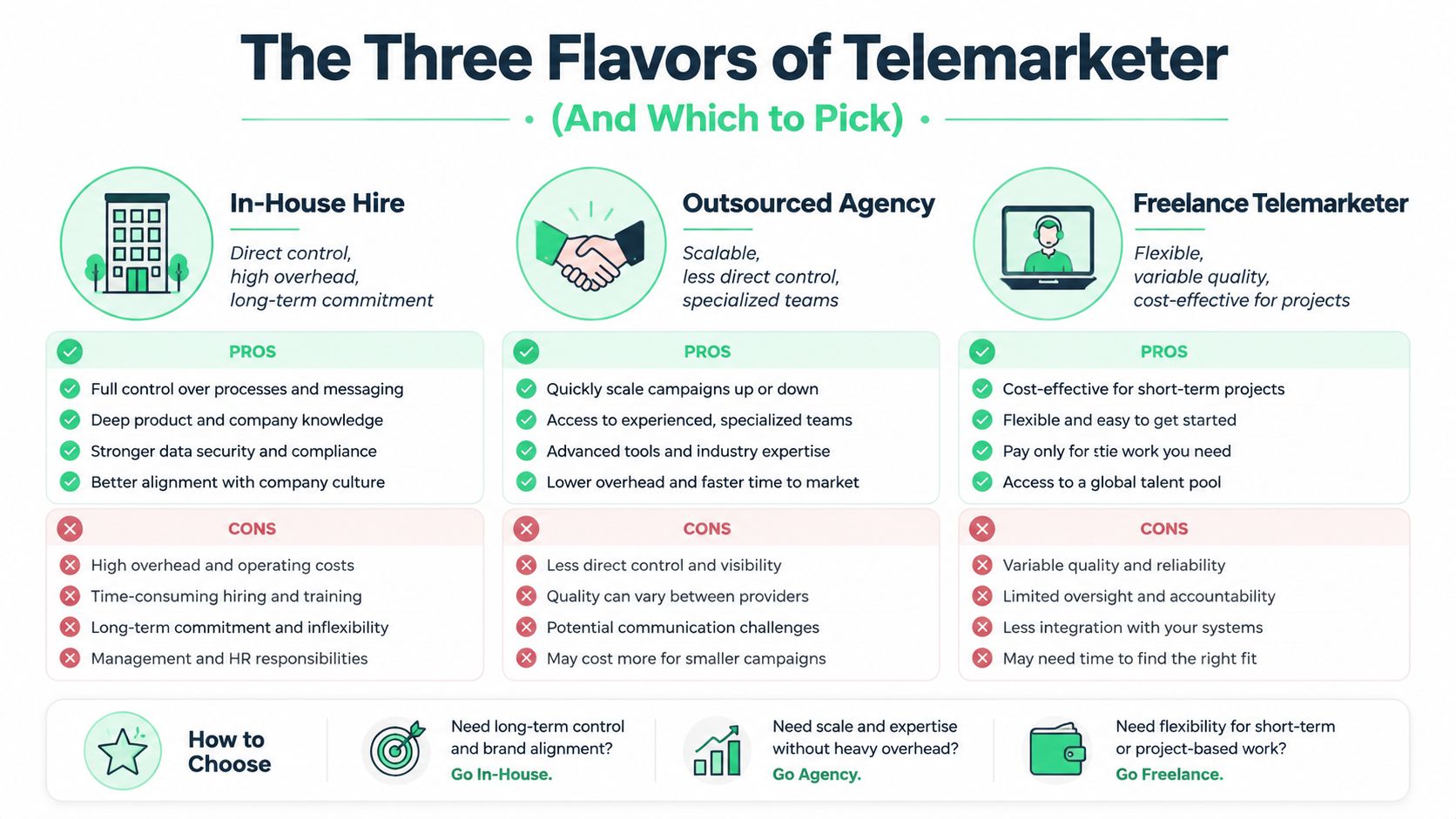
This is the classic move. You recruit them, train them, manage them, and own the whole process.
That sounds clean. It's also the heaviest option.
In the United States, telemarketers earned a mean annual wage of $36,680 in May 2023, with a median hourly wage of $17.64. The 10th percentile was $11.74 per hour, which shows how much costs can vary based on experience, location, and hiring model (BLS telemarketer wage table for occupation 41-9041).
If you go in-house, you're not just buying labor. You're buying management load.
Pros
Cons
Agencies sell speed and certainty. Sometimes they deliver. Sometimes they deliver reports.
This model is useful when you need coverage fast and don't want to build the function yourself. But understand what you're buying. You're paying for their process, their managers, and their margin. You also get less visibility into what's happening on calls unless the agency is disciplined about reporting and call review.
Practical rule: If an agency can't show you activity visibility, call quality, and pipeline logic, you're buying a black box with a nice proposal deck.
A lot of founders choose agencies because they're trying to avoid managing one rep. Fair enough. Just don't confuse outsourced work with outsourced accountability.
This is my preferred starting point for most startups. Not because it's fashionable. Because it lets you test the channel without marrying the cost structure.
Monster notes that telemarketers can be located anywhere, which is one reason remote and contract setups are attractive to businesses trying to widen the talent pool and control hiring costs, as summarized in this guide to hiring remote telemarketing talent. That doesn't mean “cheap equals good.” It means you have more options than your zip code.
Here's the trade-off in plain English.
| Model | Best when | Main headache |
|---|---|---|
| In-house | You already know the playbook | Management overhead |
| Agency | You need speed and coverage | Limited visibility |
| Freelancer | You want flexibility and testability | Variable quality |
If you're a startup and this is your first serious phone motion, start with a freelance or marketplace telemarketer on a short paid trial.
Not forever. To learn.
You'll discover whether your list is viable, whether your offer lands, whether your script survives contact with actual humans, and whether phone outreach deserves a bigger investment. If it works, you can expand into in-house or a more structured remote setup later. If it doesn't, you've learned cheaply instead of building a tiny internal bureaucracy around a guess.
Most job posts for telemarketers are painfully dull. They read like someone copied three old listings, added “self-starter,” and went to lunch.
That approach attracts exactly the wrong people. Script readers. Keyword stuffers. Applicants who can spell “CRM” but can't survive a gatekeeper.
Your job post is an ad. Treat it like one.
Lead with the challenge. Then the outcome. Then the environment. Save the “requirements” section for the end, and keep it tight.
Phone-based selling still matters, and candidates should believe in the channel. That matters more than some polished corporate background, because if they think calling is dead, they'll sound dead on the phone too. You want people who enjoy the hunt.
A stronger post sounds like this in spirit:
That last line is doing more work than most founders realize. It filters out candidates who want a salary before they've proven they can produce.
You do not need a shopping list of clichés.
Drop things like:
Those phrases are wallpaper. Nobody self-identifies as “bad at communication” in a job application.
Use a skills-based angle instead. If you want a cleaner framework for that mindset, this overview of skills-based hiring in sales roles is closer to reality than the usual resume worship.
A good job post should subtly test attention to detail.
Ask applicants to do one specific thing that a lazy mass-applier won't notice. For example:
Reply with the subject line “Phone first” and include two sentences on how you'd reopen a call after hearing “We already have a vendor.”
That tiny instruction screens out people who don't read and reveals who can think on their feet.
Here's the information that matters:
| Include this | Why it matters |
|---|---|
| Target market | Shows whether they've worked similar buyers |
| Daily work format | Sets expectations for remote autonomy |
| Success metric | Forces output-based thinking |
| Tool stack | Reveals whether they can work inside your systems |
| Trial structure | Makes the deal honest from the start |
The point isn't to sound impressive. The point is to repel the wrong candidates before they ever hit your calendar.
Resumes are mostly fiction with formatting.
Some are accurate fiction. Still fiction.
If you want to hire a telemarketer who can perform under pressure, stop pretending a resume or a polite Zoom chat will tell you that. It won't. You need a short, live audition.

Recruiting guidance recommends short, role-specific assessments of 15 to 25 minutes, because they improve completion and help teams shortlist faster with less bias by testing practical skills like objection handling and cold-calling resilience (telemarketing assessment guidance for employers).
I'd keep the live audition at about fifteen minutes. Long enough to expose weak points. Short enough that you can run several in a day without wanting to fake your own disappearance.
Break it into three pieces.
One minute of setup
Give them the product, the buyer, and the goal. Keep it simple.
Two short role-plays
One gatekeeper scenario. One direct objection from a decision-maker.
A CRM recap
Ask them what notes they'd log after the call and what follow-up they'd choose.
That last part matters. Plenty of people can sound lively for a minute. Fewer can think like an actual operator.
I like this because it reveals tone instantly.
Tell the candidate: “You're calling a mid-market operations leader. Their assistant answers and says, ‘They're not available. Send an email.’ Go.”
You're listening for a few things:
The best telemarketers don't “win” the call. They keep it alive.
Now put them in front of the actual problem. A rushed decision-maker who says, “We're all set,” or “Not interested.”
Don't score them on perfect wording. Score them on recovery.
Here's what a strong candidate usually does:
A weak candidate either argues or collapses. Neither is useful.
You can save yourself a lot of future pain by cutting fast when you hear these:
| Red flag | Why it matters |
|---|---|
| Flat tone | Prospects tune out fast |
| Script dependence | Real calls go off-script immediately |
| Defensive energy | Rejection is part of the job |
| No follow-up logic | Activity without process becomes chaos |
The whole point of this audition is brutal honesty. You're not trying to be fair in the abstract. You're trying to predict who can survive repeated rejection and still produce useful pipeline.
If they can't do that in a short simulation, they won't magically discover it after onboarding.
Monday morning, your new telemarketer says all the right things. By Friday, you still do not know if they can produce pipeline or just stay busy. That is a hiring failure, not a people problem.
Start with a paid trial and a hard deadline. A short test window forces clarity, which is exactly what a startup needs. Founders who want a faster answer on fit and ROI usually use a 2 to 4 week trial with logged activity, recorded calls, and one clear success metric, as outlined in this guide to running a short telemarketer trial and tracking early ROI.
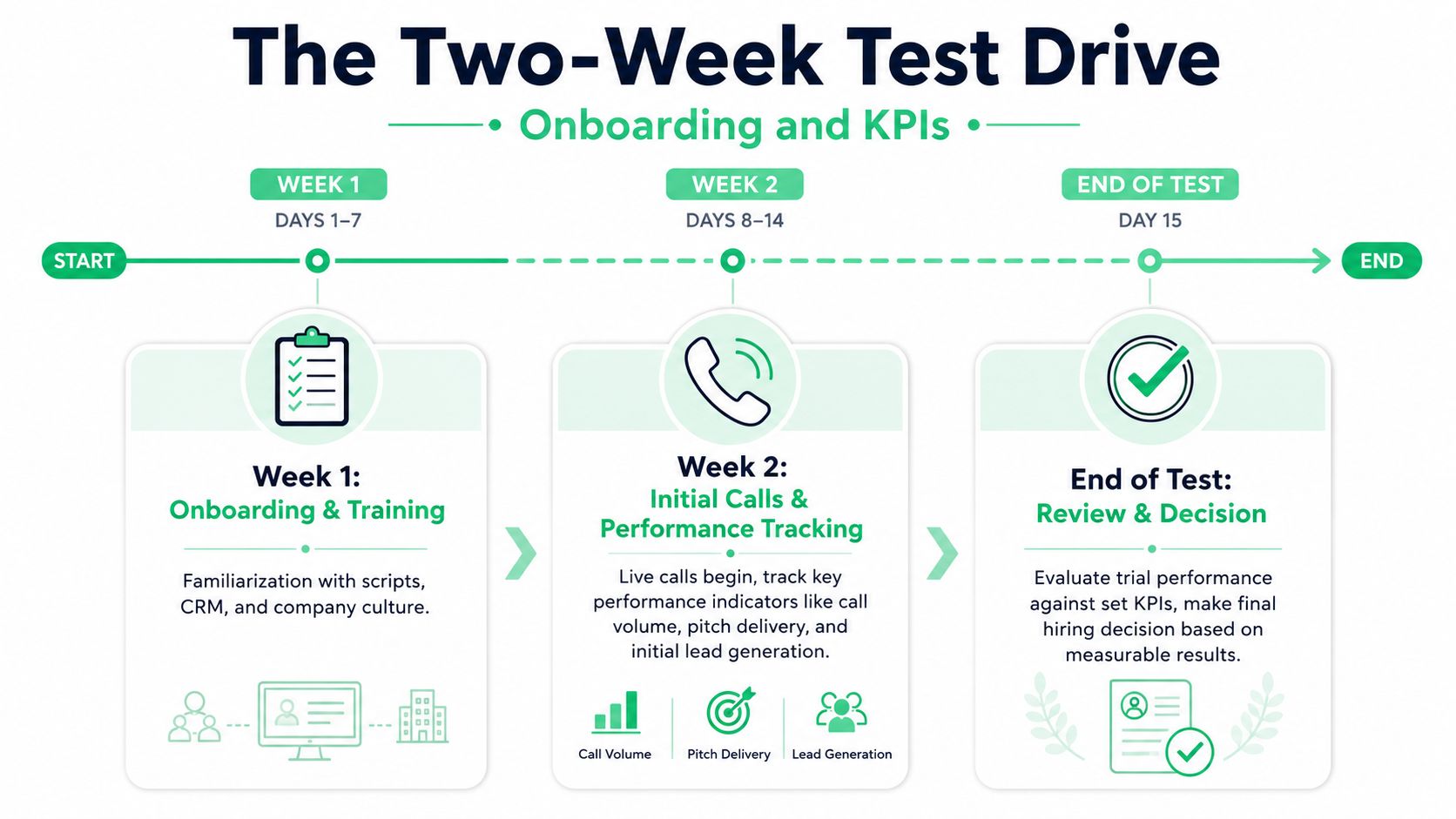
Write the agreement so a tired founder can read it in two minutes and know whether the rep passed or failed.
Include these five items:
Skip the culture essay. Skip vague language about “supporting growth.” You are buying signal.
Remote telemarketers fail fast when companies bury them in background material and delay real calls. That mistake is common, expensive, and easy to avoid.
Give them enough product context to sound credible. Give them a tight script, a clean list, and working tools. Then get them on the phone.
A useful first week looks like this:
| Day | Focus | Output |
|---|---|---|
| Day 1 | Product, ICP, script, tools | Test calls completed, CRM access confirmed |
| Day 2 | Live outreach starts | First real call block, notes logged |
| Day 3 to 5 | Daily review and coaching | Objection patterns, script edits, cleaner qualification |
By day two, they should be dialing real prospects.
If they are still “getting familiar” by the end of the week, your onboarding is broken.
A startup does not need a beautiful dashboard. It needs a fast answer to one question. Should this person get another two weeks?
Use a simple scorecard:
This order matters. Conversation volume tells you whether they can get into real exchanges. Qualified meetings tell you whether those exchanges go anywhere. Call quality and CRM discipline tell you whether the result is repeatable or luck.
Do not judge the trial on dials alone. High activity with weak conversations is fake productivity.
Listen to calls every day. Read the notes. Check whether the rep gets sharper after feedback.
At the end of the trial, make the decision with these four questions:
If the answer is no on three or four, end it. Fast.
If the answer is mixed, extend once with tighter rules and one specific improvement target. If the answer is yes, keep them and raise the standard.
One practical option for remote sourcing is hireSDR.io, which provides pre-vetted remote sales talent and handles compliance and payroll support for cross-border hiring. Useful if you want a marketplace-style path without building that infrastructure yourself.
You hired the rep, gave them a list, and two weeks later you still do not know whether to keep them or cut them. That is the moment founders start asking the right questions.
Stop arguing in theory. Pull three call recordings, open the CRM, and inspect what happened.
A weak list creates friction before the conversation gets anywhere. Wrong titles. Bad numbers. People who were never a fit. A weak rep creates friction inside the conversation. Flat opener. No control. No curiosity. No clear next step.
Use this diagnosis:
Patterns matter more than isolated calls. If several prospects sound confused, your message is off. If contact rates are lousy and the records are obviously wrong, fix the data. If the right prospects engage but the rep cannot turn interest into a real conversation, you have a hiring problem.
Fair means enough runway to see signal, not enough runway to hide failure.
For a startup, the benchmark that matters is simple. At the end of a 2 to 4 week ROI test, did this person create enough real sales movement to justify another week of salary, list spend, and manager time?
Judge that with evidence you can hear and inspect:
Do not let activity metrics rescue a weak hire. A rep can stay busy all day and still waste your market's attention.
One sentence I wish more founders would accept. Slow progress with sharper calls is worth extending once. Busy work with the same bad habits is not.
Coachability shows up fast. Perfect results do not.
Keep the setup boring and strict.
Remote telemarketers fail for predictable reasons. Noisy apartment. Bad headset. Spotty internet. Missed check-ins. Notes written from memory hours later. None of this is a talent problem. It is a management problem you allowed.
Before day one, require proof of the basics:
Then set operating rules. Calls get logged the same day. Missed blocks get explained the same day. Recordings stay on. If the rep treats remote work like freelance improvisation, end it early.
If you want help sourcing remote sales talent without building the hiring and compliance stack yourself, hireSDR.io is one option. The useful part is speed and administrative support, not magic. You still need a tight test, a clear scorecard, and the discipline to cut fast.
Usually sooner.
Founders keep weak telemarketers too long because they confuse effort with traction. Do not do that. This role is a short-cycle revenue test. If the test is failing, end it and protect your time.
Here is the cut list:
| Cut fast if you see | Why it usually ends badly |
|---|---|
| Repeated no-shows or unexplained gaps | Reliability is part of the job |
| Missing or sloppy CRM notes | You cannot coach work you cannot inspect |
| The same script-reading problem after feedback | They are not adapting |
| Excuses with no call evidence | You are paying for avoidance |
| Good prospects reached, weak calls repeated daily | The rep is the bottleneck |
Clarity beats optimism here.
A telemarketer is not a long character-development project for a startup. They are a measured bet. Give the hire a real chance, inspect the work closely, and make the call while the loss is still small.

You need more pipeline. Your calendar says “growth.” Your bank account says “please relax.” So you do what every founder does at some point: open...

Your pipeline is soft, your founder calendar is wrecked, and somebody on LinkedIn just told you to “hire A-players.” Useful. Right up there with “sleep...

Your best Account Executive is doing detective work in Apollo, cleaning CSVs, and chasing no-shows instead of closing. Your pipeline has activity, sure, but the...

Tell us who you need. We'll have pre-vetted candidates in your inbox within 72 hours. No commitment until you hire.